

mixture consists of equal proportions of propylene and butenes. Isobutene tends to
produce significantly higher yields of heptenes than n-butene. However, because
isobutene produces more dimethylpentenes, the final yield can only be calculated
on the end product after fractionation that meets the required specifications.
Nonenes
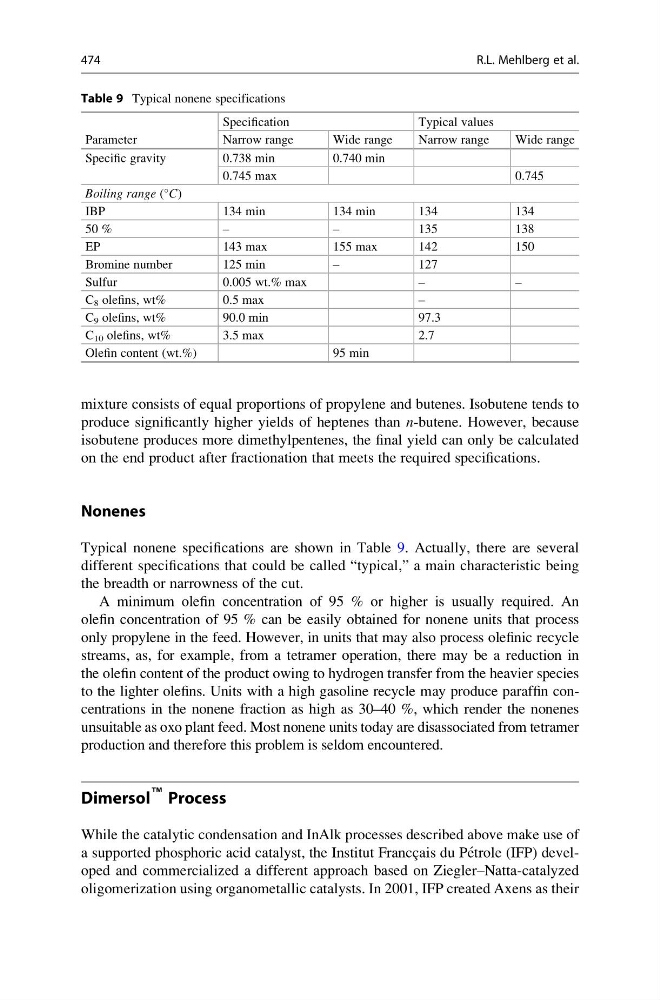
Typical nonene specifications are shown in Table 9. Actually, there are several
different specifications that could be called “typical,” a main characteristic being
the breadth or narrowness of the cut.
A minimum olefin concentration of 95 % or higher is usually required. An
olefin concentration of 95 % can be easily obtained for nonene units that process
only propylene in the feed. However, in units that may also process olefinic recycle
streams, as, for example, from a tetramer operation, there may be a reduction in
the olefin content of the product owing to hydrogen transfer from the heavier species
to the lighter olefins. Units with a high gasoline recycle may produce paraffin concentrations in the nonene fraction as high as 30–40 %, which render the nonenes
unsuitable as oxo plant feed. Most nonene units today are disassociated from tetramer
production and therefore this problem is seldom encountered.
Dimersol
™ Process
While the catalytic condensation and InAlk processes described above make use of
a supported phosphoric acid catalyst, the Institut Francc ¸ais du Pe ´trole (IFP) developed and commercialized a different approach based on Ziegler–Natta-catalyzed
oligomerization using organometallic catalysts. In 2001, IFP created Axens as their
Table 9 Typical nonene specifications
Parameter
Specification
Typical values
Narrow range
Wide range
Narrow range
Wide range
Specific gravity
0.738 min
0.740 min
0.745 max
0.745
Boiling range (
C)
IBP
134 min
134 min
134
134
50 %
–
–
135
138
EP
143 max
155 max
142
150
Bromine number
125 min
–
127
Sulfur
0.005 wt.% max
–
–
C 8 olefins, wt%
0.5 max
–
C 9 olefins, wt%
90.0 min
97.3
C 10 olefins, wt%
3.5 max
2.7
Olefin content (wt.%)
95 min
474
R.L. Mehlberg et al.
produce significantly higher yields of heptenes than n-butene. However, because
isobutene produces more dimethylpentenes, the final yield can only be calculated
on the end product after fractionation that meets the required specifications.
Nonenes
Typical nonene specifications are shown in Table 9. Actually, there are several
different specifications that could be called “typical,” a main characteristic being
the breadth or narrowness of the cut.
A minimum olefin concentration of 95 % or higher is usually required. An
olefin concentration of 95 % can be easily obtained for nonene units that process
only propylene in the feed. However, in units that may also process olefinic recycle
streams, as, for example, from a tetramer operation, there may be a reduction in
the olefin content of the product owing to hydrogen transfer from the heavier species
to the lighter olefins. Units with a high gasoline recycle may produce paraffin concentrations in the nonene fraction as high as 30–40 %, which render the nonenes
unsuitable as oxo plant feed. Most nonene units today are disassociated from tetramer
production and therefore this problem is seldom encountered.
Dimersol
™ Process
While the catalytic condensation and InAlk processes described above make use of
a supported phosphoric acid catalyst, the Institut Francc ¸ais du Pe ´trole (IFP) developed and commercialized a different approach based on Ziegler–Natta-catalyzed
oligomerization using organometallic catalysts. In 2001, IFP created Axens as their
Table 9 Typical nonene specifications
Parameter
Specification
Typical values
Narrow range
Wide range
Narrow range
Wide range
Specific gravity
0.738 min
0.740 min
0.745 max
0.745
Boiling range (
C)
IBP
134 min
134 min
134
134
50 %
–
–
135
138
EP
143 max
155 max
142
150
Bromine number
125 min
–
127
Sulfur
0.005 wt.% max
–
–
C 8 olefins, wt%
0.5 max
–
C 9 olefins, wt%
90.0 min
97.3
C 10 olefins, wt%
3.5 max
2.7
Olefin content (wt.%)
95 min
474
R.L. Mehlberg et al.