

cation, but the solubility of the aluminum chloride decreases and solid AlCl 3 can
precipitate. Acidic ionic liquids, with Hammett acidities of –H 0 $ 19, can have
super acidities that are orders of magnitude higher than HF or H 2 SO 4 (ÀH 0 $ 12).
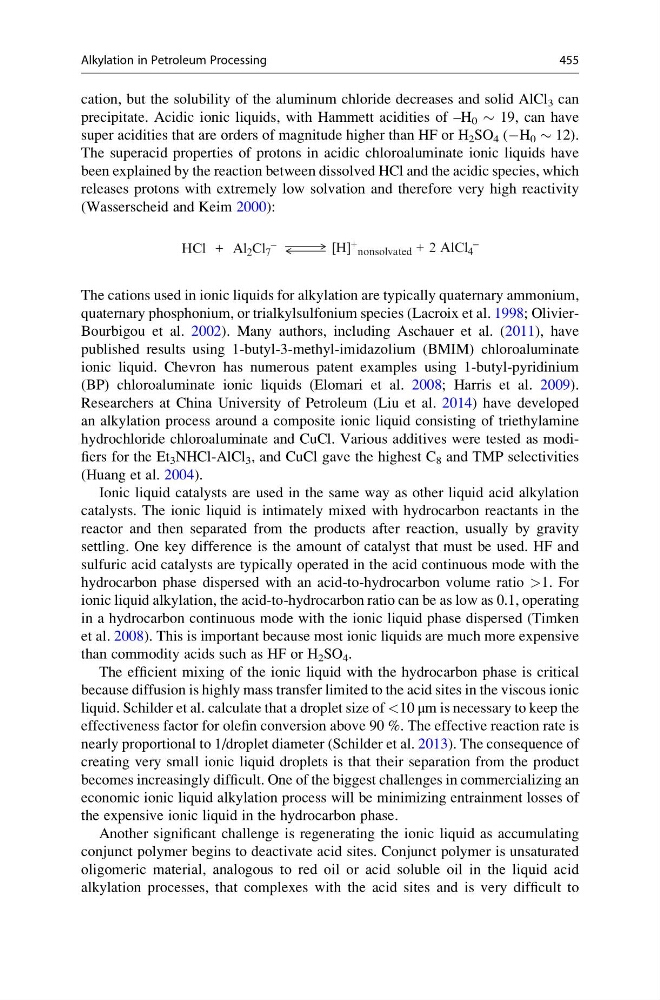
The superacid properties of protons in acidic chloroaluminate ionic liquids have
been explained by the reaction between dissolved HCl and the acidic species, which
releases protons with extremely low solvation and therefore very high reactivity
(Wasserscheid and Keim 2000):
HCl + Al 2 Cl 7
−
[H] + nonsolvated + 2 AlCl 4
−
The cations used in ionic liquids for alkylation are typically quaternary ammonium,
quaternary phosphonium, or trialkylsulfonium species (Lacroix et al. 1998; OlivierBourbigou et al. 2002). Many authors, including Aschauer et al. (2011), have
published results using 1-butyl-3-methyl-imidazolium (BMIM) chloroaluminate
ionic liquid. Chevron has numerous patent examples using 1-butyl-pyridinium
(BP) chloroaluminate ionic liquids (Elomari et al. 2008; Harris et al. 2009).
Researchers at China University of Petroleum (Liu et al. 2014) have developed
an alkylation process around a composite ionic liquid consisting of triethylamine
hydrochloride chloroaluminate and CuCl. Various additives were tested as modifiers for the Et 3 NHCl-AlCl 3 , and CuCl gave the highest C 8 and TMP selectivities
(Huang et al. 2004).
Ionic liquid catalysts are used in the same way as other liquid acid alkylation
catalysts. The ionic liquid is intimately mixed with hydrocarbon reactants in the
reactor and then separated from the products after reaction, usually by gravity
settling. One key difference is the amount of catalyst that must be used. HF and
sulfuric acid catalysts are typically operated in the acid continuous mode with the
hydrocarbon phase dispersed with an acid-to-hydrocarbon volume ratio >1. For
ionic liquid alkylation, the acid-to-hydrocarbon ratio can be as low as 0.1, operating
in a hydrocarbon continuous mode with the ionic liquid phase dispersed (Timken
et al. 2008). This is important because most ionic liquids are much more expensive
than commodity acids such as HF or H 2 SO 4 .
The efficient mixing of the ionic liquid with the hydrocarbon phase is critical
because diffusion is highly mass transfer limited to the acid sites in the viscous ionic
liquid. Schilder et al. calculate that a droplet size of <10 μm is necessary to keep the
effectiveness factor for olefin conversion above 90 %. The effective reaction rate is
nearly proportional to 1/droplet diameter (Schilder et al. 2013). The consequence of
creating very small ionic liquid droplets is that their separation from the product
becomes increasingly difficult. One of the biggest challenges in commercializing an
economic ionic liquid alkylation process will be minimizing entrainment losses of
the expensive ionic liquid in the hydrocarbon phase.
Another significant challenge is regenerating the ionic liquid as accumulating
conjunct polymer begins to deactivate acid sites. Conjunct polymer is unsaturated
oligomeric material, analogous to red oil or acid soluble oil in the liquid acid
alkylation processes, that complexes with the acid sites and is very difficult to
Alkylation in Petroleum Processing
455
precipitate. Acidic ionic liquids, with Hammett acidities of –H 0 $ 19, can have
super acidities that are orders of magnitude higher than HF or H 2 SO 4 (ÀH 0 $ 12).
The superacid properties of protons in acidic chloroaluminate ionic liquids have
been explained by the reaction between dissolved HCl and the acidic species, which
releases protons with extremely low solvation and therefore very high reactivity
(Wasserscheid and Keim 2000):
HCl + Al 2 Cl 7
−
[H] + nonsolvated + 2 AlCl 4
−
The cations used in ionic liquids for alkylation are typically quaternary ammonium,
quaternary phosphonium, or trialkylsulfonium species (Lacroix et al. 1998; OlivierBourbigou et al. 2002). Many authors, including Aschauer et al. (2011), have
published results using 1-butyl-3-methyl-imidazolium (BMIM) chloroaluminate
ionic liquid. Chevron has numerous patent examples using 1-butyl-pyridinium
(BP) chloroaluminate ionic liquids (Elomari et al. 2008; Harris et al. 2009).
Researchers at China University of Petroleum (Liu et al. 2014) have developed
an alkylation process around a composite ionic liquid consisting of triethylamine
hydrochloride chloroaluminate and CuCl. Various additives were tested as modifiers for the Et 3 NHCl-AlCl 3 , and CuCl gave the highest C 8 and TMP selectivities
(Huang et al. 2004).
Ionic liquid catalysts are used in the same way as other liquid acid alkylation
catalysts. The ionic liquid is intimately mixed with hydrocarbon reactants in the
reactor and then separated from the products after reaction, usually by gravity
settling. One key difference is the amount of catalyst that must be used. HF and
sulfuric acid catalysts are typically operated in the acid continuous mode with the
hydrocarbon phase dispersed with an acid-to-hydrocarbon volume ratio >1. For
ionic liquid alkylation, the acid-to-hydrocarbon ratio can be as low as 0.1, operating
in a hydrocarbon continuous mode with the ionic liquid phase dispersed (Timken
et al. 2008). This is important because most ionic liquids are much more expensive
than commodity acids such as HF or H 2 SO 4 .
The efficient mixing of the ionic liquid with the hydrocarbon phase is critical
because diffusion is highly mass transfer limited to the acid sites in the viscous ionic
liquid. Schilder et al. calculate that a droplet size of <10 μm is necessary to keep the
effectiveness factor for olefin conversion above 90 %. The effective reaction rate is
nearly proportional to 1/droplet diameter (Schilder et al. 2013). The consequence of
creating very small ionic liquid droplets is that their separation from the product
becomes increasingly difficult. One of the biggest challenges in commercializing an
economic ionic liquid alkylation process will be minimizing entrainment losses of
the expensive ionic liquid in the hydrocarbon phase.
Another significant challenge is regenerating the ionic liquid as accumulating
conjunct polymer begins to deactivate acid sites. Conjunct polymer is unsaturated
oligomeric material, analogous to red oil or acid soluble oil in the liquid acid
alkylation processes, that complexes with the acid sites and is very difficult to
Alkylation in Petroleum Processing
455