

Alkylate Properties
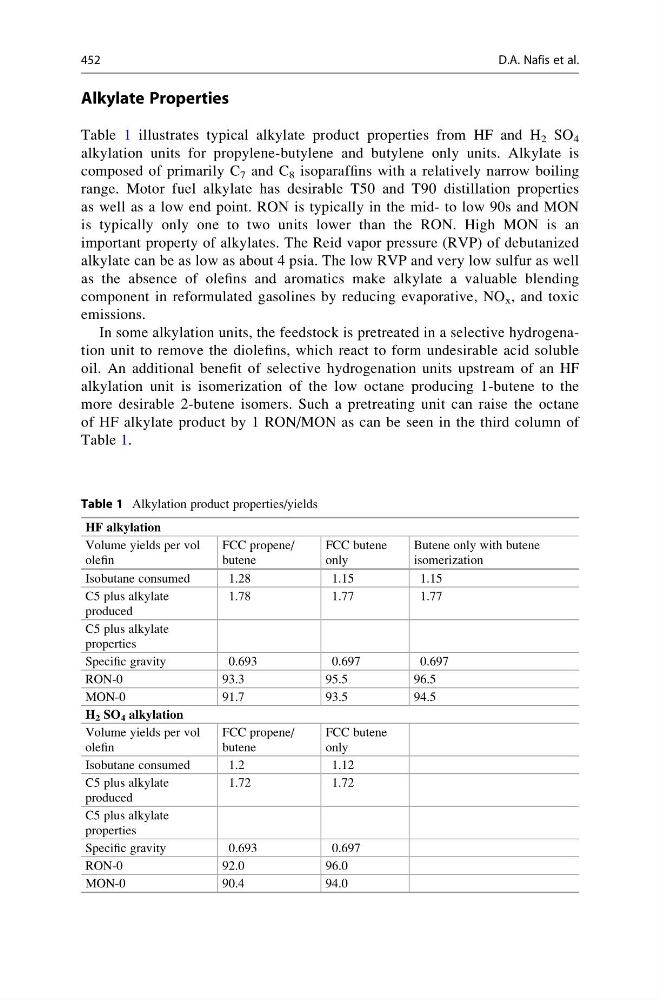
Table 1 illustrates typical alkylate product properties from HF and H 2 SO 4
alkylation units for propylene-butylene and butylene only units. Alkylate is
composed of primarily C 7 and C 8 isoparaffins with a relatively narrow boiling
range. Motor fuel alkylate has desirable T50 and T90 distillation properties
as well as a low end point. RON is typically in the mid- to low 90s and MON
is typically only one to two units lower than the RON. High MON is an
important property of alkylates. The Reid vapor pressure (RVP) of debutanized
alkylate can be as low as about 4 psia. The low RVP and very low sulfur as well
as the absence of olefins and aromatics make alkylate a valuable blending
component in reformulated gasolines by reducing evaporative, NO x , and toxic
emissions.
In some alkylation units, the feedstock is pretreated in a selective hydrogenation unit to remove the diolefins, which react to form undesirable acid soluble
oil. An additional benefit of selective hydrogenation units upstream of an HF
alkylation unit is isomerization of the low octane producing 1-butene to the
more desirable 2-butene isomers. Such a pretreating unit can raise the octane
of HF alkylate product by 1 RON/MON as can be seen in the third column of
Table 1.
Table 1 Alkylation product properties/yields
HF alkylation
Volume yields per vol
olefin
FCC propene/
butene
FCC butene
only
Butene only with butene
isomerization
Isobutane consumed
1.28
1.15
1.15
C5 plus alkylate
produced
1.78
1.77
1.77
C5 plus alkylate
properties
Specific gravity
0.693
0.697
0.697
RON-0
93.3
95.5
96.5
MON-0
91.7
93.5
94.5
H 2 SO 4 alkylation
Volume yields per vol
olefin
FCC propene/
butene
FCC butene
only
Isobutane consumed
1.2
1.12
C5 plus alkylate
produced
1.72
1.72
C5 plus alkylate
properties
Specific gravity
0.693
0.697
RON-0
92.0
96.0
MON-0
90.4
94.0
452
D.A. Nafis et al.
Table 1 illustrates typical alkylate product properties from HF and H 2 SO 4
alkylation units for propylene-butylene and butylene only units. Alkylate is
composed of primarily C 7 and C 8 isoparaffins with a relatively narrow boiling
range. Motor fuel alkylate has desirable T50 and T90 distillation properties
as well as a low end point. RON is typically in the mid- to low 90s and MON
is typically only one to two units lower than the RON. High MON is an
important property of alkylates. The Reid vapor pressure (RVP) of debutanized
alkylate can be as low as about 4 psia. The low RVP and very low sulfur as well
as the absence of olefins and aromatics make alkylate a valuable blending
component in reformulated gasolines by reducing evaporative, NO x , and toxic
emissions.
In some alkylation units, the feedstock is pretreated in a selective hydrogenation unit to remove the diolefins, which react to form undesirable acid soluble
oil. An additional benefit of selective hydrogenation units upstream of an HF
alkylation unit is isomerization of the low octane producing 1-butene to the
more desirable 2-butene isomers. Such a pretreating unit can raise the octane
of HF alkylate product by 1 RON/MON as can be seen in the third column of
Table 1.
Table 1 Alkylation product properties/yields
HF alkylation
Volume yields per vol
olefin
FCC propene/
butene
FCC butene
only
Butene only with butene
isomerization
Isobutane consumed
1.28
1.15
1.15
C5 plus alkylate
produced
1.78
1.77
1.77
C5 plus alkylate
properties
Specific gravity
0.693
0.697
0.697
RON-0
93.3
95.5
96.5
MON-0
91.7
93.5
94.5
H 2 SO 4 alkylation
Volume yields per vol
olefin
FCC propene/
butene
FCC butene
only
Isobutane consumed
1.2
1.12
C5 plus alkylate
produced
1.72
1.72
C5 plus alkylate
properties
Specific gravity
0.693
0.697
RON-0
92.0
96.0
MON-0
90.4
94.0
452
D.A. Nafis et al.