

pressure drops. Since heat release is a common feature for all hydrotreaters,
reactor temperature control has to be exercised. Generally, the maximum allowable ΔT is 75
F (42
C). If that temperature is not expected to be exceeded, the
reactor will contain only a single bed, and temperature control will be exercised
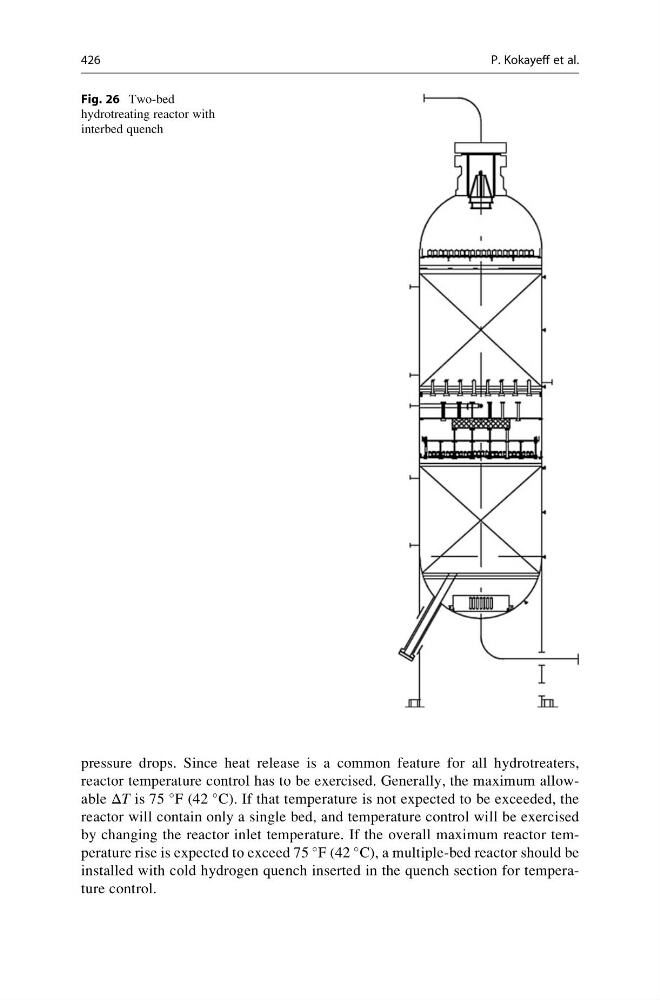
by changing the reactor inlet temperature. If the overall maximum reactor temperature rise is expected to exceed 75
F (42
C), a multiple-bed reactor should be
installed with cold hydrogen quench inserted in the quench section for temperature control.
Fig. 26 Two-bed
hydrotreating reactor with
interbed quench
426
P. Kokayeff et al.
reactor temperature control has to be exercised. Generally, the maximum allowable ΔT is 75
F (42
C). If that temperature is not expected to be exceeded, the
reactor will contain only a single bed, and temperature control will be exercised
by changing the reactor inlet temperature. If the overall maximum reactor temperature rise is expected to exceed 75
F (42
C), a multiple-bed reactor should be
installed with cold hydrogen quench inserted in the quench section for temperature control.
Fig. 26 Two-bed
hydrotreating reactor with
interbed quench
426
P. Kokayeff et al.