

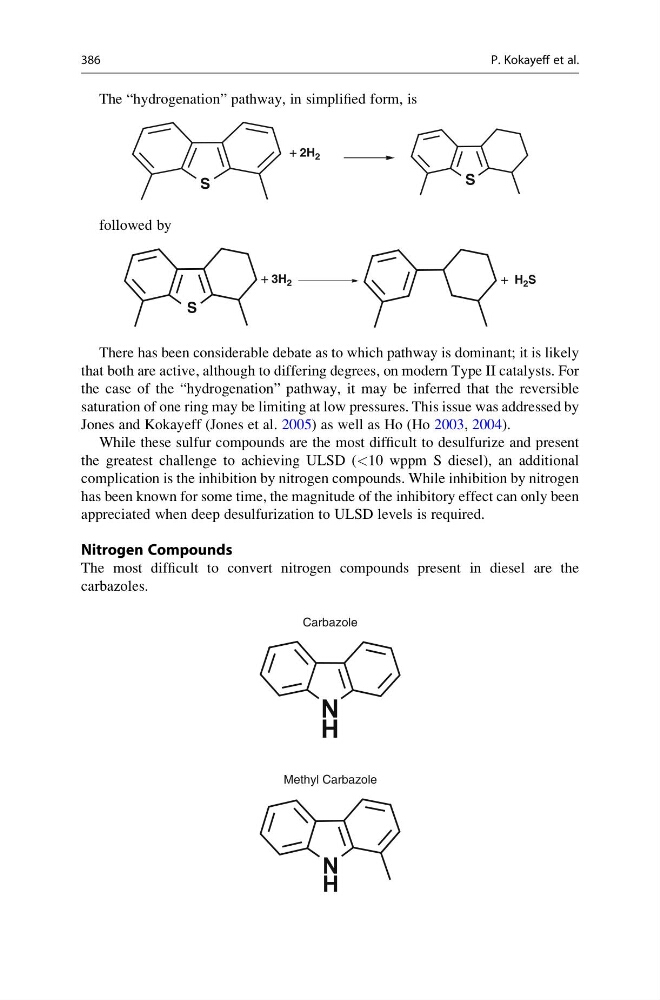
The “hydrogenation” pathway, in simplified form, is
+ 2H 2
S
S
followed by
+ 3H 2
+ H 2 S
S
There has been considerable debate as to which pathway is dominant; it is likely
that both are active, although to differing degrees, on modern Type II catalysts. For
the case of the “hydrogenation” pathway, it may be inferred that the reversible
saturation of one ring may be limiting at low pressures. This issue was addressed by
Jones and Kokayeff (Jones et al. 2005) as well as Ho (Ho 2003, 2004).
While these sulfur compounds are the most difficult to desulfurize and present
the greatest challenge to achieving ULSD (<10 wppm S diesel), an additional
complication is the inhibition by nitrogen compounds. While inhibition by nitrogen
has been known for some time, the magnitude of the inhibitory effect can only been
appreciated when deep desulfurization to ULSD levels is required.
Nitrogen Compounds
The most difficult to convert nitrogen compounds present in diesel are the
carbazoles.
Carbazole
Methyl Carbazole
386
P. Kokayeff et al.
+ 2H 2
S
S
followed by
+ 3H 2
+ H 2 S
S
There has been considerable debate as to which pathway is dominant; it is likely
that both are active, although to differing degrees, on modern Type II catalysts. For
the case of the “hydrogenation” pathway, it may be inferred that the reversible
saturation of one ring may be limiting at low pressures. This issue was addressed by
Jones and Kokayeff (Jones et al. 2005) as well as Ho (Ho 2003, 2004).
While these sulfur compounds are the most difficult to desulfurize and present
the greatest challenge to achieving ULSD (<10 wppm S diesel), an additional
complication is the inhibition by nitrogen compounds. While inhibition by nitrogen
has been known for some time, the magnitude of the inhibitory effect can only been
appreciated when deep desulfurization to ULSD levels is required.
Nitrogen Compounds
The most difficult to convert nitrogen compounds present in diesel are the
carbazoles.
Carbazole
Methyl Carbazole
386
P. Kokayeff et al.