

Catalyst formulations have had to be altered to match the changing feedstock
slate. The DCC catalysts are designed with the following characteristics: high
matrix activity for primary cracking of the heavy hydrocarbons and higher metal
tolerance, a large quantity of a modified mesopore zeolite with a pentasil structure
for cracking the primary product (gasoline), isomerization activity for the light
olefins, and minimization of hydrogen transfer. Ten different catalysts have been
used commercially in the seven operating DCC installations.
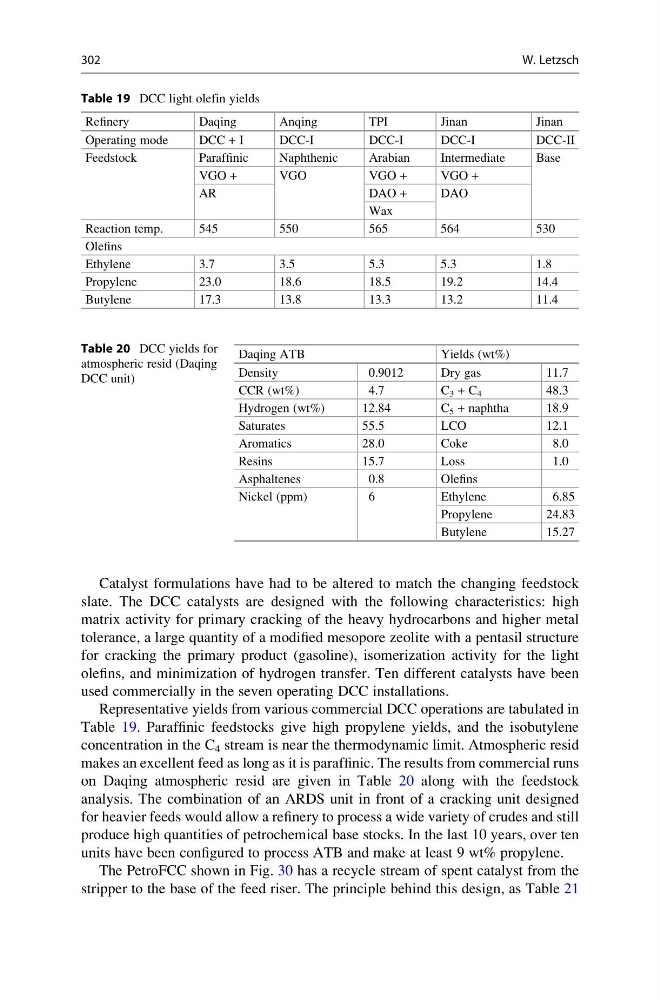
Representative yields from various commercial DCC operations are tabulated in
Table 19. Paraffinic feedstocks give high propylene yields, and the isobutylene
concentration in the C 4 stream is near the thermodynamic limit. Atmospheric resid
makes an excellent feed as long as it is paraffinic. The results from commercial runs
on Daqing atmospheric resid are given in Table 20 along with the feedstock
analysis. The combination of an ARDS unit in front of a cracking unit designed
for heavier feeds would allow a refinery to process a wide variety of crudes and still
produce high quantities of petrochemical base stocks. In the last 10 years, over ten
units have been configured to process ATB and make at least 9 wt% propylene.
The PetroFCC shown in Fig. 30 has a recycle stream of spent catalyst from the
stripper to the base of the feed riser. The principle behind this design, as Table 21
Table 19 DCC light olefin yields
Refinery
Daqing
Anqing
TPI
Jinan
Jinan
Operating mode
DCC + I
DCC-I
DCC-I
DCC-I
DCC-II
Feedstock
Paraffinic
Naphthenic
Arabian
Intermediate
Base
VGO +
VGO
VGO +
VGO +
AR
DAO +
DAO
Wax
Reaction temp.
545
550
565
564
530
Olefins
Ethylene
3.7
3.5
5.3
5.3
1.8
Propylene
23.0
18.6
18.5
19.2
14.4
Butylene
17.3
13.8
13.3
13.2
11.4
Table 20 DCC yields for
atmospheric resid (Daqing
DCC unit)
Daqing ATB
Yields (wt%)
Density
0.9012
Dry gas
11.7
CCR (wt%)
4.7
C 3 + C 4
48.3
Hydrogen (wt%)
12.84
C 5 + naphtha
18.9
Saturates
55.5
LCO
12.1
Aromatics
28.0
Coke
8.0
Resins
15.7
Loss
1.0
Asphaltenes
0.8
Olefins
Nickel (ppm)
6
Ethylene
6.85
Propylene
24.83
Butylene
15.27
302
W. Letzsch
slate. The DCC catalysts are designed with the following characteristics: high
matrix activity for primary cracking of the heavy hydrocarbons and higher metal
tolerance, a large quantity of a modified mesopore zeolite with a pentasil structure
for cracking the primary product (gasoline), isomerization activity for the light
olefins, and minimization of hydrogen transfer. Ten different catalysts have been
used commercially in the seven operating DCC installations.
Representative yields from various commercial DCC operations are tabulated in
Table 19. Paraffinic feedstocks give high propylene yields, and the isobutylene
concentration in the C 4 stream is near the thermodynamic limit. Atmospheric resid
makes an excellent feed as long as it is paraffinic. The results from commercial runs
on Daqing atmospheric resid are given in Table 20 along with the feedstock
analysis. The combination of an ARDS unit in front of a cracking unit designed
for heavier feeds would allow a refinery to process a wide variety of crudes and still
produce high quantities of petrochemical base stocks. In the last 10 years, over ten
units have been configured to process ATB and make at least 9 wt% propylene.
The PetroFCC shown in Fig. 30 has a recycle stream of spent catalyst from the
stripper to the base of the feed riser. The principle behind this design, as Table 21
Table 19 DCC light olefin yields
Refinery
Daqing
Anqing
TPI
Jinan
Jinan
Operating mode
DCC + I
DCC-I
DCC-I
DCC-I
DCC-II
Feedstock
Paraffinic
Naphthenic
Arabian
Intermediate
Base
VGO +
VGO
VGO +
VGO +
AR
DAO +
DAO
Wax
Reaction temp.
545
550
565
564
530
Olefins
Ethylene
3.7
3.5
5.3
5.3
1.8
Propylene
23.0
18.6
18.5
19.2
14.4
Butylene
17.3
13.8
13.3
13.2
11.4
Table 20 DCC yields for
atmospheric resid (Daqing
DCC unit)
Daqing ATB
Yields (wt%)
Density
0.9012
Dry gas
11.7
CCR (wt%)
4.7
C 3 + C 4
48.3
Hydrogen (wt%)
12.84
C 5 + naphtha
18.9
Saturates
55.5
LCO
12.1
Aromatics
28.0
Coke
8.0
Resins
15.7
Loss
1.0
Asphaltenes
0.8
Olefins
Nickel (ppm)
6
Ethylene
6.85
Propylene
24.83
Butylene
15.27
302
W. Letzsch