

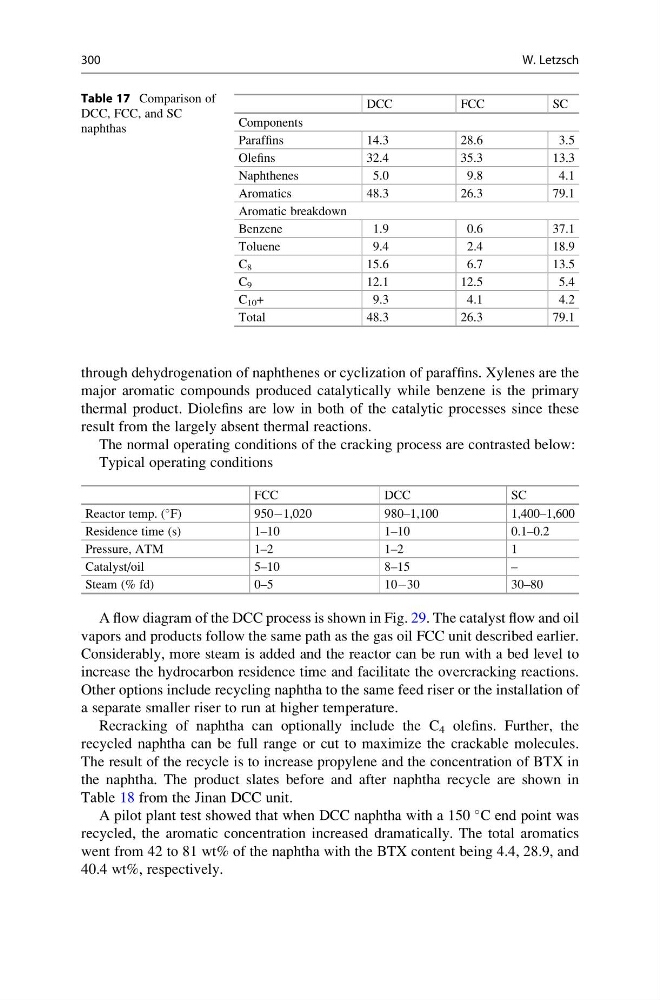
through dehydrogenation of naphthenes or cyclization of paraffins. Xylenes are the
major aromatic compounds produced catalytically while benzene is the primary
thermal product. Diolefins are low in both of the catalytic processes since these
result from the largely absent thermal reactions.
The normal operating conditions of the cracking process are contrasted below:
Typical operating conditions
FCC
DCC
SC
Reactor temp. (
F)
950À1,020
980–1,100
1,400–1,600
Residence time (s)
1–10
1–10
0.1–0.2
Pressure, ATM
1–2
1–2
1
Catalyst/oil
5–10
8–15
–
Steam (% fd)
0–5
10À30
30–80
A flow diagram of the DCC process is shown in Fig. 29. The catalyst flow and oil
vapors and products follow the same path as the gas oil FCC unit described earlier.
Considerably, more steam is added and the reactor can be run with a bed level to
increase the hydrocarbon residence time and facilitate the overcracking reactions.
Other options include recycling naphtha to the same feed riser or the installation of
a separate smaller riser to run at higher temperature.
Recracking of naphtha can optionally include the C 4 olefins. Further, the
recycled naphtha can be full range or cut to maximize the crackable molecules.
The result of the recycle is to increase propylene and the concentration of BTX in
the naphtha. The product slates before and after naphtha recycle are shown in
Table 18 from the Jinan DCC unit.
A pilot plant test showed that when DCC naphtha with a 150
C end point was
recycled, the aromatic concentration increased dramatically. The total aromatics
went from 42 to 81 wt% of the naphtha with the BTX content being 4.4, 28.9, and
40.4 wt%, respectively.
Table 17 Comparison of
DCC, FCC, and SC
naphthas
DCC
FCC
SC
Components
Paraffins
14.3
28.6
3.5
Olefins
32.4
35.3
13.3
Naphthenes
5.0
9.8
4.1
Aromatics
48.3
26.3
79.1
Aromatic breakdown
Benzene
1.9
0.6
37.1
Toluene
9.4
2.4
18.9
C 8
15.6
6.7
13.5
C 9
12.1
12.5
5.4
C 10 +
9.3
4.1
4.2
Total
48.3
26.3
79.1
300
W. Letzsch
major aromatic compounds produced catalytically while benzene is the primary
thermal product. Diolefins are low in both of the catalytic processes since these
result from the largely absent thermal reactions.
The normal operating conditions of the cracking process are contrasted below:
Typical operating conditions
FCC
DCC
SC
Reactor temp. (
F)
950À1,020
980–1,100
1,400–1,600
Residence time (s)
1–10
1–10
0.1–0.2
Pressure, ATM
1–2
1–2
1
Catalyst/oil
5–10
8–15
–
Steam (% fd)
0–5
10À30
30–80
A flow diagram of the DCC process is shown in Fig. 29. The catalyst flow and oil
vapors and products follow the same path as the gas oil FCC unit described earlier.
Considerably, more steam is added and the reactor can be run with a bed level to
increase the hydrocarbon residence time and facilitate the overcracking reactions.
Other options include recycling naphtha to the same feed riser or the installation of
a separate smaller riser to run at higher temperature.
Recracking of naphtha can optionally include the C 4 olefins. Further, the
recycled naphtha can be full range or cut to maximize the crackable molecules.
The result of the recycle is to increase propylene and the concentration of BTX in
the naphtha. The product slates before and after naphtha recycle are shown in
Table 18 from the Jinan DCC unit.
A pilot plant test showed that when DCC naphtha with a 150
C end point was
recycled, the aromatic concentration increased dramatically. The total aromatics
went from 42 to 81 wt% of the naphtha with the BTX content being 4.4, 28.9, and
40.4 wt%, respectively.
Table 17 Comparison of
DCC, FCC, and SC
naphthas
DCC
FCC
SC
Components
Paraffins
14.3
28.6
3.5
Olefins
32.4
35.3
13.3
Naphthenes
5.0
9.8
4.1
Aromatics
48.3
26.3
79.1
Aromatic breakdown
Benzene
1.9
0.6
37.1
Toluene
9.4
2.4
18.9
C 8
15.6
6.7
13.5
C 9
12.1
12.5
5.4
C 10 +
9.3
4.1
4.2
Total
48.3
26.3
79.1
300
W. Letzsch