

occurs, the refiner will shut down the SR process unit and regenerate the catalyst in
all the reactor positions to return them to their original state. In a cyclic unit, when
the coke becomes too high in a particular reactor position, a series of valves are
switched putting the deactivated reactor in a separate regeneration system. Meanwhile, a “swing” reactor is substituted for the deactivated reactor so feed processing
can continue. In a moving bed reforming unit, some of the catalyst is continually
being regenerated outside the process and returned to the reactors such that high
selectivity and activity are maintained.
Regeneration Steps
The objective of regeneration is to return the catalyst to its initial, fresh state. If the
regeneration is successful, there is no difference in performance between the fresh
and regenerated catalyst. To do this, the coke must be burned from the catalyst, the
platinum must be well redispersed, the Pt must be reduced, Pt and Pt-Re catalysts
must be sulfided, and the alumina must be rechlorided to the correct acidity level.
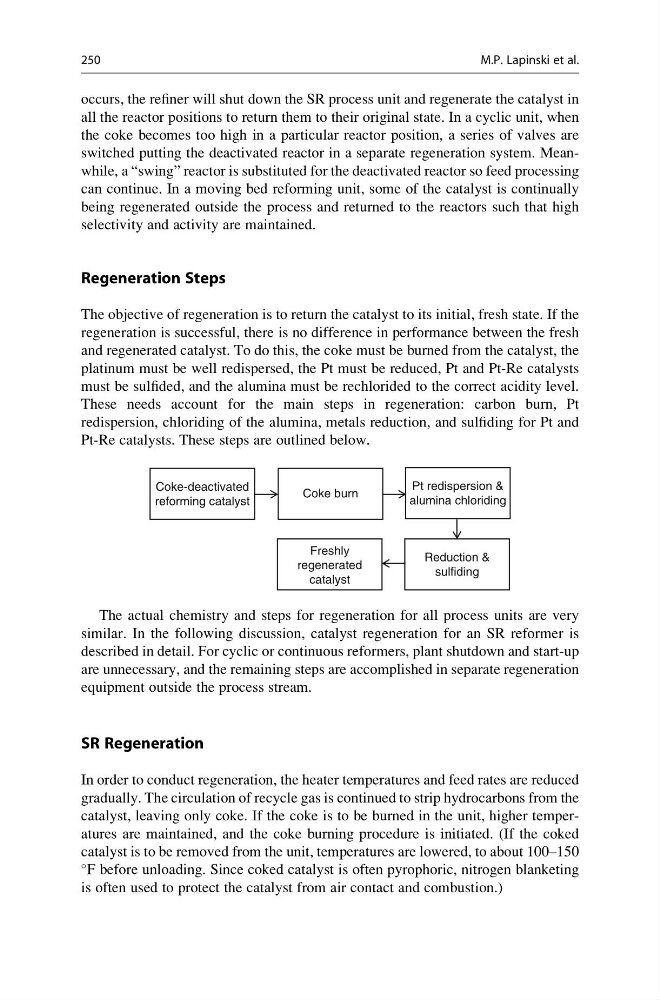
These needs account for the main steps in regeneration: carbon burn, Pt
redispersion, chloriding of the alumina, metals reduction, and sulfiding for Pt and
Pt-Re catalysts. These steps are outlined below.
Coke-deactivated
reforming catalyst
Coke burn
Pt redispersion &
alumina chloriding
Reduction &
sulfiding
Freshly
regenerated
catalyst
The actual chemistry and steps for regeneration for all process units are very
similar. In the following discussion, catalyst regeneration for an SR reformer is
described in detail. For cyclic or continuous reformers, plant shutdown and start-up
are unnecessary, and the remaining steps are accomplished in separate regeneration
equipment outside the process stream.
SR Regeneration
In order to conduct regeneration, the heater temperatures and feed rates are reduced
gradually. The circulation of recycle gas is continued to strip hydrocarbons from the
catalyst, leaving only coke. If the coke is to be burned in the unit, higher temperatures are maintained, and the coke burning procedure is initiated. (If the coked
catalyst is to be removed from the unit, temperatures are lowered, to about 100–150
F before unloading. Since coked catalyst is often pyrophoric, nitrogen blanketing
is often used to protect the catalyst from air contact and combustion.)
250
M.P. Lapinski et al.
all the reactor positions to return them to their original state. In a cyclic unit, when
the coke becomes too high in a particular reactor position, a series of valves are
switched putting the deactivated reactor in a separate regeneration system. Meanwhile, a “swing” reactor is substituted for the deactivated reactor so feed processing
can continue. In a moving bed reforming unit, some of the catalyst is continually
being regenerated outside the process and returned to the reactors such that high
selectivity and activity are maintained.
Regeneration Steps
The objective of regeneration is to return the catalyst to its initial, fresh state. If the
regeneration is successful, there is no difference in performance between the fresh
and regenerated catalyst. To do this, the coke must be burned from the catalyst, the
platinum must be well redispersed, the Pt must be reduced, Pt and Pt-Re catalysts
must be sulfided, and the alumina must be rechlorided to the correct acidity level.
These needs account for the main steps in regeneration: carbon burn, Pt
redispersion, chloriding of the alumina, metals reduction, and sulfiding for Pt and
Pt-Re catalysts. These steps are outlined below.
Coke-deactivated
reforming catalyst
Coke burn
Pt redispersion &
alumina chloriding
Reduction &
sulfiding
Freshly
regenerated
catalyst
The actual chemistry and steps for regeneration for all process units are very
similar. In the following discussion, catalyst regeneration for an SR reformer is
described in detail. For cyclic or continuous reformers, plant shutdown and start-up
are unnecessary, and the remaining steps are accomplished in separate regeneration
equipment outside the process stream.
SR Regeneration
In order to conduct regeneration, the heater temperatures and feed rates are reduced
gradually. The circulation of recycle gas is continued to strip hydrocarbons from the
catalyst, leaving only coke. If the coke is to be burned in the unit, higher temperatures are maintained, and the coke burning procedure is initiated. (If the coked
catalyst is to be removed from the unit, temperatures are lowered, to about 100–150
F before unloading. Since coked catalyst is often pyrophoric, nitrogen blanketing
is often used to protect the catalyst from air contact and combustion.)
250
M.P. Lapinski et al.