

R
R
+ 3 H 2
H 3 C
R
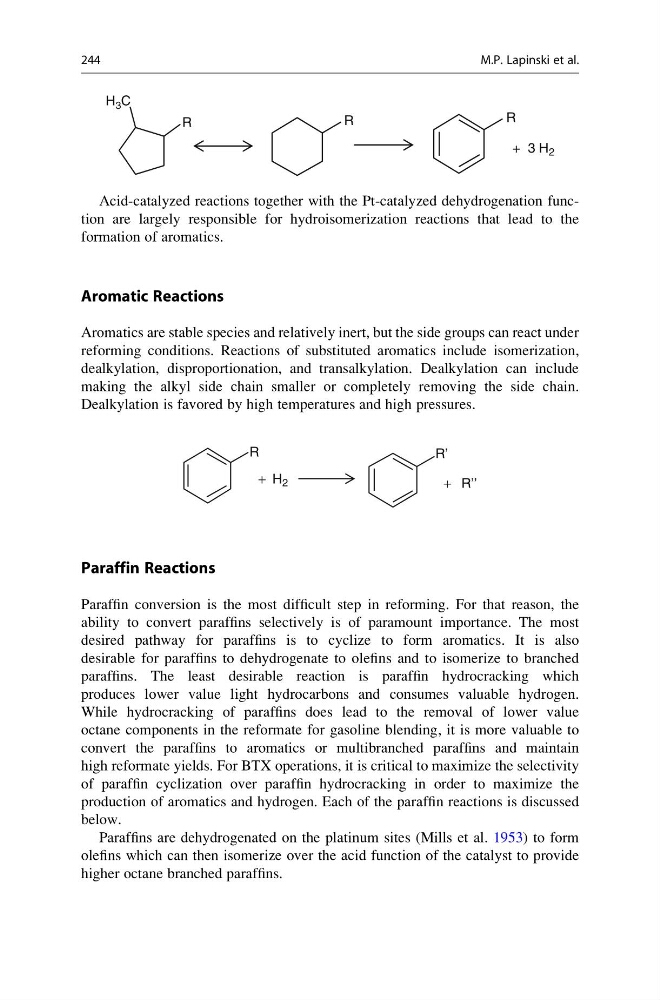
Acid-catalyzed reactions together with the Pt-catalyzed dehydrogenation function are largely responsible for hydroisomerization reactions that lead to the
formation of aromatics.
Aromatic Reactions
Aromatics are stable species and relatively inert, but the side groups can react under
reforming conditions. Reactions of substituted aromatics include isomerization,
dealkylation, disproportionation, and transalkylation. Dealkylation can include
making the alkyl side chain smaller or completely removing the side chain.
Dealkylation is favored by high temperatures and high pressures.
R
+ H 2
R’
+ R’’
Paraffin Reactions
Paraffin conversion is the most difficult step in reforming. For that reason, the
ability to convert paraffins selectively is of paramount importance. The most
desired pathway for paraffins is to cyclize to form aromatics. It is also
desirable for paraffins to dehydrogenate to olefins and to isomerize to branched
paraffins. The least desirable reaction is paraffin hydrocracking which
produces lower value light hydrocarbons and consumes valuable hydrogen.
While hydrocracking of paraffins does lead to the removal of lower value
octane components in the reformate for gasoline blending, it is more valuable to
convert the paraffins to aromatics or multibranched paraffins and maintain
high reformate yields. For BTX operations, it is critical to maximize the selectivity
of paraffin cyclization over paraffin hydrocracking in order to maximize the
production of aromatics and hydrogen. Each of the paraffin reactions is discussed
below.
Paraffins are dehydrogenated on the platinum sites (Mills et al. 1953) to form
olefins which can then isomerize over the acid function of the catalyst to provide
higher octane branched paraffins.
244
M.P. Lapinski et al.
R
+ 3 H 2
H 3 C
R
Acid-catalyzed reactions together with the Pt-catalyzed dehydrogenation function are largely responsible for hydroisomerization reactions that lead to the
formation of aromatics.
Aromatic Reactions
Aromatics are stable species and relatively inert, but the side groups can react under
reforming conditions. Reactions of substituted aromatics include isomerization,
dealkylation, disproportionation, and transalkylation. Dealkylation can include
making the alkyl side chain smaller or completely removing the side chain.
Dealkylation is favored by high temperatures and high pressures.
R
+ H 2
R’
+ R’’
Paraffin Reactions
Paraffin conversion is the most difficult step in reforming. For that reason, the
ability to convert paraffins selectively is of paramount importance. The most
desired pathway for paraffins is to cyclize to form aromatics. It is also
desirable for paraffins to dehydrogenate to olefins and to isomerize to branched
paraffins. The least desirable reaction is paraffin hydrocracking which
produces lower value light hydrocarbons and consumes valuable hydrogen.
While hydrocracking of paraffins does lead to the removal of lower value
octane components in the reformate for gasoline blending, it is more valuable to
convert the paraffins to aromatics or multibranched paraffins and maintain
high reformate yields. For BTX operations, it is critical to maximize the selectivity
of paraffin cyclization over paraffin hydrocracking in order to maximize the
production of aromatics and hydrogen. Each of the paraffin reactions is discussed
below.
Paraffins are dehydrogenated on the platinum sites (Mills et al. 1953) to form
olefins which can then isomerize over the acid function of the catalyst to provide
higher octane branched paraffins.
244
M.P. Lapinski et al.