

catalyst regeneration, or the CCR Platforming process, by UOP in 1971.
The Institut Franc ¸ais du Pe ´trole commercialized a continuous regeneration
reforming process (Octanizing and Aromizing process versions) a few years later.
With continuous catalyst regeneration, small amounts of catalyst are continuously
removed from the last reactor where the coke level is highest, regenerated in a
controlled environment in a separate regeneration vessel that is in series with the
process, and transferred back to the first reactor. The catalyst travels around a
closed loop between the reactors and regenerator. The CCR Platforming process
has enabled the use of significantly lower pressures of 345 kPa (50 psig) and
significantly higher product octanes, as high as 108 RON, compared to both cyclic
and SR reforming processes. More than 95 % of all new catalytic reformers today
are designed with continuous regeneration. In addition, many units that were
originally built as SR reforming units have been revamped to continuously regenerable reforming units.
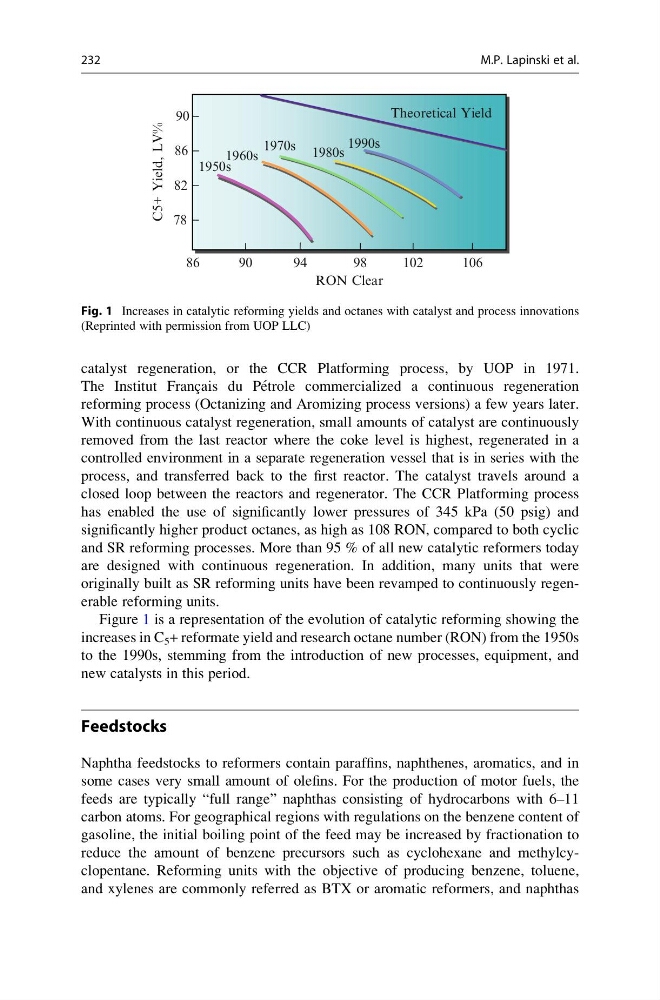
Figure 1 is a representation of the evolution of catalytic reforming showing the
increases in C 5 + reformate yield and research octane number (RON) from the 1950s
to the 1990s, stemming from the introduction of new processes, equipment, and
new catalysts in this period.
Feedstocks
Naphtha feedstocks to reformers contain paraffins, naphthenes, aromatics, and in
some cases very small amount of olefins. For the production of motor fuels, the
feeds are typically “full range” naphthas consisting of hydrocarbons with 6–11
carbon atoms. For geographical regions with regulations on the benzene content of
gasoline, the initial boiling point of the feed may be increased by fractionation to
reduce the amount of benzene precursors such as cyclohexane and methylcyclopentane. Reforming units with the objective of producing benzene, toluene,
and xylenes are commonly referred as BTX or aromatic reformers, and naphthas
RON Clear
86
90
94
98
102
106
Theoretical Yield
90
C5+ Yield, LV%
86
82
78
1950s
1960s
1970s 1980s
1990s
Fig. 1 Increases in catalytic reforming yields and octanes with catalyst and process innovations
(Reprinted with permission from UOP LLC)
232
M.P. Lapinski et al.
The Institut Franc ¸ais du Pe ´trole commercialized a continuous regeneration
reforming process (Octanizing and Aromizing process versions) a few years later.
With continuous catalyst regeneration, small amounts of catalyst are continuously
removed from the last reactor where the coke level is highest, regenerated in a
controlled environment in a separate regeneration vessel that is in series with the
process, and transferred back to the first reactor. The catalyst travels around a
closed loop between the reactors and regenerator. The CCR Platforming process
has enabled the use of significantly lower pressures of 345 kPa (50 psig) and
significantly higher product octanes, as high as 108 RON, compared to both cyclic
and SR reforming processes. More than 95 % of all new catalytic reformers today
are designed with continuous regeneration. In addition, many units that were
originally built as SR reforming units have been revamped to continuously regenerable reforming units.
Figure 1 is a representation of the evolution of catalytic reforming showing the
increases in C 5 + reformate yield and research octane number (RON) from the 1950s
to the 1990s, stemming from the introduction of new processes, equipment, and
new catalysts in this period.
Feedstocks
Naphtha feedstocks to reformers contain paraffins, naphthenes, aromatics, and in
some cases very small amount of olefins. For the production of motor fuels, the
feeds are typically “full range” naphthas consisting of hydrocarbons with 6–11
carbon atoms. For geographical regions with regulations on the benzene content of
gasoline, the initial boiling point of the feed may be increased by fractionation to
reduce the amount of benzene precursors such as cyclohexane and methylcyclopentane. Reforming units with the objective of producing benzene, toluene,
and xylenes are commonly referred as BTX or aromatic reformers, and naphthas
RON Clear
86
90
94
98
102
106
Theoretical Yield
90
C5+ Yield, LV%
86
82
78
1950s
1960s
1970s 1980s
1990s
Fig. 1 Increases in catalytic reforming yields and octanes with catalyst and process innovations
(Reprinted with permission from UOP LLC)
232
M.P. Lapinski et al.