

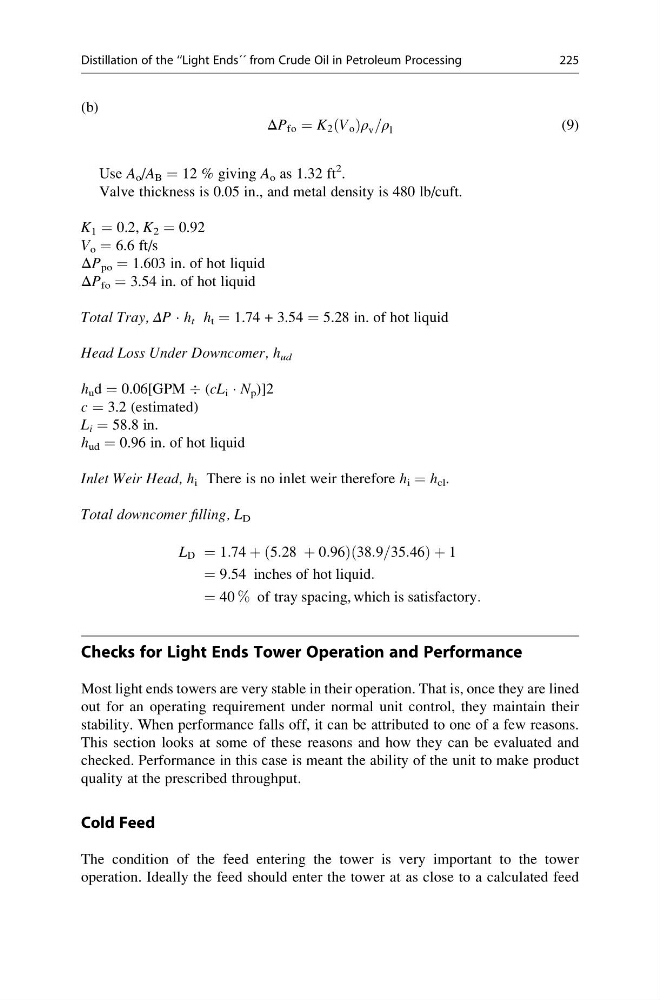
(b)
ΔP fo ¼ K 2 V o
ð Þρ v =ρ l
(9)
Use A o /A B = 12 % giving A o as 1.32 ft
2 .
Valve thickness is 0.05 in., and metal density is 480 lb/cuft.
K 1 = 0.2, K 2 = 0.92
V o = 6.6 ft/s
ΔP po = 1.603 in. of hot liquid
ΔP fo = 3.54 in. of hot liquid
Total Tray, ΔP Á h t h t = 1.74 + 3.54 = 5.28 in. of hot liquid
Head Loss Under Downcomer, h ud
h u d = 0.06[GPM Ä (cL i Á N p )]2
c = 3.2 (estimated)
L i = 58.8 in.
h ud = 0.96 in. of hot liquid
Inlet Weir Head, h i There is no inlet weir therefore h i = h cl .
Total downcomer filling, L D
L D ¼ 1:74 þ 5:28 þ 0:96
ð
Þ38:9=35:46 ð
Þþ1
¼ 9:54 inches of hot liquid:
¼ 40 % of tray spacing, which is satisfactory:
Checks for Light Ends Tower Operation and Performance
Most light ends towers are very stable in their operation. That is, once they are lined
out for an operating requirement under normal unit control, they maintain their
stability. When performance falls off, it can be attributed to one of a few reasons.
This section looks at some of these reasons and how they can be evaluated and
checked. Performance in this case is meant the ability of the unit to make product
quality at the prescribed throughput.
Cold Feed
The condition of the feed entering the tower is very important to the tower
operation. Ideally the feed should enter the tower at as close to a calculated feed
Distillation of the ‘‘Light Ends´´ from Crude Oil in Petroleum Processing
225
ΔP fo ¼ K 2 V o
ð Þρ v =ρ l
(9)
Use A o /A B = 12 % giving A o as 1.32 ft
2 .
Valve thickness is 0.05 in., and metal density is 480 lb/cuft.
K 1 = 0.2, K 2 = 0.92
V o = 6.6 ft/s
ΔP po = 1.603 in. of hot liquid
ΔP fo = 3.54 in. of hot liquid
Total Tray, ΔP Á h t h t = 1.74 + 3.54 = 5.28 in. of hot liquid
Head Loss Under Downcomer, h ud
h u d = 0.06[GPM Ä (cL i Á N p )]2
c = 3.2 (estimated)
L i = 58.8 in.
h ud = 0.96 in. of hot liquid
Inlet Weir Head, h i There is no inlet weir therefore h i = h cl .
Total downcomer filling, L D
L D ¼ 1:74 þ 5:28 þ 0:96
ð
Þ38:9=35:46 ð
Þþ1
¼ 9:54 inches of hot liquid:
¼ 40 % of tray spacing, which is satisfactory:
Checks for Light Ends Tower Operation and Performance
Most light ends towers are very stable in their operation. That is, once they are lined
out for an operating requirement under normal unit control, they maintain their
stability. When performance falls off, it can be attributed to one of a few reasons.
This section looks at some of these reasons and how they can be evaluated and
checked. Performance in this case is meant the ability of the unit to make product
quality at the prescribed throughput.
Cold Feed
The condition of the feed entering the tower is very important to the tower
operation. Ideally the feed should enter the tower at as close to a calculated feed
Distillation of the ‘‘Light Ends´´ from Crude Oil in Petroleum Processing
225