

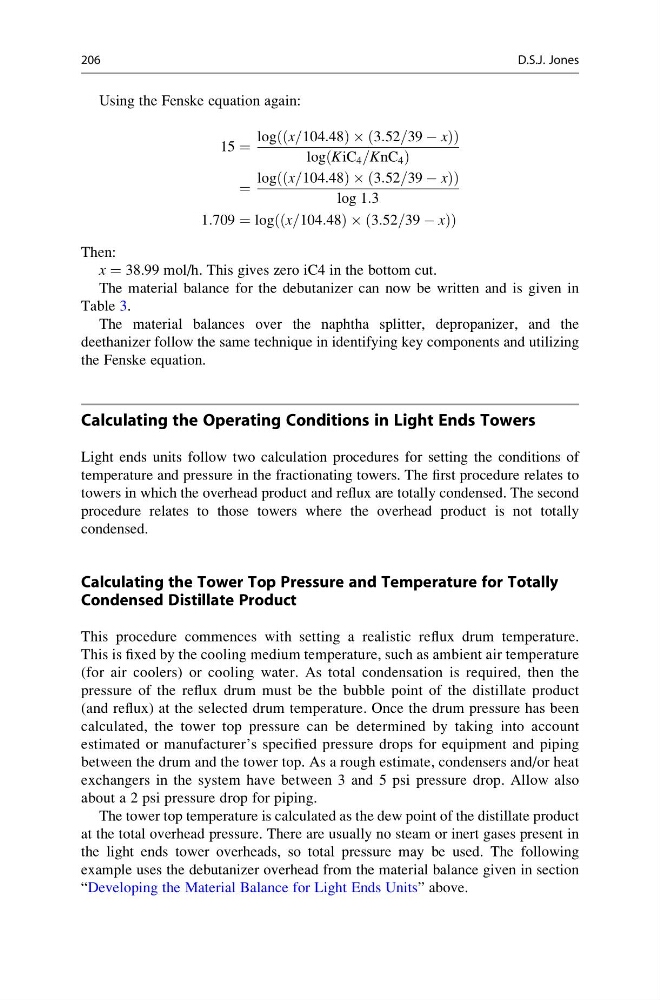
Using the Fenske equation again:
15 ¼
log x=104:48
ð
ÞÂ 3:52=39 À x
ð
Þ
ð
Þ
log KiC 4 =KnC 4
ð
Þ
¼
log x=104:48
ð
ÞÂ 3:52=39 À x
ð
Þ
ð
Þ
log 1:3
1:709 ¼ log x=104:48
ð
ÞÂ 3:52=39 À x
ð
Þ
ð
Þ
Then:
x = 38.99 mol/h. This gives zero iC4 in the bottom cut.
The material balance for the debutanizer can now be written and is given in
Table 3.
The material balances over the naphtha splitter, depropanizer, and the
deethanizer follow the same technique in identifying key components and utilizing
the Fenske equation.
Calculating the Operating Conditions in Light Ends Towers
Light ends units follow two calculation procedures for setting the conditions of
temperature and pressure in the fractionating towers. The first procedure relates to
towers in which the overhead product and reflux are totally condensed. The second
procedure relates to those towers where the overhead product is not totally
condensed.
Calculating the Tower Top Pressure and Temperature for Totally
Condensed Distillate Product
This procedure commences with setting a realistic reflux drum temperature.
This is fixed by the cooling medium temperature, such as ambient air temperature
(for air coolers) or cooling water. As total condensation is required, then the
pressure of the reflux drum must be the bubble point of the distillate product
(and reflux) at the selected drum temperature. Once the drum pressure has been
calculated, the tower top pressure can be determined by taking into account
estimated or manufacturer’s specified pressure drops for equipment and piping
between the drum and the tower top. As a rough estimate, condensers and/or heat
exchangers in the system have between 3 and 5 psi pressure drop. Allow also
about a 2 psi pressure drop for piping.
The tower top temperature is calculated as the dew point of the distillate product
at the total overhead pressure. There are usually no steam or inert gases present in
the light ends tower overheads, so total pressure may be used. The following
example uses the debutanizer overhead from the material balance given in section
“Developing the Material Balance for Light Ends Units” above.
206
D.S.J. Jones
15 ¼
log x=104:48
ð
ÞÂ 3:52=39 À x
ð
Þ
ð
Þ
log KiC 4 =KnC 4
ð
Þ
¼
log x=104:48
ð
ÞÂ 3:52=39 À x
ð
Þ
ð
Þ
log 1:3
1:709 ¼ log x=104:48
ð
ÞÂ 3:52=39 À x
ð
Þ
ð
Þ
Then:
x = 38.99 mol/h. This gives zero iC4 in the bottom cut.
The material balance for the debutanizer can now be written and is given in
Table 3.
The material balances over the naphtha splitter, depropanizer, and the
deethanizer follow the same technique in identifying key components and utilizing
the Fenske equation.
Calculating the Operating Conditions in Light Ends Towers
Light ends units follow two calculation procedures for setting the conditions of
temperature and pressure in the fractionating towers. The first procedure relates to
towers in which the overhead product and reflux are totally condensed. The second
procedure relates to those towers where the overhead product is not totally
condensed.
Calculating the Tower Top Pressure and Temperature for Totally
Condensed Distillate Product
This procedure commences with setting a realistic reflux drum temperature.
This is fixed by the cooling medium temperature, such as ambient air temperature
(for air coolers) or cooling water. As total condensation is required, then the
pressure of the reflux drum must be the bubble point of the distillate product
(and reflux) at the selected drum temperature. Once the drum pressure has been
calculated, the tower top pressure can be determined by taking into account
estimated or manufacturer’s specified pressure drops for equipment and piping
between the drum and the tower top. As a rough estimate, condensers and/or heat
exchangers in the system have between 3 and 5 psi pressure drop. Allow also
about a 2 psi pressure drop for piping.
The tower top temperature is calculated as the dew point of the distillate product
at the total overhead pressure. There are usually no steam or inert gases present in
the light ends tower overheads, so total pressure may be used. The following
example uses the debutanizer overhead from the material balance given in section
“Developing the Material Balance for Light Ends Units” above.
206
D.S.J. Jones