

Step 3. Give values to the fraction of LT and HY keys in the distillate and
bottoms. Use x as the unknown where appropriate.
Step 4. The Fenske equation will be used to calculate the distribution of keys.
Determine the value of N m by taking the actual number of trays and using an
efficiency of 70–75 % to arrive at total theoretical trays. Divide this figure by
1.5 to arrive at the minimum theoretical trays N m . Do not forget to add 1 for
the reboiler to use in the equation.
Step 5. Estimate the mean tower conditions. This can be achieved by examining
past plant logs and other sources. Determine K values for the keys at this
mean tower condition. Use published data for real components and the ratio
of vapor pressure divided by total systems pressure for pseudo-components.
Step 6. Solve for x in the Fenske correlation. This will be the split of the key
components and the basis for the material balance.
Very often when setting up a design for a light ends tower, the actual number of
trays is not known at the time when calculation number two is required. The rules of
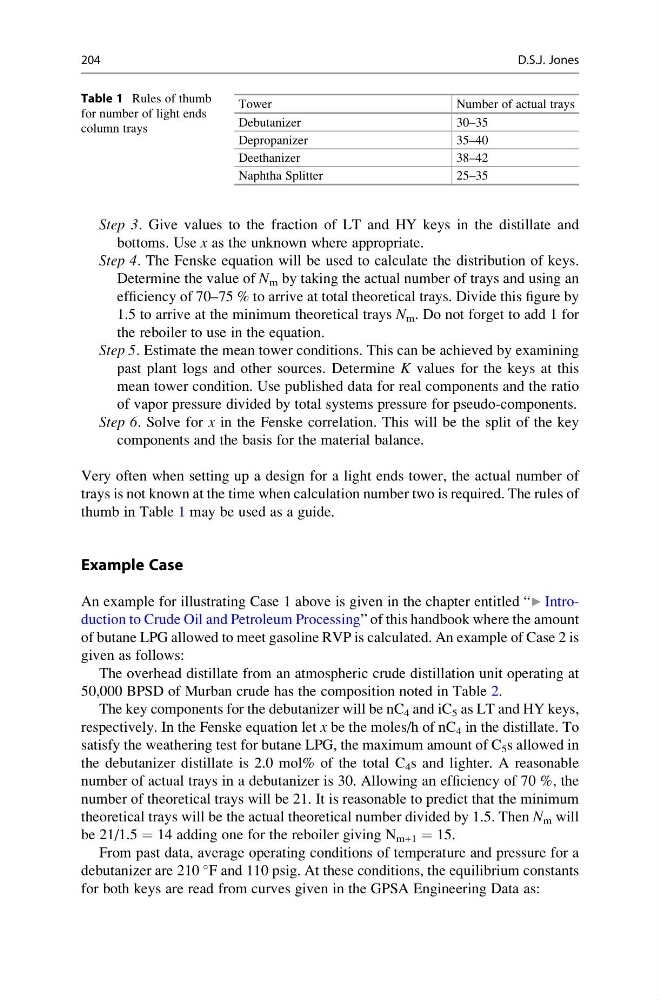
thumb in Table 1 may be used as a guide.
Example Case
An example for illustrating Case 1 above is given in the chapter entitled “▶ Introduction to Crude Oil and Petroleum Processing” of this handbook where the amount
of butane LPG allowed to meet gasoline RVP is calculated. An example of Case 2 is
given as follows:
The overhead distillate from an atmospheric crude distillation unit operating at
50,000 BPSD of Murban crude has the composition noted in Table 2.
The key components for the debutanizer will be nC 4 and iC 5 as LT and HY keys,
respectively. In the Fenske equation let x be the moles/h of nC 4 in the distillate. To
satisfy the weathering test for butane LPG, the maximum amount of C 5 s allowed in
the debutanizer distillate is 2.0 mol% of the total C 4 s and lighter. A reasonable
number of actual trays in a debutanizer is 30. Allowing an efficiency of 70 %, the
number of theoretical trays will be 21. It is reasonable to predict that the minimum
theoretical trays will be the actual theoretical number divided by 1.5. Then N m will
be 21/1.5 = 14 adding one for the reboiler giving N m+1 = 15.
From past data, average operating conditions of temperature and pressure for a
debutanizer are 210
F and 110 psig. At these conditions, the equilibrium constants
for both keys are read from curves given in the GPSA Engineering Data as:
Table 1 Rules of thumb
for number of light ends
column trays
Tower
Number of actual trays
Debutanizer
30–35
Depropanizer
35–40
Deethanizer
38–42
Naphtha Splitter
25–35
204
D.S.J. Jones
bottoms. Use x as the unknown where appropriate.
Step 4. The Fenske equation will be used to calculate the distribution of keys.
Determine the value of N m by taking the actual number of trays and using an
efficiency of 70–75 % to arrive at total theoretical trays. Divide this figure by
1.5 to arrive at the minimum theoretical trays N m . Do not forget to add 1 for
the reboiler to use in the equation.
Step 5. Estimate the mean tower conditions. This can be achieved by examining
past plant logs and other sources. Determine K values for the keys at this
mean tower condition. Use published data for real components and the ratio
of vapor pressure divided by total systems pressure for pseudo-components.
Step 6. Solve for x in the Fenske correlation. This will be the split of the key
components and the basis for the material balance.
Very often when setting up a design for a light ends tower, the actual number of
trays is not known at the time when calculation number two is required. The rules of
thumb in Table 1 may be used as a guide.
Example Case
An example for illustrating Case 1 above is given in the chapter entitled “▶ Introduction to Crude Oil and Petroleum Processing” of this handbook where the amount
of butane LPG allowed to meet gasoline RVP is calculated. An example of Case 2 is
given as follows:
The overhead distillate from an atmospheric crude distillation unit operating at
50,000 BPSD of Murban crude has the composition noted in Table 2.
The key components for the debutanizer will be nC 4 and iC 5 as LT and HY keys,
respectively. In the Fenske equation let x be the moles/h of nC 4 in the distillate. To
satisfy the weathering test for butane LPG, the maximum amount of C 5 s allowed in
the debutanizer distillate is 2.0 mol% of the total C 4 s and lighter. A reasonable
number of actual trays in a debutanizer is 30. Allowing an efficiency of 70 %, the
number of theoretical trays will be 21. It is reasonable to predict that the minimum
theoretical trays will be the actual theoretical number divided by 1.5. Then N m will
be 21/1.5 = 14 adding one for the reboiler giving N m+1 = 15.
From past data, average operating conditions of temperature and pressure for a
debutanizer are 210
F and 110 psig. At these conditions, the equilibrium constants
for both keys are read from curves given in the GPSA Engineering Data as:
Table 1 Rules of thumb
for number of light ends
column trays
Tower
Number of actual trays
Debutanizer
30–35
Depropanizer
35–40
Deethanizer
38–42
Naphtha Splitter
25–35
204
D.S.J. Jones