

Developing the Material Balances for Light Ends Units
In light ends towers, the material balance is developed on a molal balance. This
type of balance is determined by the degree of separation of the feed molal
components that enter the distillate fraction and those that leave with the bottom
product.
Effective separation by fractionation in light ends towers obeys the same laws as
those in the crude distillation units, that is: the degree of separation is the result of
the number of trays (or stages) and the reflux (or overflow) in the column.
In the crude unit, this separation was measured by the difference between the
ASTM 95 % point of the lighter fraction and the 5 % ASTM point of the heavier
fraction. This is the ASTM gap or overlap.
In light ends towers the degree of separation is a little more precise. This is
determined by the distribution of key components in the two fractions to be
separated. Key components may be real components (such as C 4 s or C 5 s) or
pseudo-components defined by their mid-boiling points. Normally key components
are adjacent components by boiling point in the feed composition. Any two key
components may be selected – a light key and a heavy key. By definition, the light
key has the lower boiling point. Both key components must, however, be present in
the distillate and bottom products of the column. If a side stream exists, then these
keys must also be present in the side stream product.
There are several correlations that describe the behavior of these key components in their distribution and relationship to one another. By far, the more common
of these correlations is the Fenske equation which relates the distribution of key
components at minimum trays with infinite reflux. The equation is relatively simple
and does not require iterative calculation techniques to solve it. The Fenske
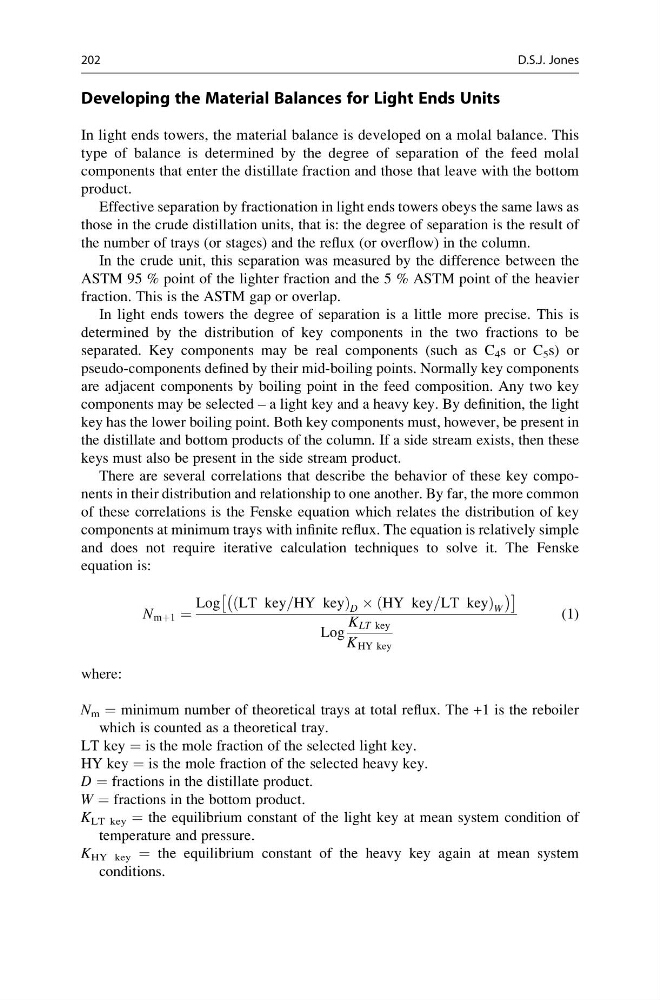
equation is:
N mþ1 ¼
Log LT key=HY key
ð
Þ D Â HY key=LT key
ð
Þ W
À
Á
Â
Ã
Log
K LT key
K HY key
(1)
where:
N m = minimum number of theoretical trays at total reflux. The +1 is the reboiler
which is counted as a theoretical tray.
LT key = is the mole fraction of the selected light key.
HY key = is the mole fraction of the selected heavy key.
D = fractions in the distillate product.
W = fractions in the bottom product.
K LT key = the equilibrium constant of the light key at mean system condition of
temperature and pressure.
K HY key = the equilibrium constant of the heavy key again at mean system
conditions.
202
D.S.J. Jones
In light ends towers, the material balance is developed on a molal balance. This
type of balance is determined by the degree of separation of the feed molal
components that enter the distillate fraction and those that leave with the bottom
product.
Effective separation by fractionation in light ends towers obeys the same laws as
those in the crude distillation units, that is: the degree of separation is the result of
the number of trays (or stages) and the reflux (or overflow) in the column.
In the crude unit, this separation was measured by the difference between the
ASTM 95 % point of the lighter fraction and the 5 % ASTM point of the heavier
fraction. This is the ASTM gap or overlap.
In light ends towers the degree of separation is a little more precise. This is
determined by the distribution of key components in the two fractions to be
separated. Key components may be real components (such as C 4 s or C 5 s) or
pseudo-components defined by their mid-boiling points. Normally key components
are adjacent components by boiling point in the feed composition. Any two key
components may be selected – a light key and a heavy key. By definition, the light
key has the lower boiling point. Both key components must, however, be present in
the distillate and bottom products of the column. If a side stream exists, then these
keys must also be present in the side stream product.
There are several correlations that describe the behavior of these key components in their distribution and relationship to one another. By far, the more common
of these correlations is the Fenske equation which relates the distribution of key
components at minimum trays with infinite reflux. The equation is relatively simple
and does not require iterative calculation techniques to solve it. The Fenske
equation is:
N mþ1 ¼
Log LT key=HY key
ð
Þ D Â HY key=LT key
ð
Þ W
À
Á
Â
Ã
Log
K LT key
K HY key
(1)
where:
N m = minimum number of theoretical trays at total reflux. The +1 is the reboiler
which is counted as a theoretical tray.
LT key = is the mole fraction of the selected light key.
HY key = is the mole fraction of the selected heavy key.
D = fractions in the distillate product.
W = fractions in the bottom product.
K LT key = the equilibrium constant of the light key at mean system condition of
temperature and pressure.
K HY key = the equilibrium constant of the heavy key again at mean system
conditions.
202
D.S.J. Jones