

200–250
F, water is injected into the crude to dissolve salt that is usually present.
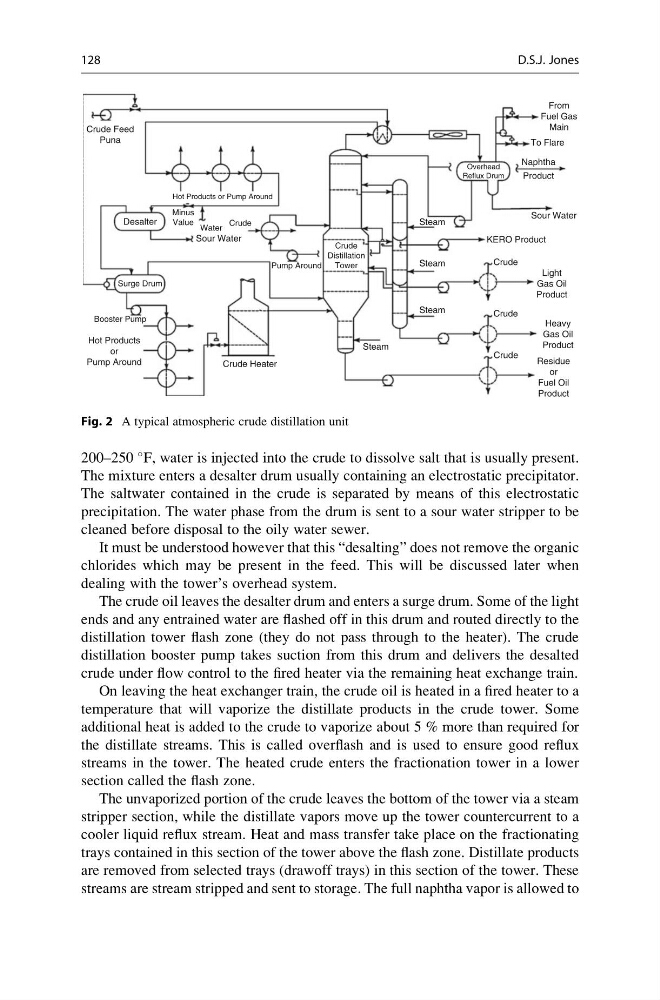
The mixture enters a desalter drum usually containing an electrostatic precipitator.
The saltwater contained in the crude is separated by means of this electrostatic
precipitation. The water phase from the drum is sent to a sour water stripper to be
cleaned before disposal to the oily water sewer.
It must be understood however that this “desalting” does not remove the organic
chlorides which may be present in the feed. This will be discussed later when
dealing with the tower’s overhead system.
The crude oil leaves the desalter drum and enters a surge drum. Some of the light
ends and any entrained water are flashed off in this drum and routed directly to the
distillation tower flash zone (they do not pass through to the heater). The crude
distillation booster pump takes suction from this drum and delivers the desalted
crude under flow control to the fired heater via the remaining heat exchange train.
On leaving the heat exchanger train, the crude oil is heated in a fired heater to a
temperature that will vaporize the distillate products in the crude tower. Some
additional heat is added to the crude to vaporize about 5 % more than required for
the distillate streams. This is called overflash and is used to ensure good reflux
streams in the tower. The heated crude enters the fractionation tower in a lower
section called the flash zone.
The unvaporized portion of the crude leaves the bottom of the tower via a steam
stripper section, while the distillate vapors move up the tower countercurrent to a
cooler liquid reflux stream. Heat and mass transfer take place on the fractionating
trays contained in this section of the tower above the flash zone. Distillate products
are removed from selected trays (drawoff trays) in this section of the tower. These
streams are stream stripped and sent to storage. The full naphtha vapor is allowed to
Crude Feed
Puna
Hot Products or Pump Around
Desalter
Surge Drum
Booster Pump
Crude Heater
Hot Products
or
Pump Around
Minus
Value Water
Sour Water
Crude
Pump Around
Crude
Distillation
Tower
Steam
Steam
KERO Product
Crude
Steam
Steam
Crude
Crude
Heavy
Gas Oil
Product
Residue
or
Fuel Oil
Product
Sour Water
Naphtha
Product
From
Fuel Gas
Main
To Flare
Overhead
Reflux Drum
Light
Gas Oil
Product
Fig. 2 A typical atmospheric crude distillation unit
128
D.S.J. Jones
F, water is injected into the crude to dissolve salt that is usually present.
The mixture enters a desalter drum usually containing an electrostatic precipitator.
The saltwater contained in the crude is separated by means of this electrostatic
precipitation. The water phase from the drum is sent to a sour water stripper to be
cleaned before disposal to the oily water sewer.
It must be understood however that this “desalting” does not remove the organic
chlorides which may be present in the feed. This will be discussed later when
dealing with the tower’s overhead system.
The crude oil leaves the desalter drum and enters a surge drum. Some of the light
ends and any entrained water are flashed off in this drum and routed directly to the
distillation tower flash zone (they do not pass through to the heater). The crude
distillation booster pump takes suction from this drum and delivers the desalted
crude under flow control to the fired heater via the remaining heat exchange train.
On leaving the heat exchanger train, the crude oil is heated in a fired heater to a
temperature that will vaporize the distillate products in the crude tower. Some
additional heat is added to the crude to vaporize about 5 % more than required for
the distillate streams. This is called overflash and is used to ensure good reflux
streams in the tower. The heated crude enters the fractionation tower in a lower
section called the flash zone.
The unvaporized portion of the crude leaves the bottom of the tower via a steam
stripper section, while the distillate vapors move up the tower countercurrent to a
cooler liquid reflux stream. Heat and mass transfer take place on the fractionating
trays contained in this section of the tower above the flash zone. Distillate products
are removed from selected trays (drawoff trays) in this section of the tower. These
streams are stream stripped and sent to storage. The full naphtha vapor is allowed to
Crude Feed
Puna
Hot Products or Pump Around
Desalter
Surge Drum
Booster Pump
Crude Heater
Hot Products
or
Pump Around
Minus
Value Water
Sour Water
Crude
Pump Around
Crude
Distillation
Tower
Steam
Steam
KERO Product
Crude
Steam
Steam
Crude
Crude
Heavy
Gas Oil
Product
Residue
or
Fuel Oil
Product
Sour Water
Naphtha
Product
From
Fuel Gas
Main
To Flare
Overhead
Reflux Drum
Light
Gas Oil
Product
Fig. 2 A typical atmospheric crude distillation unit
128
D.S.J. Jones