

the refinery units. This chapter describes the initial crude fractionation process in
both atmospheric and vacuum distillation units and how these units are designed.
Detailed example design calculations are provided.
Keywords
Crude unit • Vacuum unit • Distillation • Refinery • Petroleum • Fractionation
Introduction
The distillation of petroleum products from crude oil has long been practiced. The
ancient Egyptians, Greeks, and Romans had some form of extracting a flammable
oil from, probably, weathered crude oil seepage. It was not though until the turn of
the nineteenth and twentieth century that crude oil well drilling was first discovered
and commercialized. Originally the crude oil was refined to produce essentially
kerosene (lamp oil) and a form of gasoline known then as “benzine” (as opposed to
“benzene” already being produced from coal) and the residue used as pitch for
calking and sealing. The lamp oil or kerosene was produced to provide a means of
illumination; later a lighter cut known as naphtha was produced for the same
purpose but used in special pressurized lamps.
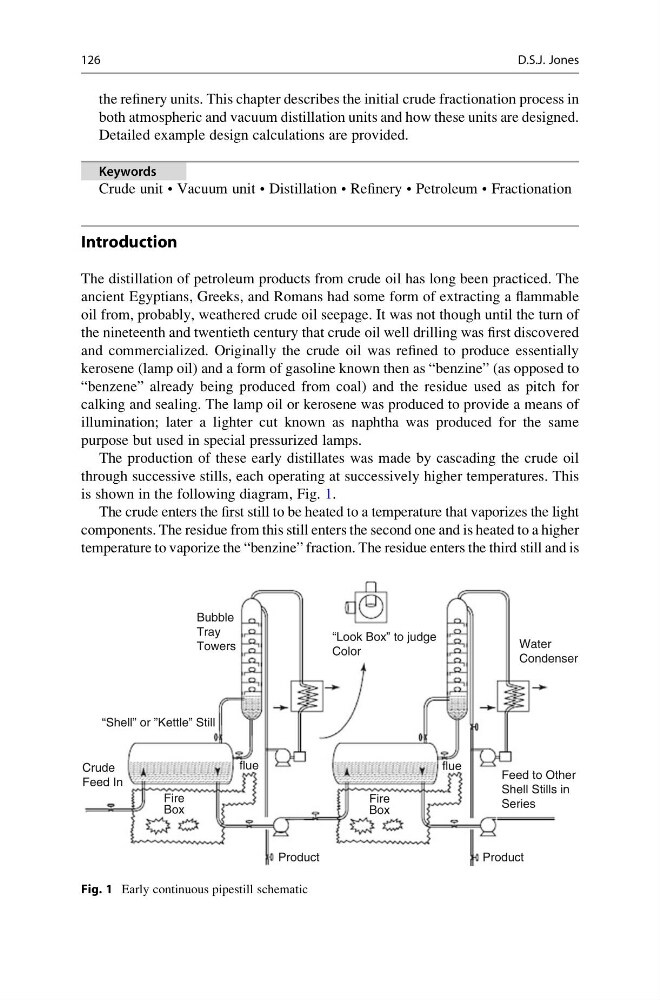
The production of these early distillates was made by cascading the crude oil
through successive stills, each operating at successively higher temperatures. This
is shown in the following diagram, Fig. 1.
The crude enters the first still to be heated to a temperature that vaporizes the light
components. The residue from this still enters the second one and is heated to a higher
temperature to vaporize the “benzine” fraction. The residue enters the third still and is
Bubble
Tray
Towers
“Look Box” to judge
Color
Water
Condenser
Feed to Other
Shell Stills in
Series
Product
“Shell” or ”Kettle” Still
Crude
Feed In
Fire
Box
Fire
Box
flue
Product
flue
Fig. 1 Early continuous pipestill schematic
126
D.S.J. Jones
both atmospheric and vacuum distillation units and how these units are designed.
Detailed example design calculations are provided.
Keywords
Crude unit • Vacuum unit • Distillation • Refinery • Petroleum • Fractionation
Introduction
The distillation of petroleum products from crude oil has long been practiced. The
ancient Egyptians, Greeks, and Romans had some form of extracting a flammable
oil from, probably, weathered crude oil seepage. It was not though until the turn of
the nineteenth and twentieth century that crude oil well drilling was first discovered
and commercialized. Originally the crude oil was refined to produce essentially
kerosene (lamp oil) and a form of gasoline known then as “benzine” (as opposed to
“benzene” already being produced from coal) and the residue used as pitch for
calking and sealing. The lamp oil or kerosene was produced to provide a means of
illumination; later a lighter cut known as naphtha was produced for the same
purpose but used in special pressurized lamps.
The production of these early distillates was made by cascading the crude oil
through successive stills, each operating at successively higher temperatures. This
is shown in the following diagram, Fig. 1.
The crude enters the first still to be heated to a temperature that vaporizes the light
components. The residue from this still enters the second one and is heated to a higher
temperature to vaporize the “benzine” fraction. The residue enters the third still and is
Bubble
Tray
Towers
“Look Box” to judge
Color
Water
Condenser
Feed to Other
Shell Stills in
Series
Product
“Shell” or ”Kettle” Still
Crude
Feed In
Fire
Box
Fire
Box
flue
Product
flue
Fig. 1 Early continuous pipestill schematic
126
D.S.J. Jones