

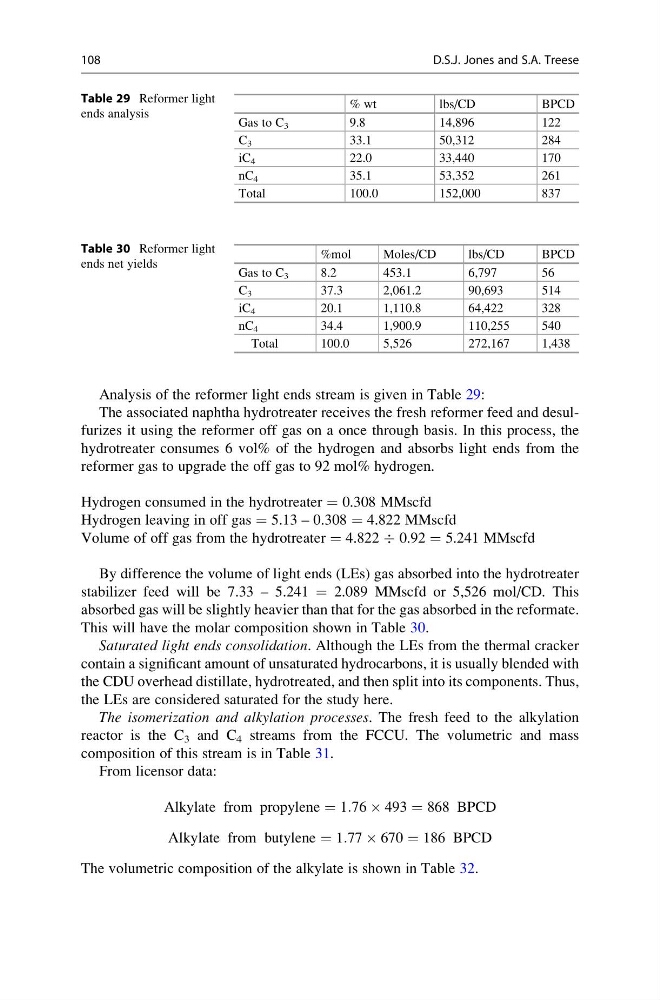
Analysis of the reformer light ends stream is given in Table 29:
The associated naphtha hydrotreater receives the fresh reformer feed and desulfurizes it using the reformer off gas on a once through basis. In this process, the
hydrotreater consumes 6 vol% of the hydrogen and absorbs light ends from the
reformer gas to upgrade the off gas to 92 mol% hydrogen.
Hydrogen consumed in the hydrotreater = 0.308 MMscfd
Hydrogen leaving in off gas = 5.13 – 0.308 = 4.822 MMscfd
Volume of off gas from the hydrotreater = 4.822 Ä 0.92 = 5.241 MMscfd
By difference the volume of light ends (LEs) gas absorbed into the hydrotreater
stabilizer feed will be 7.33 – 5.241 = 2.089 MMscfd or 5,526 mol/CD. This
absorbed gas will be slightly heavier than that for the gas absorbed in the reformate.
This will have the molar composition shown in Table 30.
Saturated light ends consolidation. Although the LEs from the thermal cracker
contain a significant amount of unsaturated hydrocarbons, it is usually blended with
the CDU overhead distillate, hydrotreated, and then split into its components. Thus,
the LEs are considered saturated for the study here.
The isomerization and alkylation processes. The fresh feed to the alkylation
reactor is the C 3 and C 4 streams from the FCCU. The volumetric and mass
composition of this stream is in Table 31.
From licensor data:
Alkylate from propylene ¼ 1:76 Â 493 ¼ 868 BPCD
Alkylate from butylene ¼ 1:77 Â 670 ¼ 186 BPCD
The volumetric composition of the alkylate is shown in Table 32.
Table 29 Reformer light
ends analysis
% wt
lbs/CD
BPCD
Gas to C 3
9.8
14,896
122
C 3
33.1
50,312
284
iC 4
22.0
33,440
170
nC 4
35.1
53,352
261
Total
100.0
152,000
837
Table 30 Reformer light
ends net yields
%mol
Moles/CD
lbs/CD
BPCD
Gas to C 3
8.2
453.1
6,797
56
C 3
37.3
2,061.2
90,693
514
iC 4
20.1
1,110.8
64,422
328
nC 4
34.4
1,900.9
110,255
540
Total
100.0
5,526
272,167
1,438
108
D.S.J. Jones and S.A. Treese
The associated naphtha hydrotreater receives the fresh reformer feed and desulfurizes it using the reformer off gas on a once through basis. In this process, the
hydrotreater consumes 6 vol% of the hydrogen and absorbs light ends from the
reformer gas to upgrade the off gas to 92 mol% hydrogen.
Hydrogen consumed in the hydrotreater = 0.308 MMscfd
Hydrogen leaving in off gas = 5.13 – 0.308 = 4.822 MMscfd
Volume of off gas from the hydrotreater = 4.822 Ä 0.92 = 5.241 MMscfd
By difference the volume of light ends (LEs) gas absorbed into the hydrotreater
stabilizer feed will be 7.33 – 5.241 = 2.089 MMscfd or 5,526 mol/CD. This
absorbed gas will be slightly heavier than that for the gas absorbed in the reformate.
This will have the molar composition shown in Table 30.
Saturated light ends consolidation. Although the LEs from the thermal cracker
contain a significant amount of unsaturated hydrocarbons, it is usually blended with
the CDU overhead distillate, hydrotreated, and then split into its components. Thus,
the LEs are considered saturated for the study here.
The isomerization and alkylation processes. The fresh feed to the alkylation
reactor is the C 3 and C 4 streams from the FCCU. The volumetric and mass
composition of this stream is in Table 31.
From licensor data:
Alkylate from propylene ¼ 1:76 Â 493 ¼ 868 BPCD
Alkylate from butylene ¼ 1:77 Â 670 ¼ 186 BPCD
The volumetric composition of the alkylate is shown in Table 32.
Table 29 Reformer light
ends analysis
% wt
lbs/CD
BPCD
Gas to C 3
9.8
14,896
122
C 3
33.1
50,312
284
iC 4
22.0
33,440
170
nC 4
35.1
53,352
261
Total
100.0
152,000
837
Table 30 Reformer light
ends net yields
%mol
Moles/CD
lbs/CD
BPCD
Gas to C 3
8.2
453.1
6,797
56
C 3
37.3
2,061.2
90,693
514
iC 4
20.1
1,110.8
64,422
328
nC 4
34.4
1,900.9
110,255
540
Total
100.0
5,526
272,167
1,438
108
D.S.J. Jones and S.A. Treese