

expense of the treated gas oil yield. These reactions double the hydrogen used in
this case. Hence:
Total chemical hydrogen required ¼ 1,866,878 Scf=CD this is from the licensor’s data
ð
Þ :
There will also be a loss of hydrogen from the system (mostly due to the flash drum
operation and purge (see the chapter entitled “▶ Hydrotreating in Petroleum
Processing” for more details)). This “purge and dissolved hydrogen loss” amounts
to 186,689 Scf (again from Licensor data).
Total hydrogen makeup required then ¼ 1,866, 878 þ 186,689
¼ 2,053,567 Scf=CD:
900
800
700
1700
1500
1100
900
100
90
80
% Vol
70
60
1300 °F
600
500
400
Temperature °F
300
200
Light Ends
Gas to C3
C3
IC 4
NC 4
Total Cut
% Vol On Cut
4.16
1.39
0.53
1.48
7.57
100
100
90
80
70
60
% Volume Distilled
50
40
30
20
10
0
0
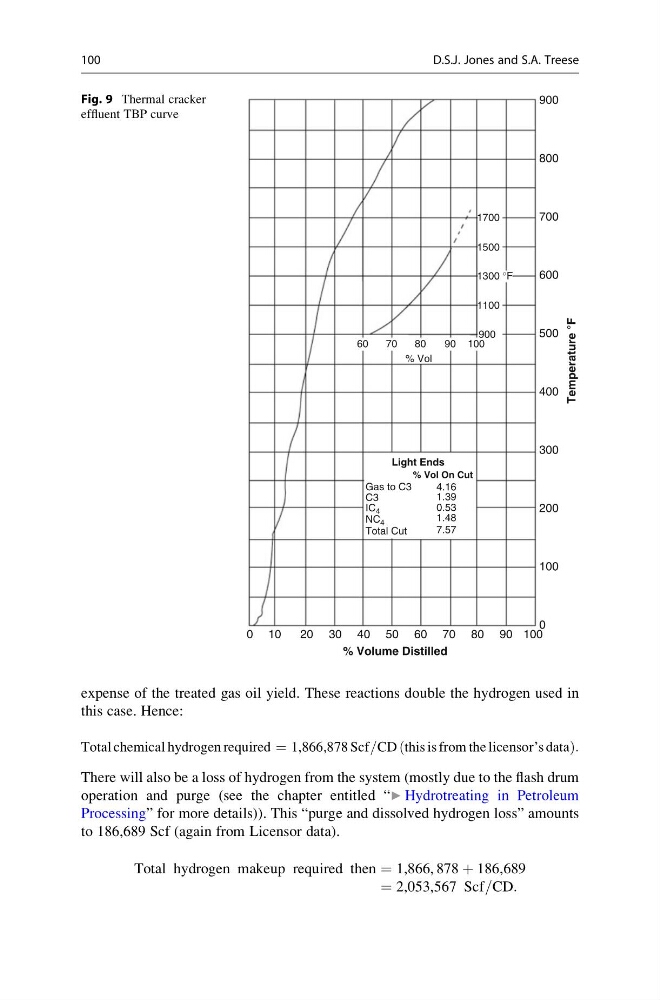
Fig. 9 Thermal cracker
effluent TBP curve
100
D.S.J. Jones and S.A. Treese
this case. Hence:
Total chemical hydrogen required ¼ 1,866,878 Scf=CD this is from the licensor’s data
ð
Þ :
There will also be a loss of hydrogen from the system (mostly due to the flash drum
operation and purge (see the chapter entitled “▶ Hydrotreating in Petroleum
Processing” for more details)). This “purge and dissolved hydrogen loss” amounts
to 186,689 Scf (again from Licensor data).
Total hydrogen makeup required then ¼ 1,866, 878 þ 186,689
¼ 2,053,567 Scf=CD:
900
800
700
1700
1500
1100
900
100
90
80
% Vol
70
60
1300 °F
600
500
400
Temperature °F
300
200
Light Ends
Gas to C3
C3
IC 4
NC 4
Total Cut
% Vol On Cut
4.16
1.39
0.53
1.48
7.57
100
100
90
80
70
60
% Volume Distilled
50
40
30
20
10
0
0
Fig. 9 Thermal cracker
effluent TBP curve
100
D.S.J. Jones and S.A. Treese