

• Fluid catalytic cracker (FCCU)
• Isomerization/alkylation plant
• Thermal cracker (TC)
• Gas treating and sulfur recovery processes
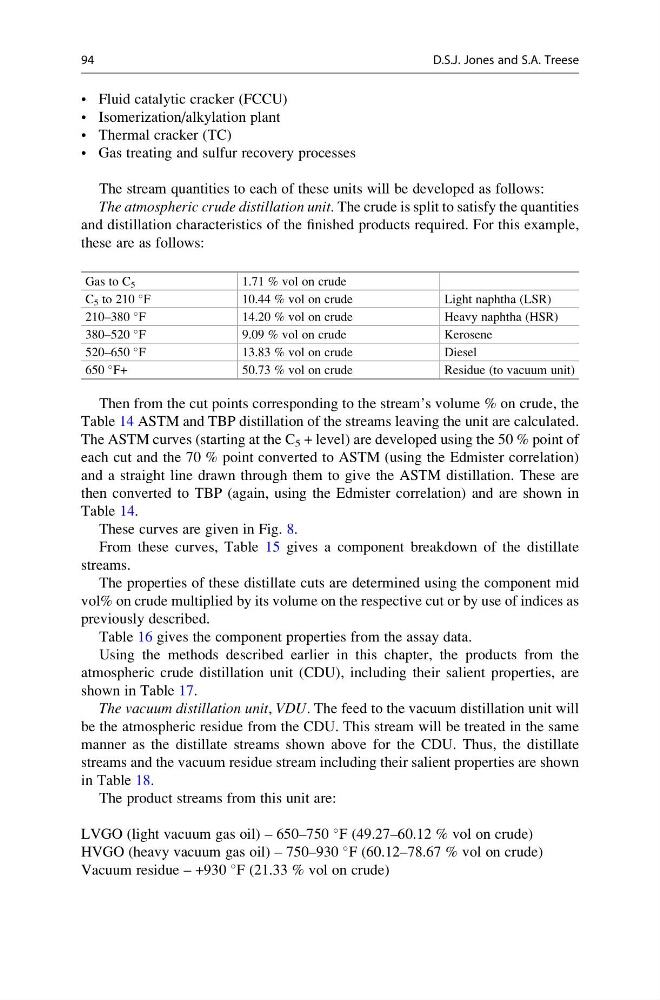
The stream quantities to each of these units will be developed as follows:
The atmospheric crude distillation unit. The crude is split to satisfy the quantities
and distillation characteristics of the finished products required. For this example,
these are as follows:
Gas to C 5
1.71 % vol on crude
C 5 to 210
F
10.44 % vol on crude
Light naphtha (LSR)
210–380
F
14.20 % vol on crude
Heavy naphtha (HSR)
380–520
F
9.09 % vol on crude
Kerosene
520–650
F
13.83 % vol on crude
Diesel
650
F+
50.73 % vol on crude
Residue (to vacuum unit)
Then from the cut points corresponding to the stream’s volume % on crude, the
Table 14 ASTM and TBP distillation of the streams leaving the unit are calculated.
The ASTM curves (starting at the C 5 + level) are developed using the 50 % point of
each cut and the 70 % point converted to ASTM (using the Edmister correlation)
and a straight line drawn through them to give the ASTM distillation. These are
then converted to TBP (again, using the Edmister correlation) and are shown in
Table 14.
These curves are given in Fig. 8.
From these curves, Table 15 gives a component breakdown of the distillate
streams.
The properties of these distillate cuts are determined using the component mid
vol% on crude multiplied by its volume on the respective cut or by use of indices as
previously described.
Table 16 gives the component properties from the assay data.
Using the methods described earlier in this chapter, the products from the
atmospheric crude distillation unit (CDU), including their salient properties, are
shown in Table 17.
The vacuum distillation unit, VDU. The feed to the vacuum distillation unit will
be the atmospheric residue from the CDU. This stream will be treated in the same
manner as the distillate streams shown above for the CDU. Thus, the distillate
streams and the vacuum residue stream including their salient properties are shown
in Table 18.
The product streams from this unit are:
LVGO (light vacuum gas oil) – 650–750
F (49.27–60.12 % vol on crude)
HVGO (heavy vacuum gas oil) – 750–930
F (60.12–78.67 % vol on crude)
Vacuum residue – +930
F (21.33 % vol on crude)
94
D.S.J. Jones and S.A. Treese
• Isomerization/alkylation plant
• Thermal cracker (TC)
• Gas treating and sulfur recovery processes
The stream quantities to each of these units will be developed as follows:
The atmospheric crude distillation unit. The crude is split to satisfy the quantities
and distillation characteristics of the finished products required. For this example,
these are as follows:
Gas to C 5
1.71 % vol on crude
C 5 to 210
F
10.44 % vol on crude
Light naphtha (LSR)
210–380
F
14.20 % vol on crude
Heavy naphtha (HSR)
380–520
F
9.09 % vol on crude
Kerosene
520–650
F
13.83 % vol on crude
Diesel
650
F+
50.73 % vol on crude
Residue (to vacuum unit)
Then from the cut points corresponding to the stream’s volume % on crude, the
Table 14 ASTM and TBP distillation of the streams leaving the unit are calculated.
The ASTM curves (starting at the C 5 + level) are developed using the 50 % point of
each cut and the 70 % point converted to ASTM (using the Edmister correlation)
and a straight line drawn through them to give the ASTM distillation. These are
then converted to TBP (again, using the Edmister correlation) and are shown in
Table 14.
These curves are given in Fig. 8.
From these curves, Table 15 gives a component breakdown of the distillate
streams.
The properties of these distillate cuts are determined using the component mid
vol% on crude multiplied by its volume on the respective cut or by use of indices as
previously described.
Table 16 gives the component properties from the assay data.
Using the methods described earlier in this chapter, the products from the
atmospheric crude distillation unit (CDU), including their salient properties, are
shown in Table 17.
The vacuum distillation unit, VDU. The feed to the vacuum distillation unit will
be the atmospheric residue from the CDU. This stream will be treated in the same
manner as the distillate streams shown above for the CDU. Thus, the distillate
streams and the vacuum residue stream including their salient properties are shown
in Table 18.
The product streams from this unit are:
LVGO (light vacuum gas oil) – 650–750
F (49.27–60.12 % vol on crude)
HVGO (heavy vacuum gas oil) – 750–930
F (60.12–78.67 % vol on crude)
Vacuum residue – +930
F (21.33 % vol on crude)
94
D.S.J. Jones and S.A. Treese