

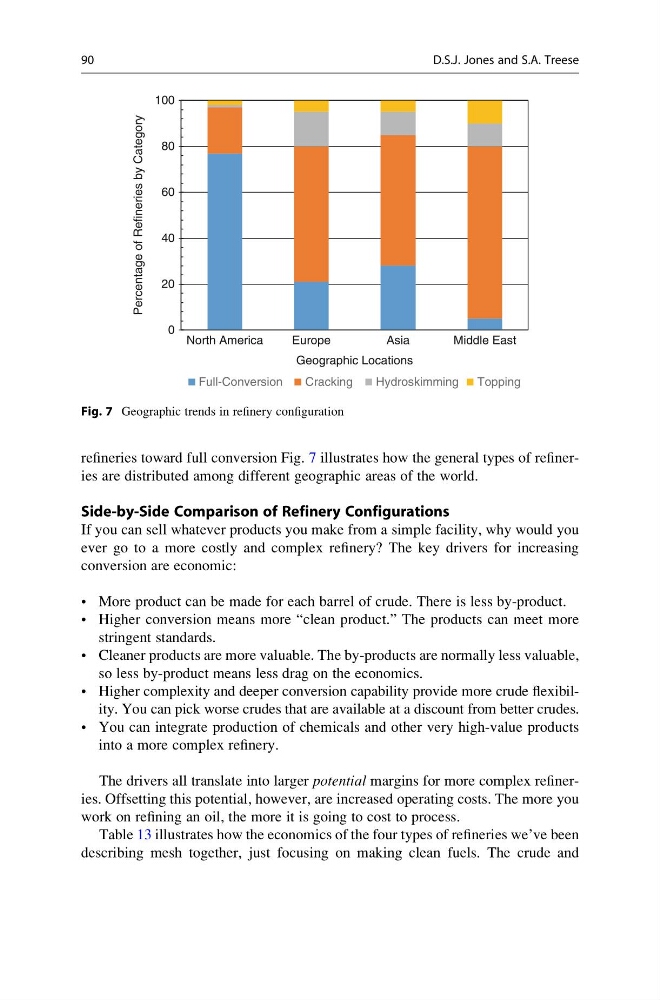
refineries toward full conversion Fig. 7 illustrates how the general types of refineries are distributed among different geographic areas of the world.
Side-by-Side Comparison of Refinery Configurations
If you can sell whatever products you make from a simple facility, why would you
ever go to a more costly and complex refinery? The key drivers for increasing
conversion are economic:
• More product can be made for each barrel of crude. There is less by-product.
• Higher conversion means more “clean product.” The products can meet more
stringent standards.
• Cleaner products are more valuable. The by-products are normally less valuable,
so less by-product means less drag on the economics.
• Higher complexity and deeper conversion capability provide more crude flexibility. You can pick worse crudes that are available at a discount from better crudes.
• You can integrate production of chemicals and other very high-value products
into a more complex refinery.
The drivers all translate into larger potential margins for more complex refineries. Offsetting this potential, however, are increased operating costs. The more you
work on refining an oil, the more it is going to cost to process.
Table 13 illustrates how the economics of the four types of refineries we’ve been
describing mesh together, just focusing on making clean fuels. The crude and
0
20
40
60
80
100
North America
Europe
Asia
Middle East
Percentage of Refineries by Category
Geographic Locations
Full-Conversion
Cracking
Hydroskimming
Topping
Fig. 7 Geographic trends in refinery configuration
90
D.S.J. Jones and S.A. Treese
Side-by-Side Comparison of Refinery Configurations
If you can sell whatever products you make from a simple facility, why would you
ever go to a more costly and complex refinery? The key drivers for increasing
conversion are economic:
• More product can be made for each barrel of crude. There is less by-product.
• Higher conversion means more “clean product.” The products can meet more
stringent standards.
• Cleaner products are more valuable. The by-products are normally less valuable,
so less by-product means less drag on the economics.
• Higher complexity and deeper conversion capability provide more crude flexibility. You can pick worse crudes that are available at a discount from better crudes.
• You can integrate production of chemicals and other very high-value products
into a more complex refinery.
The drivers all translate into larger potential margins for more complex refineries. Offsetting this potential, however, are increased operating costs. The more you
work on refining an oil, the more it is going to cost to process.
Table 13 illustrates how the economics of the four types of refineries we’ve been
describing mesh together, just focusing on making clean fuels. The crude and
0
20
40
60
80
100
North America
Europe
Asia
Middle East
Percentage of Refineries by Category
Geographic Locations
Full-Conversion
Cracking
Hydroskimming
Topping
Fig. 7 Geographic trends in refinery configuration
90
D.S.J. Jones and S.A. Treese