

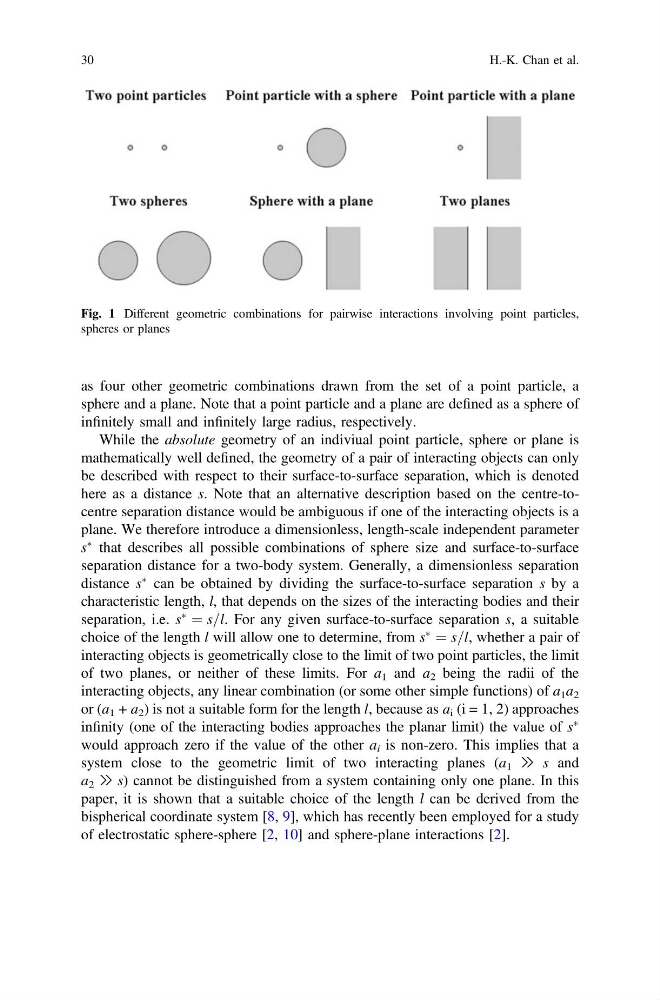
as four other geometric combinations drawn from the set of a point particle, a
sphere and a plane. Note that a point particle and a plane are defined as a sphere of
infinitely small and infinitely large radius, respectively.
While the absolute geometry of an indiviual point particle, sphere or plane is
mathematically well defined, the geometry of a pair of interacting objects can only
be described with respect to their surface-to-surface separation, which is denoted
here as a distance s. Note that an alternative description based on the centre-tocentre separation distance would be ambiguous if one of the interacting objects is a
plane. We therefore introduce a dimensionless, length-scale independent parameter
s
à that describes all possible combinations of sphere size and surface-to-surface
separation distance for a two-body system. Generally, a dimensionless separation
distance s
à can be obtained by dividing the surface-to-surface separation s by a
characteristic length, l, that depends on the sizes of the interacting bodies and their
separation, i.e. s
Ã
¼ s=l. For any given surface-to-surface separation s, a suitable
choice of the length l will allow one to determine, from s
Ã
¼ s=l, whether a pair of
interacting objects is geometrically close to the limit of two point particles, the limit
of two planes, or neither of these limits. For a 1 and a 2 being the radii of the
interacting objects, any linear combination (or some other simple functions) of a 1 a 2
or (a 1 + a 2 ) is not a suitable form for the length l, because as a i (i = 1, 2) approaches
infinity (one of the interacting bodies approaches the planar limit) the value of s
Ã
would approach zero if the value of the other a i is non-zero. This implies that a
system close to the geometric limit of two interacting planes (a 1 ≫ s and
a 2 ≫ s) cannot be distinguished from a system containing only one plane. In this
paper, it is shown that a suitable choice of the length l can be derived from the
bispherical coordinate system [8, 9], which has recently been employed for a study
of electrostatic sphere-sphere [2, 10] and sphere-plane interactions [2].
Fig. 1 Different geometric combinations for pairwise interactions involving point particles,
spheres or planes
30
H.-K. Chan et al.
sphere and a plane. Note that a point particle and a plane are defined as a sphere of
infinitely small and infinitely large radius, respectively.
While the absolute geometry of an indiviual point particle, sphere or plane is
mathematically well defined, the geometry of a pair of interacting objects can only
be described with respect to their surface-to-surface separation, which is denoted
here as a distance s. Note that an alternative description based on the centre-tocentre separation distance would be ambiguous if one of the interacting objects is a
plane. We therefore introduce a dimensionless, length-scale independent parameter
s
à that describes all possible combinations of sphere size and surface-to-surface
separation distance for a two-body system. Generally, a dimensionless separation
distance s
à can be obtained by dividing the surface-to-surface separation s by a
characteristic length, l, that depends on the sizes of the interacting bodies and their
separation, i.e. s
Ã
¼ s=l. For any given surface-to-surface separation s, a suitable
choice of the length l will allow one to determine, from s
Ã
¼ s=l, whether a pair of
interacting objects is geometrically close to the limit of two point particles, the limit
of two planes, or neither of these limits. For a 1 and a 2 being the radii of the
interacting objects, any linear combination (or some other simple functions) of a 1 a 2
or (a 1 + a 2 ) is not a suitable form for the length l, because as a i (i = 1, 2) approaches
infinity (one of the interacting bodies approaches the planar limit) the value of s
Ã
would approach zero if the value of the other a i is non-zero. This implies that a
system close to the geometric limit of two interacting planes (a 1 ≫ s and
a 2 ≫ s) cannot be distinguished from a system containing only one plane. In this
paper, it is shown that a suitable choice of the length l can be derived from the
bispherical coordinate system [8, 9], which has recently been employed for a study
of electrostatic sphere-sphere [2, 10] and sphere-plane interactions [2].
Fig. 1 Different geometric combinations for pairwise interactions involving point particles,
spheres or planes
30
H.-K. Chan et al.