

Often testing the stability of the wave function based on the orbital Hessian
matrix can be unnecessary due to the optimization technique employed. One such
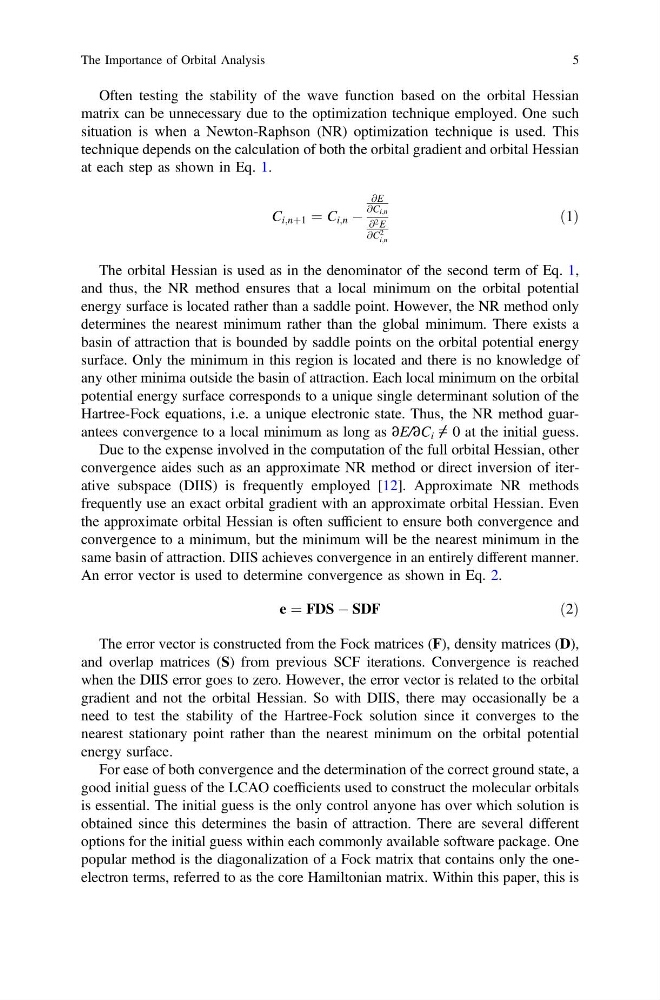
situation is when a Newton-Raphson (NR) optimization technique is used. This
technique depends on the calculation of both the orbital gradient and orbital Hessian
at each step as shown in Eq. 1.
C i;nþ1 ¼ C i;n À
@E
@C i;n
@ 2 E
@C 2
i;n
ð1Þ
The orbital Hessian is used as in the denominator of the second term of Eq. 1,
and thus, the NR method ensures that a local minimum on the orbital potential
energy surface is located rather than a saddle point. However, the NR method only
determines the nearest minimum rather than the global minimum. There exists a
basin of attraction that is bounded by saddle points on the orbital potential energy
surface. Only the minimum in this region is located and there is no knowledge of
any other minima outside the basin of attraction. Each local minimum on the orbital
potential energy surface corresponds to a unique single determinant solution of the
Hartree-Fock equations, i.e. a unique electronic state. Thus, the NR method guarantees convergence to a local minimum as long as ∂E/∂C i ≠ 0 at the initial guess.
Due to the expense involved in the computation of the full orbital Hessian, other
convergence aides such as an approximate NR method or direct inversion of iterative subspace (DIIS) is frequently employed [12]. Approximate NR methods
frequently use an exact orbital gradient with an approximate orbital Hessian. Even
the approximate orbital Hessian is often sufficient to ensure both convergence and
convergence to a minimum, but the minimum will be the nearest minimum in the
same basin of attraction. DIIS achieves convergence in an entirely different manner.
An error vector is used to determine convergence as shown in Eq. 2.
e ¼ FDS À SDF
ð2Þ
The error vector is constructed from the Fock matrices (F), density matrices (D),
and overlap matrices (S) from previous SCF iterations. Convergence is reached
when the DIIS error goes to zero. However, the error vector is related to the orbital
gradient and not the orbital Hessian. So with DIIS, there may occasionally be a
need to test the stability of the Hartree-Fock solution since it converges to the
nearest stationary point rather than the nearest minimum on the orbital potential
energy surface.
For ease of both convergence and the determination of the correct ground state, a
good initial guess of the LCAO coefficients used to construct the molecular orbitals
is essential. The initial guess is the only control anyone has over which solution is
obtained since this determines the basin of attraction. There are several different
options for the initial guess within each commonly available software package. One
popular method is the diagonalization of a Fock matrix that contains only the oneelectron terms, referred to as the core Hamiltonian matrix. Within this paper, this is
The Importance of Orbital Analysis
5
matrix can be unnecessary due to the optimization technique employed. One such
situation is when a Newton-Raphson (NR) optimization technique is used. This
technique depends on the calculation of both the orbital gradient and orbital Hessian
at each step as shown in Eq. 1.
C i;nþ1 ¼ C i;n À
@E
@C i;n
@ 2 E
@C 2
i;n
ð1Þ
The orbital Hessian is used as in the denominator of the second term of Eq. 1,
and thus, the NR method ensures that a local minimum on the orbital potential
energy surface is located rather than a saddle point. However, the NR method only
determines the nearest minimum rather than the global minimum. There exists a
basin of attraction that is bounded by saddle points on the orbital potential energy
surface. Only the minimum in this region is located and there is no knowledge of
any other minima outside the basin of attraction. Each local minimum on the orbital
potential energy surface corresponds to a unique single determinant solution of the
Hartree-Fock equations, i.e. a unique electronic state. Thus, the NR method guarantees convergence to a local minimum as long as ∂E/∂C i ≠ 0 at the initial guess.
Due to the expense involved in the computation of the full orbital Hessian, other
convergence aides such as an approximate NR method or direct inversion of iterative subspace (DIIS) is frequently employed [12]. Approximate NR methods
frequently use an exact orbital gradient with an approximate orbital Hessian. Even
the approximate orbital Hessian is often sufficient to ensure both convergence and
convergence to a minimum, but the minimum will be the nearest minimum in the
same basin of attraction. DIIS achieves convergence in an entirely different manner.
An error vector is used to determine convergence as shown in Eq. 2.
e ¼ FDS À SDF
ð2Þ
The error vector is constructed from the Fock matrices (F), density matrices (D),
and overlap matrices (S) from previous SCF iterations. Convergence is reached
when the DIIS error goes to zero. However, the error vector is related to the orbital
gradient and not the orbital Hessian. So with DIIS, there may occasionally be a
need to test the stability of the Hartree-Fock solution since it converges to the
nearest stationary point rather than the nearest minimum on the orbital potential
energy surface.
For ease of both convergence and the determination of the correct ground state, a
good initial guess of the LCAO coefficients used to construct the molecular orbitals
is essential. The initial guess is the only control anyone has over which solution is
obtained since this determines the basin of attraction. There are several different
options for the initial guess within each commonly available software package. One
popular method is the diagonalization of a Fock matrix that contains only the oneelectron terms, referred to as the core Hamiltonian matrix. Within this paper, this is
The Importance of Orbital Analysis
5