

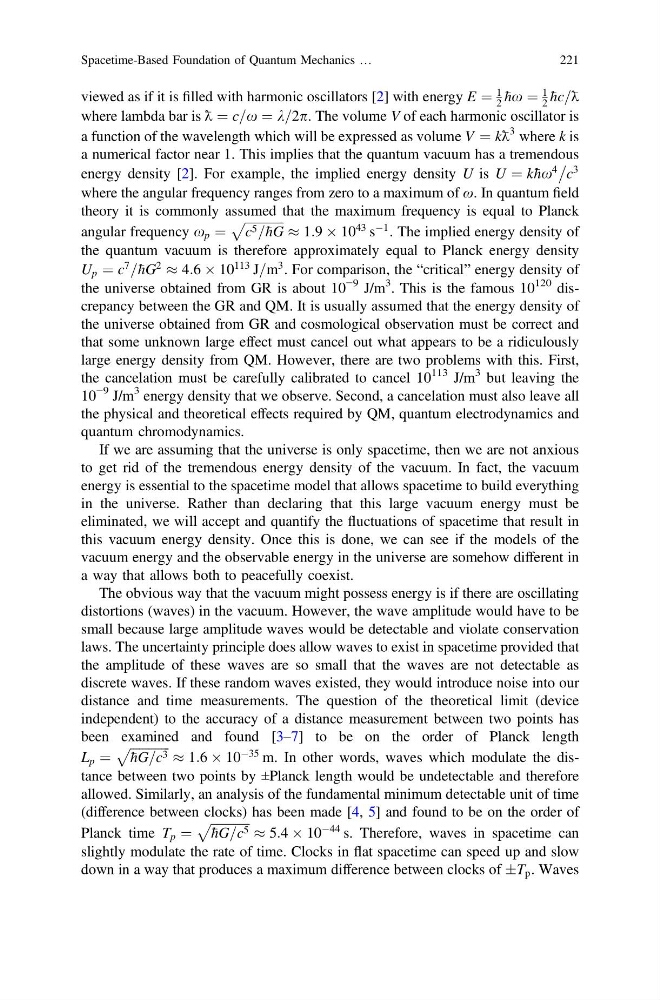
viewed as if it is filled with harmonic oscillators [2] with energy E ¼
1
2 hx ¼
1
2 hc= k
where lambda bar is
k ¼ c=x ¼ k=2p. The volume V of each harmonic oscillator is
a function of the wavelength which will be expressed as volume V ¼ k k
3 where k is
a numerical factor near 1. This implies that the quantum vacuum has a tremendous
energy density [2]. For example, the implied energy density U is U ¼ k hx
4
c
3
where the angular frequency ranges from zero to a maximum of ω. In quantum field
theory it is commonly assumed that the maximum frequency is equal to Planck
angular frequency x p ¼
ffiffiffiffiffiffiffiffiffiffiffiffi ffi
c 5 = hG
p
% 1:9 Â 10
43 s
À1 . The implied energy density of
the quantum vacuum is therefore approximately equal to Planck energy density
U p ¼ c
7
= hG
2
% 4:6 Â 10
113 J=m
3 . For comparison, the “critical” energy density of
the universe obtained from GR is about 10
−9 J/m
3 . This is the famous 10
120 discrepancy between the GR and QM. It is usually assumed that the energy density of
the universe obtained from GR and cosmological observation must be correct and
that some unknown large effect must cancel out what appears to be a ridiculously
large energy density from QM. However, there are two problems with this. First,
the cancelation must be carefully calibrated to cancel 10
113 J/m
3 but leaving the
10
−9 J/m
3 energy density that we observe. Second, a cancelation must also leave all
the physical and theoretical effects required by QM, quantum electrodynamics and
quantum chromodynamics.
If we are assuming that the universe is only spacetime, then we are not anxious
to get rid of the tremendous energy density of the vacuum. In fact, the vacuum
energy is essential to the spacetime model that allows spacetime to build everything
in the universe. Rather than declaring that this large vacuum energy must be
eliminated, we will accept and quantify the fluctuations of spacetime that result in
this vacuum energy density. Once this is done, we can see if the models of the
vacuum energy and the observable energy in the universe are somehow different in
a way that allows both to peacefully coexist.
The obvious way that the vacuum might possess energy is if there are oscillating
distortions (waves) in the vacuum. However, the wave amplitude would have to be
small because large amplitude waves would be detectable and violate conservation
laws. The uncertainty principle does allow waves to exist in spacetime provided that
the amplitude of these waves are so small that the waves are not detectable as
discrete waves. If these random waves existed, they would introduce noise into our
distance and time measurements. The question of the theoretical limit (device
independent) to the accuracy of a distance measurement between two points has
been examined and found [3–7] to be on the order of Planck length
L p ¼
ffiffiffiffiffiffiffiffiffiffiffiffi ffi
hG=c 3
p
% 1:6 Â 10
À35 m. In other words, waves which modulate the distance between two points by ±Planck length would be undetectable and therefore
allowed. Similarly, an analysis of the fundamental minimum detectable unit of time
(difference between clocks) has been made [4, 5] and found to be on the order of
Planck time T p ¼
ffiffiffiffiffiffiffiffiffiffiffiffi ffi
hG=c 5
p
% 5:4 Â 10
À44 s. Therefore, waves in spacetime can
slightly modulate the rate of time. Clocks in flat spacetime can speed up and slow
down in a way that produces a maximum difference between clocks of ÆT p . Waves
Spacetime-Based Foundation of Quantum Mechanics …
221
1
2 hx ¼
1
2 hc= k
where lambda bar is
k ¼ c=x ¼ k=2p. The volume V of each harmonic oscillator is
a function of the wavelength which will be expressed as volume V ¼ k k
3 where k is
a numerical factor near 1. This implies that the quantum vacuum has a tremendous
energy density [2]. For example, the implied energy density U is U ¼ k hx
4
c
3
where the angular frequency ranges from zero to a maximum of ω. In quantum field
theory it is commonly assumed that the maximum frequency is equal to Planck
angular frequency x p ¼
ffiffiffiffiffiffiffiffiffiffiffiffi ffi
c 5 = hG
p
% 1:9 Â 10
43 s
À1 . The implied energy density of
the quantum vacuum is therefore approximately equal to Planck energy density
U p ¼ c
7
= hG
2
% 4:6 Â 10
113 J=m
3 . For comparison, the “critical” energy density of
the universe obtained from GR is about 10
−9 J/m
3 . This is the famous 10
120 discrepancy between the GR and QM. It is usually assumed that the energy density of
the universe obtained from GR and cosmological observation must be correct and
that some unknown large effect must cancel out what appears to be a ridiculously
large energy density from QM. However, there are two problems with this. First,
the cancelation must be carefully calibrated to cancel 10
113 J/m
3 but leaving the
10
−9 J/m
3 energy density that we observe. Second, a cancelation must also leave all
the physical and theoretical effects required by QM, quantum electrodynamics and
quantum chromodynamics.
If we are assuming that the universe is only spacetime, then we are not anxious
to get rid of the tremendous energy density of the vacuum. In fact, the vacuum
energy is essential to the spacetime model that allows spacetime to build everything
in the universe. Rather than declaring that this large vacuum energy must be
eliminated, we will accept and quantify the fluctuations of spacetime that result in
this vacuum energy density. Once this is done, we can see if the models of the
vacuum energy and the observable energy in the universe are somehow different in
a way that allows both to peacefully coexist.
The obvious way that the vacuum might possess energy is if there are oscillating
distortions (waves) in the vacuum. However, the wave amplitude would have to be
small because large amplitude waves would be detectable and violate conservation
laws. The uncertainty principle does allow waves to exist in spacetime provided that
the amplitude of these waves are so small that the waves are not detectable as
discrete waves. If these random waves existed, they would introduce noise into our
distance and time measurements. The question of the theoretical limit (device
independent) to the accuracy of a distance measurement between two points has
been examined and found [3–7] to be on the order of Planck length
L p ¼
ffiffiffiffiffiffiffiffiffiffiffiffi ffi
hG=c 3
p
% 1:6 Â 10
À35 m. In other words, waves which modulate the distance between two points by ±Planck length would be undetectable and therefore
allowed. Similarly, an analysis of the fundamental minimum detectable unit of time
(difference between clocks) has been made [4, 5] and found to be on the order of
Planck time T p ¼
ffiffiffiffiffiffiffiffiffiffiffiffi ffi
hG=c 5
p
% 5:4 Â 10
À44 s. Therefore, waves in spacetime can
slightly modulate the rate of time. Clocks in flat spacetime can speed up and slow
down in a way that produces a maximum difference between clocks of ÆT p . Waves
Spacetime-Based Foundation of Quantum Mechanics …
221