

Keywords Relativistic quantum chemistry Á Green’s function method Á Dirac
equation with complex energy Á Relativistic mean-field nuclear potential Á Fermi
model potential
1 Introduction
As it is well known, in quantum mechanics and quantum field theory, the probability amplitude for a quantum particle to travel from one place to another in a given
time, or to travel with a certain energy and momentum is given by the propagator
[1–8]. Since the propagator or Green’s function of the wave equation was introduced to calculate the scattering matrix by Stückelberg and Feynman [1, 2], it has
become an important tool of quantum field theory [5–7]. As usually, in the Feynman diagrams, which describe the rate of collisions in quantum field theory,
virtual particles contribute their propagator to the rate of the scattering event
described by the diagram. They also can be viewed as the inverse of the wave
operator appropriate to the particle, and are called as Green’s functions. The
Green’s function plays a central, very important role as in atomic and molecular
physics as in the statistical physics, physics of plasma and solids physics. A
development of the effective analytical and numerical algorithms for computing the
electron Green’s function of the Dirac equation with arbitrary central potential and
complex energy is of great importance in a modern relativistic many-body theory
[1–52]. One could guess that the different fundamental characteristics of the atomic
and molecular systems can be expressed through the electron and photon Green’s
functions. Usually the energy corrections to levels and oscillation strengths in
quantum theory of atoms and molecules are defined by the electron Green’s
function with a complex energy parameter E and integration on E is spread on the
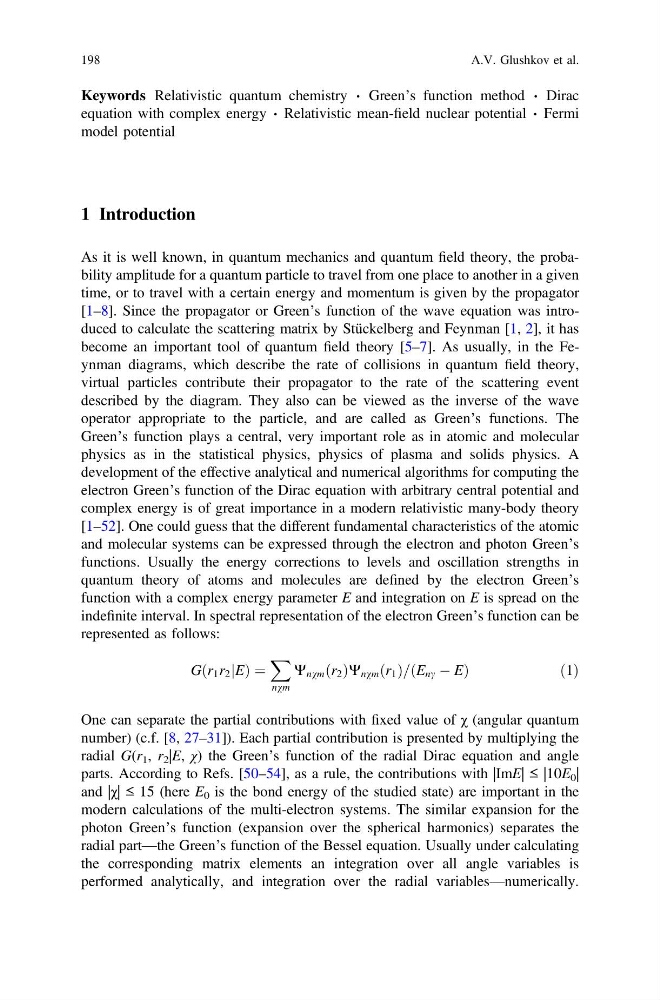
indefinite interval. In spectral representation of the electron Green’s function can be
represented as follows:
Gðr 1 r 2 jEÞ ¼
X
nvm
W nvm ðr 2 ÞW nvm ðr 1 Þ=ðE nc À EÞ
ð 1Þ
One can separate the partial contributions with fixed value of χ (angular quantum
number) (c.f. [8, 27–31]). Each partial contribution is presented by multiplying the
radial G(r 1 , r 2 |E, χ) the Green’s function of the radial Dirac equation and angle
parts. According to Refs. [50–54], as a rule, the contributions with |ImE| ≤ |10E 0 |
and |χ| ≤ 15 (here E 0 is the bond energy of the studied state) are important in the
modern calculations of the multi-electron systems. The similar expansion for the
photon Green’s function (expansion over the spherical harmonics) separates the
radial part—the Green’s function of the Bessel equation. Usually under calculating
the corresponding matrix elements an integration over all angle variables is
performed analytically, and integration over the radial variables—numerically.
198
A.V. Glushkov et al.
equation with complex energy Á Relativistic mean-field nuclear potential Á Fermi
model potential
1 Introduction
As it is well known, in quantum mechanics and quantum field theory, the probability amplitude for a quantum particle to travel from one place to another in a given
time, or to travel with a certain energy and momentum is given by the propagator
[1–8]. Since the propagator or Green’s function of the wave equation was introduced to calculate the scattering matrix by Stückelberg and Feynman [1, 2], it has
become an important tool of quantum field theory [5–7]. As usually, in the Feynman diagrams, which describe the rate of collisions in quantum field theory,
virtual particles contribute their propagator to the rate of the scattering event
described by the diagram. They also can be viewed as the inverse of the wave
operator appropriate to the particle, and are called as Green’s functions. The
Green’s function plays a central, very important role as in atomic and molecular
physics as in the statistical physics, physics of plasma and solids physics. A
development of the effective analytical and numerical algorithms for computing the
electron Green’s function of the Dirac equation with arbitrary central potential and
complex energy is of great importance in a modern relativistic many-body theory
[1–52]. One could guess that the different fundamental characteristics of the atomic
and molecular systems can be expressed through the electron and photon Green’s
functions. Usually the energy corrections to levels and oscillation strengths in
quantum theory of atoms and molecules are defined by the electron Green’s
function with a complex energy parameter E and integration on E is spread on the
indefinite interval. In spectral representation of the electron Green’s function can be
represented as follows:
Gðr 1 r 2 jEÞ ¼
X
nvm
W nvm ðr 2 ÞW nvm ðr 1 Þ=ðE nc À EÞ
ð 1Þ
One can separate the partial contributions with fixed value of χ (angular quantum
number) (c.f. [8, 27–31]). Each partial contribution is presented by multiplying the
radial G(r 1 , r 2 |E, χ) the Green’s function of the radial Dirac equation and angle
parts. According to Refs. [50–54], as a rule, the contributions with |ImE| ≤ |10E 0 |
and |χ| ≤ 15 (here E 0 is the bond energy of the studied state) are important in the
modern calculations of the multi-electron systems. The similar expansion for the
photon Green’s function (expansion over the spherical harmonics) separates the
radial part—the Green’s function of the Bessel equation. Usually under calculating
the corresponding matrix elements an integration over all angle variables is
performed analytically, and integration over the radial variables—numerically.
198
A.V. Glushkov et al.