

More detailed investigations are necessary, however, in order to make a true
prediction for the diffusion rate of H/Pd(111). These studies, which include a more
realistic modeling of vibrational lifetimes, are currently being carried out. It can be
shown that the variation range of the diffusion rate increases, if a much larger value
of the intrinsic broadening is assumed, meaning a much shorter relaxation time due
to “friction”. Relaxation times shorter than those assumed here for hydrogen on
ruthenium or palladium can indeed be expected from theory [20].
A second investigation route includes the study of di-hydrogen structures. It is
known that hydrogen atoms, even if adsorbed at low coverage degrees, form
clusters of di-hydrogen on the substrate [21]. H 2 dissociates upon adsorption on
0
0.1
0.2
0.3
0.4
0.5
0
1
2
3
4
5
S(q,E)/S(q,0)
E / meV
q / Å
−1
0.38
0.95
1.52
1.89
2.46
2.84
3.40
3.78
0.5
500
501
502
E / μeV
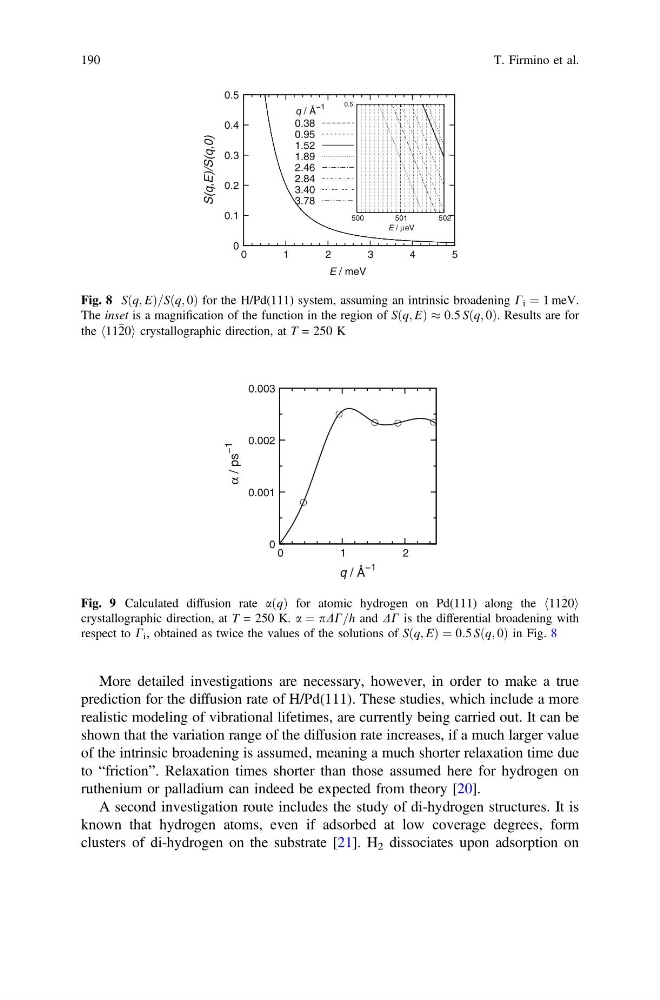
Fig. 8 Sðq; EÞ=Sðq; 0Þ for the H/Pd(111) system, assuming an intrinsic broadening C i ¼ 1 meV.
The inset is a magnification of the function in the region of Sðq; EÞ % 0:5 Sðq; 0Þ. Results are for
the h11 20i crystallographic direction, at T = 250 K
0
0.001
0.002
0.003
0
1
2
α / ps
−1
q / Å
−1
Fig. 9 Calculated diffusion rate aðqÞ for atomic hydrogen on Pd(111) along the h11 20i
crystallographic direction, at T = 250 K. a ¼ pDC=h and DC is the differential broadening with
respect to C i , obtained as twice the values of the solutions of Sðq; EÞ ¼ 0:5 Sðq; 0Þ in Fig. 8
190
T. Firmino et al.
prediction for the diffusion rate of H/Pd(111). These studies, which include a more
realistic modeling of vibrational lifetimes, are currently being carried out. It can be
shown that the variation range of the diffusion rate increases, if a much larger value
of the intrinsic broadening is assumed, meaning a much shorter relaxation time due
to “friction”. Relaxation times shorter than those assumed here for hydrogen on
ruthenium or palladium can indeed be expected from theory [20].
A second investigation route includes the study of di-hydrogen structures. It is
known that hydrogen atoms, even if adsorbed at low coverage degrees, form
clusters of di-hydrogen on the substrate [21]. H 2 dissociates upon adsorption on
0
0.1
0.2
0.3
0.4
0.5
0
1
2
3
4
5
S(q,E)/S(q,0)
E / meV
q / Å
−1
0.38
0.95
1.52
1.89
2.46
2.84
3.40
3.78
0.5
500
501
502
E / μeV
Fig. 8 Sðq; EÞ=Sðq; 0Þ for the H/Pd(111) system, assuming an intrinsic broadening C i ¼ 1 meV.
The inset is a magnification of the function in the region of Sðq; EÞ % 0:5 Sðq; 0Þ. Results are for
the h11 20i crystallographic direction, at T = 250 K
0
0.001
0.002
0.003
0
1
2
α / ps
−1
q / Å
−1
Fig. 9 Calculated diffusion rate aðqÞ for atomic hydrogen on Pd(111) along the h11 20i
crystallographic direction, at T = 250 K. a ¼ pDC=h and DC is the differential broadening with
respect to C i , obtained as twice the values of the solutions of Sðq; EÞ ¼ 0:5 Sðq; 0Þ in Fig. 8
190
T. Firmino et al.