

integrator and eigenfunctions are calculated individually with the mode eigenfunction selector (meignf) in the initial wave function section.
For the H/Pd(111) system, the analytical model potential was used to generate a
natural potential representation [13, 14] with the aid of the “potfit” program contained in the MCTDH program package. Eigenfunctions were then calculated
within the MCTDH program with the aid of the “block relaxation method” [15]
(here, the version 84.8 of the MCTDH code was used).
The matrix elements of the e
iqx operator are calculated for several values of
q with the crosscorr utility program contained in the MCTDH program package.
Matrix elements obtained in this way were tested analytically for the particle in the
box problem (i.e. when V 2 % 0 with the Model 1 potential used to describe the CO/
Cu(100) system, see above). Because the potential energy surface commutes with
the parity operator, jhmje
iqx
jnij ¼ jhnje
iqx
jmij, hence only the upper half of this
matrix needs to be computed.
Calculations for the CO/Cu(100) system were carried out on a grid ranging from
−383.4 to 383.4 pm for the coordinate of the carbon atom that links two nearest Cu
atoms (the Cu-Cu distance is fixed to its bulk value 255.6 pm [16]). This corresponds to including 3 Wigner-Seitz surface cells in the grid. A FFT discrete variable
representation (DVR) was used with a basis set of 72 functions. The equations of
motion were solved with the “short iterative Lanczos” (SIL/ALL) integrator, a
maximal order of 20, an accuracy parameter of 10
−8 and parameters
eps_inv = eps_no = 10
−8 (see also [12] and [17] for the definition of the acronyms
and the related parameters). For this system, the CO mass of 27.9949 Da was used.
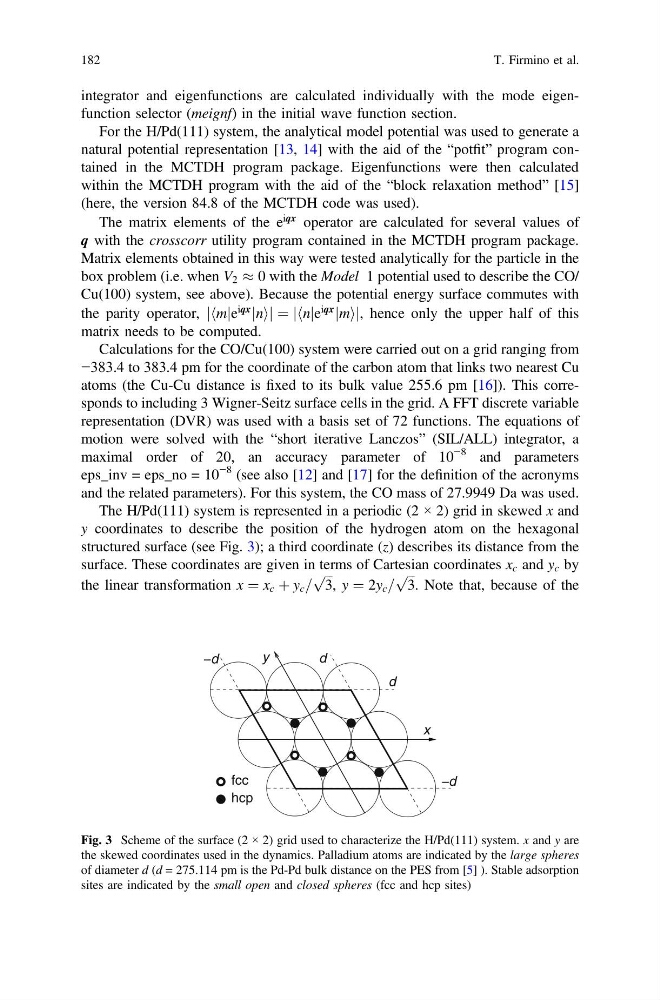
The H/Pd(111) system is represented in a periodic (2 × 2) grid in skewed x and
y coordinates to describe the position of the hydrogen atom on the hexagonal
structured surface (see Fig. 3); a third coordinate (z) describes its distance from the
surface. These coordinates are given in terms of Cartesian coordinates x c and y c by
the linear transformation x ¼ x c þ y c =
ffiffi ffi
3
p
, y ¼ 2y c =
ffiffi ffi
3
p
. Note that, because of the
fcc
hcp
x
d
−d
y
−d
d
Fig. 3 Scheme of the surface (2 × 2) grid used to characterize the H/Pd(111) system. x and y are
the skewed coordinates used in the dynamics. Palladium atoms are indicated by the large spheres
of diameter d (d = 275.114 pm is the Pd-Pd bulk distance on the PES from [5] ). Stable adsorption
sites are indicated by the small open and closed spheres (fcc and hcp sites)
182
T. Firmino et al.
For the H/Pd(111) system, the analytical model potential was used to generate a
natural potential representation [13, 14] with the aid of the “potfit” program contained in the MCTDH program package. Eigenfunctions were then calculated
within the MCTDH program with the aid of the “block relaxation method” [15]
(here, the version 84.8 of the MCTDH code was used).
The matrix elements of the e
iqx operator are calculated for several values of
q with the crosscorr utility program contained in the MCTDH program package.
Matrix elements obtained in this way were tested analytically for the particle in the
box problem (i.e. when V 2 % 0 with the Model 1 potential used to describe the CO/
Cu(100) system, see above). Because the potential energy surface commutes with
the parity operator, jhmje
iqx
jnij ¼ jhnje
iqx
jmij, hence only the upper half of this
matrix needs to be computed.
Calculations for the CO/Cu(100) system were carried out on a grid ranging from
−383.4 to 383.4 pm for the coordinate of the carbon atom that links two nearest Cu
atoms (the Cu-Cu distance is fixed to its bulk value 255.6 pm [16]). This corresponds to including 3 Wigner-Seitz surface cells in the grid. A FFT discrete variable
representation (DVR) was used with a basis set of 72 functions. The equations of
motion were solved with the “short iterative Lanczos” (SIL/ALL) integrator, a
maximal order of 20, an accuracy parameter of 10
−8 and parameters
eps_inv = eps_no = 10
−8 (see also [12] and [17] for the definition of the acronyms
and the related parameters). For this system, the CO mass of 27.9949 Da was used.
The H/Pd(111) system is represented in a periodic (2 × 2) grid in skewed x and
y coordinates to describe the position of the hydrogen atom on the hexagonal
structured surface (see Fig. 3); a third coordinate (z) describes its distance from the
surface. These coordinates are given in terms of Cartesian coordinates x c and y c by
the linear transformation x ¼ x c þ y c =
ffiffi ffi
3
p
, y ¼ 2y c =
ffiffi ffi
3
p
. Note that, because of the
fcc
hcp
x
d
−d
y
−d
d
Fig. 3 Scheme of the surface (2 × 2) grid used to characterize the H/Pd(111) system. x and y are
the skewed coordinates used in the dynamics. Palladium atoms are indicated by the large spheres
of diameter d (d = 275.114 pm is the Pd-Pd bulk distance on the PES from [5] ). Stable adsorption
sites are indicated by the small open and closed spheres (fcc and hcp sites)
182
T. Firmino et al.