

2 Theory and Methods
2.1 Dynamical Structure Factor
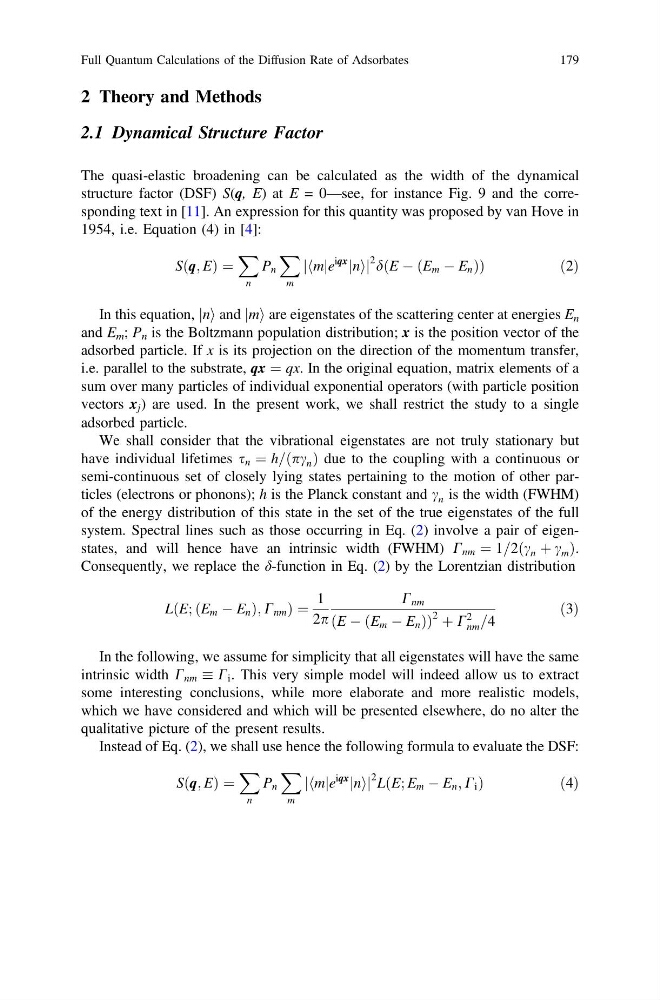
The quasi-elastic broadening can be calculated as the width of the dynamical
structure factor (DSF) S(q, E) at E = 0—see, for instance Fig. 9 and the corresponding text in [11]. An expression for this quantity was proposed by van Hove in
1954, i.e. Equation (4) in [4]:
Sðq; EÞ ¼
X
n
P n
X
m
jhmje
iqx
jnij
2 dðE À ðE m À E n ÞÞ
ð2Þ
In this equation, jni and jmi are eigenstates of the scattering center at energies E n
and E m ; P n is the Boltzmann population distribution; x is the position vector of the
adsorbed particle. If x is its projection on the direction of the momentum transfer,
i.e. parallel to the substrate, qx ¼ qx. In the original equation, matrix elements of a
sum over many particles of individual exponential operators (with particle position
vectors x j ) are used. In the present work, we shall restrict the study to a single
adsorbed particle.
We shall consider that the vibrational eigenstates are not truly stationary but
have individual lifetimes s n ¼ h=ðpc n Þ due to the coupling with a continuous or
semi-continuous set of closely lying states pertaining to the motion of other particles (electrons or phonons); h is the Planck constant and c n is the width (FWHM)
of the energy distribution of this state in the set of the true eigenstates of the full
system. Spectral lines such as those occurring in Eq. (2) involve a pair of eigenstates, and will hence have an intrinsic width (FWHM) C nm ¼ 1=2ðc n þ c m Þ.
Consequently, we replace the δ-function in Eq. (2) by the Lorentzian distribution
LðE; ðE m À E n Þ; C nm Þ ¼
1
2p
C nm
ðE À ðE m À E n ÞÞ
2 þ C
2
nm =4
ð3Þ
In the following, we assume for simplicity that all eigenstates will have the same
intrinsic width C nm C i . This very simple model will indeed allow us to extract
some interesting conclusions, while more elaborate and more realistic models,
which we have considered and which will be presented elsewhere, do no alter the
qualitative picture of the present results.
Instead of Eq. (2), we shall use hence the following formula to evaluate the DSF:
Sðq; EÞ ¼
X
n
P n
X
m
jhmje
iqx
jnij
2 LðE; E m À E n ; C i Þ
ð 4Þ
Full Quantum Calculations of the Diffusion Rate of Adsorbates
179
2.1 Dynamical Structure Factor
The quasi-elastic broadening can be calculated as the width of the dynamical
structure factor (DSF) S(q, E) at E = 0—see, for instance Fig. 9 and the corresponding text in [11]. An expression for this quantity was proposed by van Hove in
1954, i.e. Equation (4) in [4]:
Sðq; EÞ ¼
X
n
P n
X
m
jhmje
iqx
jnij
2 dðE À ðE m À E n ÞÞ
ð2Þ
In this equation, jni and jmi are eigenstates of the scattering center at energies E n
and E m ; P n is the Boltzmann population distribution; x is the position vector of the
adsorbed particle. If x is its projection on the direction of the momentum transfer,
i.e. parallel to the substrate, qx ¼ qx. In the original equation, matrix elements of a
sum over many particles of individual exponential operators (with particle position
vectors x j ) are used. In the present work, we shall restrict the study to a single
adsorbed particle.
We shall consider that the vibrational eigenstates are not truly stationary but
have individual lifetimes s n ¼ h=ðpc n Þ due to the coupling with a continuous or
semi-continuous set of closely lying states pertaining to the motion of other particles (electrons or phonons); h is the Planck constant and c n is the width (FWHM)
of the energy distribution of this state in the set of the true eigenstates of the full
system. Spectral lines such as those occurring in Eq. (2) involve a pair of eigenstates, and will hence have an intrinsic width (FWHM) C nm ¼ 1=2ðc n þ c m Þ.
Consequently, we replace the δ-function in Eq. (2) by the Lorentzian distribution
LðE; ðE m À E n Þ; C nm Þ ¼
1
2p
C nm
ðE À ðE m À E n ÞÞ
2 þ C
2
nm =4
ð3Þ
In the following, we assume for simplicity that all eigenstates will have the same
intrinsic width C nm C i . This very simple model will indeed allow us to extract
some interesting conclusions, while more elaborate and more realistic models,
which we have considered and which will be presented elsewhere, do no alter the
qualitative picture of the present results.
Instead of Eq. (2), we shall use hence the following formula to evaluate the DSF:
Sðq; EÞ ¼
X
n
P n
X
m
jhmje
iqx
jnij
2 LðE; E m À E n ; C i Þ
ð 4Þ
Full Quantum Calculations of the Diffusion Rate of Adsorbates
179