

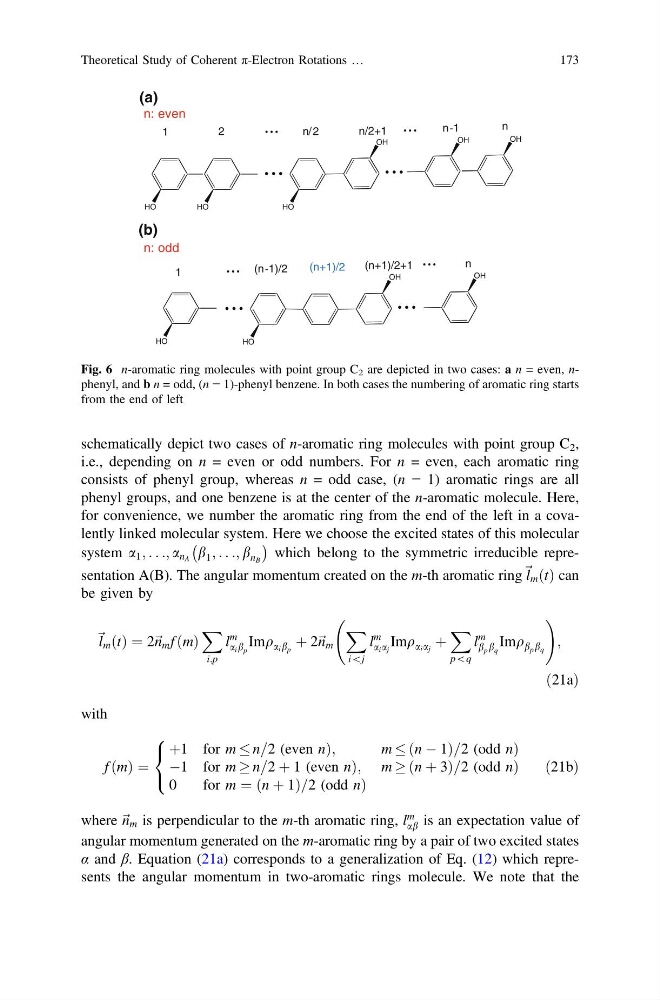
schematically depict two cases of n-aromatic ring molecules with point group C 2 ,
i.e., depending on n = even or odd numbers. For n = even, each aromatic ring
consists of phenyl group, whereas n = odd case, (n − 1) aromatic rings are all
phenyl groups, and one benzene is at the center of the n-aromatic molecule. Here,
for convenience, we number the aromatic ring from the end of the left in a covalently linked molecular system. Here we choose the excited states of this molecular
system a 1 ; . . .; a n A b 1 ; . . .; b n B
À
Á
which belong to the symmetric irreducible representation A(B). The angular momentum created on the m-th aromatic ring ~ l m ðtÞ can
be given by
~ l m ðtÞ ¼ 2~ n m f ðmÞ
X
i;p
l
m
a i b p
Imq a i b p þ 2~ n m
X
i\j
l
m
a i a j
Imq a i a j þ
X
p\q
l
m
b p b q
Imq b p b q
!
;
ð21aÞ
with
f ðmÞ ¼
þ1 for m n=2 (even nÞ;
m ðn À 1Þ=2 (odd nÞ
À1 for m ! n=2 þ 1 (even nÞ; m ! ðn þ 3Þ=2 (odd nÞ
0
for m ¼ ðn þ 1Þ=2 (odd nÞ
8
<
:
ð21bÞ
where ~ n m is perpendicular to the m-th aromatic ring, l
m
ab is an expectation value of
angular momentum generated on the m-aromatic ring by a pair of two excited states
α and β. Equation (21a) corresponds to a generalization of Eq. (12) which represents the angular momentum in two-aromatic rings molecule. We note that the
(a)
(b)
1
2
n / 2
n: even
n/2+1
n 1
n
n: odd
1
(n 1)/2
(n+1)/2
(n+1)/2+1
n
HO
HO
HO
HO
HO
OH
OH
OH
OH
OH
Fig. 6 n-aromatic ring molecules with point group C 2 are depicted in two cases: a n = even, nphenyl, and b n = odd, (n − 1)-phenyl benzene. In both cases the numbering of aromatic ring starts
from the end of left
Theoretical Study of Coherent π-Electron Rotations …
173
i.e., depending on n = even or odd numbers. For n = even, each aromatic ring
consists of phenyl group, whereas n = odd case, (n − 1) aromatic rings are all
phenyl groups, and one benzene is at the center of the n-aromatic molecule. Here,
for convenience, we number the aromatic ring from the end of the left in a covalently linked molecular system. Here we choose the excited states of this molecular
system a 1 ; . . .; a n A b 1 ; . . .; b n B
À
Á
which belong to the symmetric irreducible representation A(B). The angular momentum created on the m-th aromatic ring ~ l m ðtÞ can
be given by
~ l m ðtÞ ¼ 2~ n m f ðmÞ
X
i;p
l
m
a i b p
Imq a i b p þ 2~ n m
X
i\j
l
m
a i a j
Imq a i a j þ
X
p\q
l
m
b p b q
Imq b p b q
!
;
ð21aÞ
with
f ðmÞ ¼
þ1 for m n=2 (even nÞ;
m ðn À 1Þ=2 (odd nÞ
À1 for m ! n=2 þ 1 (even nÞ; m ! ðn þ 3Þ=2 (odd nÞ
0
for m ¼ ðn þ 1Þ=2 (odd nÞ
8
<
:
ð21bÞ
where ~ n m is perpendicular to the m-th aromatic ring, l
m
ab is an expectation value of
angular momentum generated on the m-aromatic ring by a pair of two excited states
α and β. Equation (21a) corresponds to a generalization of Eq. (12) which represents the angular momentum in two-aromatic rings molecule. We note that the
(a)
(b)
1
2
n / 2
n: even
n/2+1
n 1
n
n: odd
1
(n 1)/2
(n+1)/2
(n+1)/2+1
n
HO
HO
HO
HO
HO
OH
OH
OH
OH
OH
Fig. 6 n-aromatic ring molecules with point group C 2 are depicted in two cases: a n = even, nphenyl, and b n = odd, (n − 1)-phenyl benzene. In both cases the numbering of aromatic ring starts
from the end of left
Theoretical Study of Coherent π-Electron Rotations …
173