

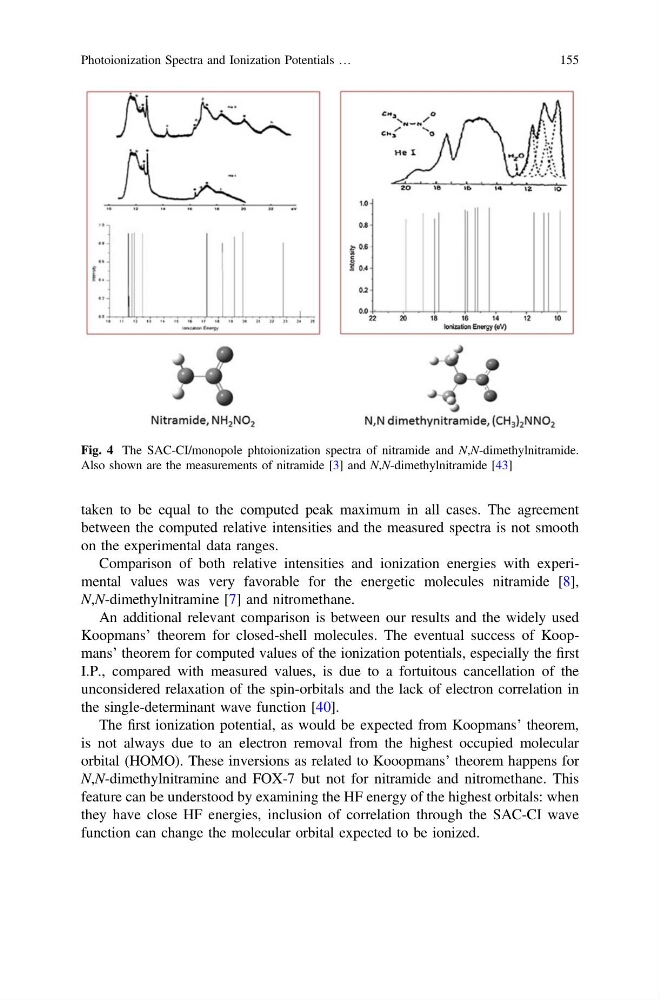
taken to be equal to the computed peak maximum in all cases. The agreement
between the computed relative intensities and the measured spectra is not smooth
on the experimental data ranges.
Comparison of both relative intensities and ionization energies with experimental values was very favorable for the energetic molecules nitramide [8],
N,N-dimethylnitramine [7] and nitromethane.
An additional relevant comparison is between our results and the widely used
Koopmans’ theorem for closed-shell molecules. The eventual success of Koopmans’ theorem for computed values of the ionization potentials, especially the first
I.P., compared with measured values, is due to a fortuitous cancellation of the
unconsidered relaxation of the spin-orbitals and the lack of electron correlation in
the single-determinant wave function [40].
The first ionization potential, as would be expected from Koopmans’ theorem,
is not always due to an electron removal from the highest occupied molecular
orbital (HOMO). These inversions as related to Kooopmans’ theorem happens for
N,N-dimethylnitramine and FOX-7 but not for nitramide and nitromethane. This
feature can be understood by examining the HF energy of the highest orbitals: when
they have close HF energies, inclusion of correlation through the SAC-CI wave
function can change the molecular orbital expected to be ionized.
Fig. 4 The SAC-CI/monopole phtoionization spectra of nitramide and N,N-dimethylnitramide.
Also shown are the measurements of nitramide [3] and N,N-dimethylnitramide [43]
Photoionization Spectra and Ionization Potentials …
155
between the computed relative intensities and the measured spectra is not smooth
on the experimental data ranges.
Comparison of both relative intensities and ionization energies with experimental values was very favorable for the energetic molecules nitramide [8],
N,N-dimethylnitramine [7] and nitromethane.
An additional relevant comparison is between our results and the widely used
Koopmans’ theorem for closed-shell molecules. The eventual success of Koopmans’ theorem for computed values of the ionization potentials, especially the first
I.P., compared with measured values, is due to a fortuitous cancellation of the
unconsidered relaxation of the spin-orbitals and the lack of electron correlation in
the single-determinant wave function [40].
The first ionization potential, as would be expected from Koopmans’ theorem,
is not always due to an electron removal from the highest occupied molecular
orbital (HOMO). These inversions as related to Kooopmans’ theorem happens for
N,N-dimethylnitramine and FOX-7 but not for nitramide and nitromethane. This
feature can be understood by examining the HF energy of the highest orbitals: when
they have close HF energies, inclusion of correlation through the SAC-CI wave
function can change the molecular orbital expected to be ionized.
Fig. 4 The SAC-CI/monopole phtoionization spectra of nitramide and N,N-dimethylnitramide.
Also shown are the measurements of nitramide [3] and N,N-dimethylnitramide [43]
Photoionization Spectra and Ionization Potentials …
155