

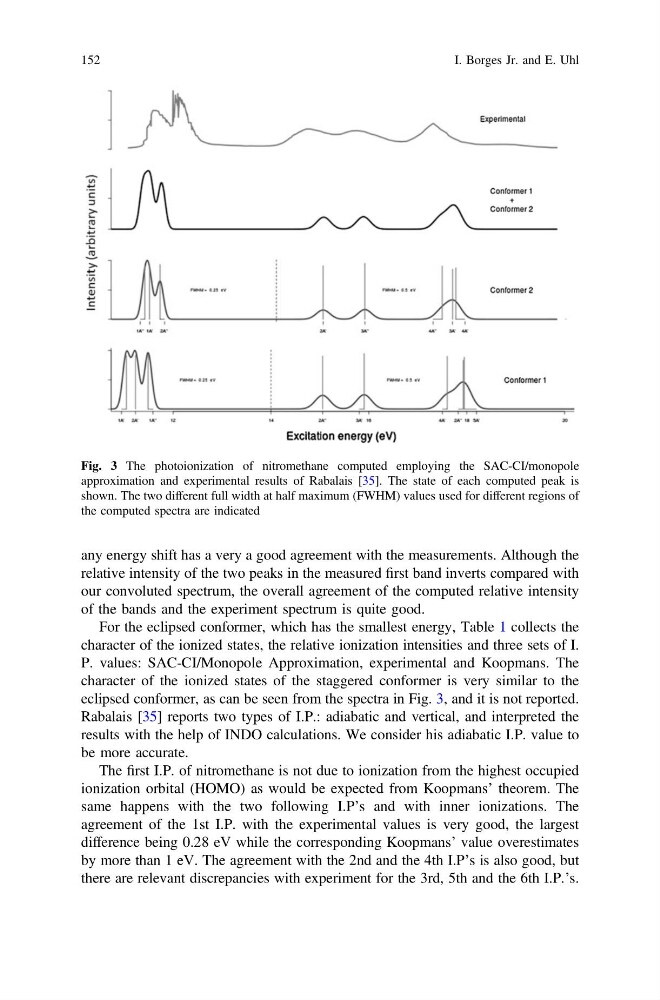
any energy shift has a very a good agreement with the measurements. Although the
relative intensity of the two peaks in the measured first band inverts compared with
our convoluted spectrum, the overall agreement of the computed relative intensity
of the bands and the experiment spectrum is quite good.
For the eclipsed conformer, which has the smallest energy, Table 1 collects the
character of the ionized states, the relative ionization intensities and three sets of I.
P. values: SAC-CI/Monopole Approximation, experimental and Koopmans. The
character of the ionized states of the staggered conformer is very similar to the
eclipsed conformer, as can be seen from the spectra in Fig. 3, and it is not reported.
Rabalais [35] reports two types of I.P.: adiabatic and vertical, and interpreted the
results with the help of INDO calculations. We consider his adiabatic I.P. value to
be more accurate.
The first I.P. of nitromethane is not due to ionization from the highest occupied
ionization orbital (HOMO) as would be expected from Koopmans’ theorem. The
same happens with the two following I.P’s and with inner ionizations. The
agreement of the 1st I.P. with the experimental values is very good, the largest
difference being 0.28 eV while the corresponding Koopmans’ value overestimates
by more than 1 eV. The agreement with the 2nd and the 4th I.P’s is also good, but
there are relevant discrepancies with experiment for the 3rd, 5th and the 6th I.P.’s.
Fig. 3 The photoionization of nitromethane computed employing the SAC-CI/monopole
approximation and experimental results of Rabalais [35]. The state of each computed peak is
shown. The two different full width at half maximum (FWHM) values used for different regions of
the computed spectra are indicated
152
I. Borges Jr. and E. Uhl
relative intensity of the two peaks in the measured first band inverts compared with
our convoluted spectrum, the overall agreement of the computed relative intensity
of the bands and the experiment spectrum is quite good.
For the eclipsed conformer, which has the smallest energy, Table 1 collects the
character of the ionized states, the relative ionization intensities and three sets of I.
P. values: SAC-CI/Monopole Approximation, experimental and Koopmans. The
character of the ionized states of the staggered conformer is very similar to the
eclipsed conformer, as can be seen from the spectra in Fig. 3, and it is not reported.
Rabalais [35] reports two types of I.P.: adiabatic and vertical, and interpreted the
results with the help of INDO calculations. We consider his adiabatic I.P. value to
be more accurate.
The first I.P. of nitromethane is not due to ionization from the highest occupied
ionization orbital (HOMO) as would be expected from Koopmans’ theorem. The
same happens with the two following I.P’s and with inner ionizations. The
agreement of the 1st I.P. with the experimental values is very good, the largest
difference being 0.28 eV while the corresponding Koopmans’ value overestimates
by more than 1 eV. The agreement with the 2nd and the 4th I.P’s is also good, but
there are relevant discrepancies with experiment for the 3rd, 5th and the 6th I.P.’s.
Fig. 3 The photoionization of nitromethane computed employing the SAC-CI/monopole
approximation and experimental results of Rabalais [35]. The state of each computed peak is
shown. The two different full width at half maximum (FWHM) values used for different regions of
the computed spectra are indicated
152
I. Borges Jr. and E. Uhl