

T N þ V u ðRÞ À E F ðt
0
Þ
½
u u ðR; t
0
Þ À 1=2E 0 ðt
0
ÞlðRÞu g ðR; t
0
Þ ¼ 0
ð13Þ
where g and u have been substituted to 1 and 2. Solution of these equations is made
with the method described for the instantaneous case. The functions can be called
diabatic as they are obtained from the coupled equations involving the so-called
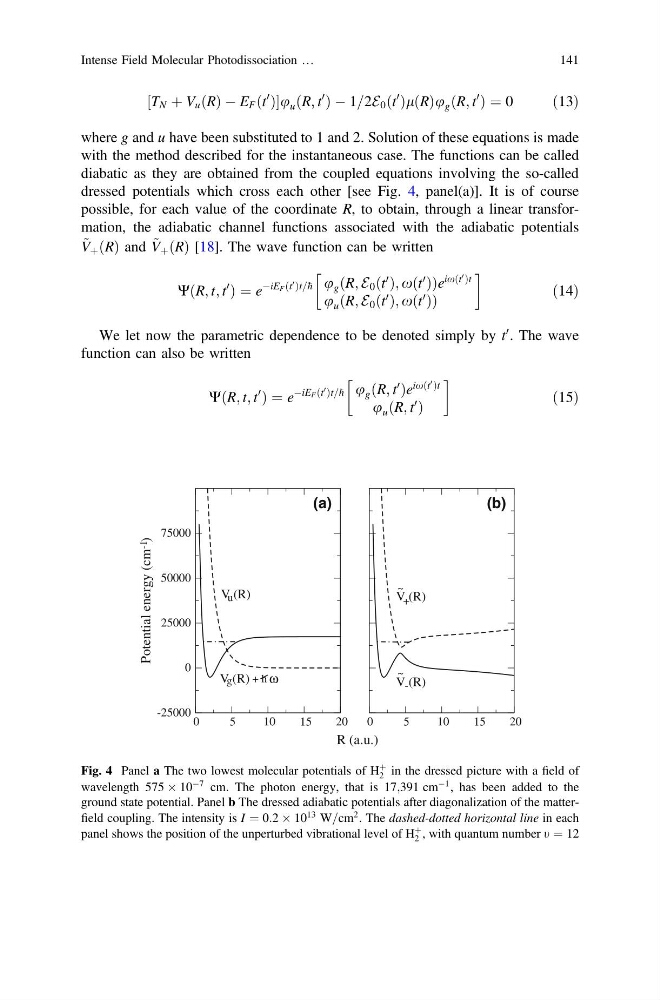
dressed potentials which cross each other [see Fig. 4, panel(a)]. It is of course
possible, for each value of the coordinate R, to obtain, through a linear transformation, the adiabatic channel functions associated with the adiabatic potentials
~
V þ ðRÞ and ~
V þ ðRÞ [18]. The wave function can be written
WðR; t; t
0
Þ ¼ e
ÀiE F ðt
0 Þt= h u g ðR; E 0 ðt
0
Þ; xðt
0
ÞÞe
ixðt
0 Þt
u u ðR; E 0 ðt
0
Þ; xðt
0
ÞÞ
!
ð14Þ
We let now the parametric dependence to be denoted simply by t
0 . The wave
function can also be written
WðR; t; t
0
Þ ¼ e
ÀiE F ðt
0 Þt= h u g ðR; t
0
Þe
ixðt
0 Þt
u u ðR; t
0
Þ
!
ð15Þ
0
5
10
15
20
-25000
0
25000
50000
75000
0
5
10
15
20
(a)
(b)
R (a.u.)
Potential energy (cm )
-1
g
V (R)
V (R)
V (R)
V (R)
u
+
-
~
h ω
~
+
Fig. 4 Panel a The two lowest molecular potentials of H
þ
2 in the dressed picture with a field of
wavelength 575 Â 10
À7 cm. The photon energy, that is 17;391 cm
À1 , has been added to the
ground state potential. Panel b The dressed adiabatic potentials after diagonalization of the matterfield coupling. The intensity is I ¼ 0:2 Â 10
13 W=cm
2 . The dashed-dotted horizontal line in each
panel shows the position of the unperturbed vibrational level of H
þ
2 , with quantum number t ¼ 12
Intense Field Molecular Photodissociation …
141
0
Þ
½
u u ðR; t
0
Þ À 1=2E 0 ðt
0
ÞlðRÞu g ðR; t
0
Þ ¼ 0
ð13Þ
where g and u have been substituted to 1 and 2. Solution of these equations is made
with the method described for the instantaneous case. The functions can be called
diabatic as they are obtained from the coupled equations involving the so-called
dressed potentials which cross each other [see Fig. 4, panel(a)]. It is of course
possible, for each value of the coordinate R, to obtain, through a linear transformation, the adiabatic channel functions associated with the adiabatic potentials
~
V þ ðRÞ and ~
V þ ðRÞ [18]. The wave function can be written
WðR; t; t
0
Þ ¼ e
ÀiE F ðt
0 Þt= h u g ðR; E 0 ðt
0
Þ; xðt
0
ÞÞe
ixðt
0 Þt
u u ðR; E 0 ðt
0
Þ; xðt
0
ÞÞ
!
ð14Þ
We let now the parametric dependence to be denoted simply by t
0 . The wave
function can also be written
WðR; t; t
0
Þ ¼ e
ÀiE F ðt
0 Þt= h u g ðR; t
0
Þe
ixðt
0 Þt
u u ðR; t
0
Þ
!
ð15Þ
0
5
10
15
20
-25000
0
25000
50000
75000
0
5
10
15
20
(a)
(b)
R (a.u.)
Potential energy (cm )
-1
g
V (R)
V (R)
V (R)
V (R)
u
+
-
~
h ω
~
+
Fig. 4 Panel a The two lowest molecular potentials of H
þ
2 in the dressed picture with a field of
wavelength 575 Â 10
À7 cm. The photon energy, that is 17;391 cm
À1 , has been added to the
ground state potential. Panel b The dressed adiabatic potentials after diagonalization of the matterfield coupling. The intensity is I ¼ 0:2 Â 10
13 W=cm
2 . The dashed-dotted horizontal line in each
panel shows the position of the unperturbed vibrational level of H
þ
2 , with quantum number t ¼ 12
Intense Field Molecular Photodissociation …
141