

1 Introduction
Fatty Acid Amide Hydrolase (FAAH) [1], first isolated from rat liver [2] is a
mammalian membrane-associated enzyme that belongs to the amidase signature
(AS) family, a class of serine hydrolases with a unique catalytic triad of Ser-Ser-Lys
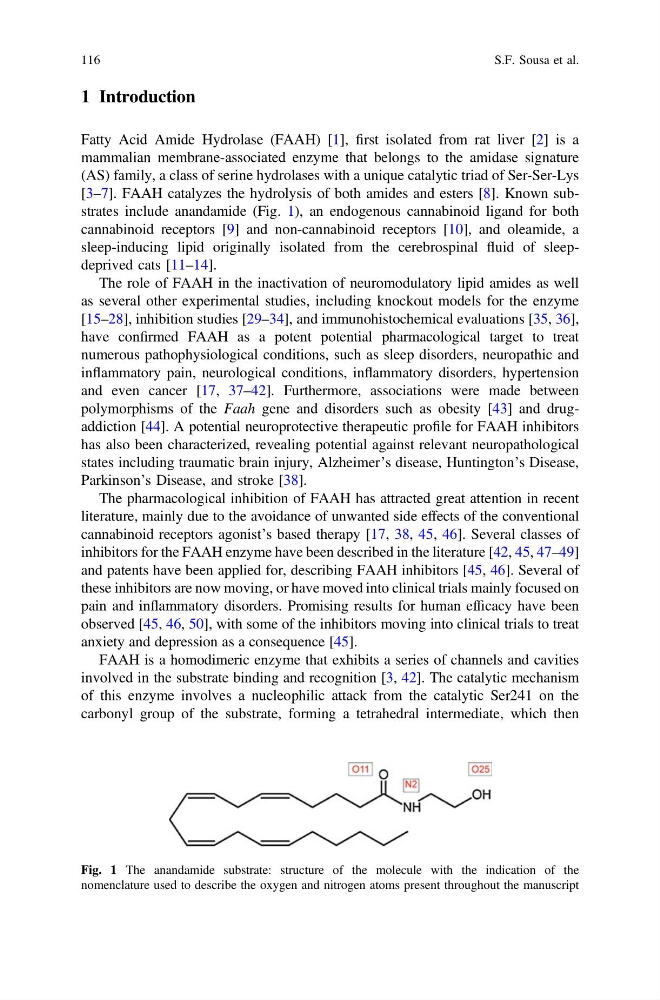
[3–7]. FAAH catalyzes the hydrolysis of both amides and esters [8]. Known substrates include anandamide (Fig. 1), an endogenous cannabinoid ligand for both
cannabinoid receptors [9] and non-cannabinoid receptors [10], and oleamide, a
sleep-inducing lipid originally isolated from the cerebrospinal fluid of sleepdeprived cats [11–14].
The role of FAAH in the inactivation of neuromodulatory lipid amides as well
as several other experimental studies, including knockout models for the enzyme
[15–28], inhibition studies [29–34], and immunohistochemical evaluations [35, 36],
have confirmed FAAH as a potent potential pharmacological target to treat
numerous pathophysiological conditions, such as sleep disorders, neuropathic and
inflammatory pain, neurological conditions, inflammatory disorders, hypertension
and even cancer [17, 37–42]. Furthermore, associations were made between
polymorphisms of the Faah gene and disorders such as obesity [43] and drugaddiction [44]. A potential neuroprotective therapeutic profile for FAAH inhibitors
has also been characterized, revealing potential against relevant neuropathological
states including traumatic brain injury, Alzheimer’s disease, Huntington’s Disease,
Parkinson’s Disease, and stroke [38].
The pharmacological inhibition of FAAH has attracted great attention in recent
literature, mainly due to the avoidance of unwanted side effects of the conventional
cannabinoid receptors agonist’s based therapy [17, 38, 45, 46]. Several classes of
inhibitors for the FAAH enzyme have been described in the literature [42, 45, 47–49]
and patents have been applied for, describing FAAH inhibitors [45, 46]. Several of
these inhibitors are now moving, or have moved into clinical trials mainly focused on
pain and inflammatory disorders. Promising results for human efficacy have been
observed [45, 46, 50], with some of the inhibitors moving into clinical trials to treat
anxiety and depression as a consequence [45].
FAAH is a homodimeric enzyme that exhibits a series of channels and cavities
involved in the substrate binding and recognition [3, 42]. The catalytic mechanism
of this enzyme involves a nucleophilic attack from the catalytic Ser241 on the
carbonyl group of the substrate, forming a tetrahedral intermediate, which then
Fig. 1 The anandamide substrate: structure of the molecule with the indication of the
nomenclature used to describe the oxygen and nitrogen atoms present throughout the manuscript
116
S.F. Sousa et al.
Fatty Acid Amide Hydrolase (FAAH) [1], first isolated from rat liver [2] is a
mammalian membrane-associated enzyme that belongs to the amidase signature
(AS) family, a class of serine hydrolases with a unique catalytic triad of Ser-Ser-Lys
[3–7]. FAAH catalyzes the hydrolysis of both amides and esters [8]. Known substrates include anandamide (Fig. 1), an endogenous cannabinoid ligand for both
cannabinoid receptors [9] and non-cannabinoid receptors [10], and oleamide, a
sleep-inducing lipid originally isolated from the cerebrospinal fluid of sleepdeprived cats [11–14].
The role of FAAH in the inactivation of neuromodulatory lipid amides as well
as several other experimental studies, including knockout models for the enzyme
[15–28], inhibition studies [29–34], and immunohistochemical evaluations [35, 36],
have confirmed FAAH as a potent potential pharmacological target to treat
numerous pathophysiological conditions, such as sleep disorders, neuropathic and
inflammatory pain, neurological conditions, inflammatory disorders, hypertension
and even cancer [17, 37–42]. Furthermore, associations were made between
polymorphisms of the Faah gene and disorders such as obesity [43] and drugaddiction [44]. A potential neuroprotective therapeutic profile for FAAH inhibitors
has also been characterized, revealing potential against relevant neuropathological
states including traumatic brain injury, Alzheimer’s disease, Huntington’s Disease,
Parkinson’s Disease, and stroke [38].
The pharmacological inhibition of FAAH has attracted great attention in recent
literature, mainly due to the avoidance of unwanted side effects of the conventional
cannabinoid receptors agonist’s based therapy [17, 38, 45, 46]. Several classes of
inhibitors for the FAAH enzyme have been described in the literature [42, 45, 47–49]
and patents have been applied for, describing FAAH inhibitors [45, 46]. Several of
these inhibitors are now moving, or have moved into clinical trials mainly focused on
pain and inflammatory disorders. Promising results for human efficacy have been
observed [45, 46, 50], with some of the inhibitors moving into clinical trials to treat
anxiety and depression as a consequence [45].
FAAH is a homodimeric enzyme that exhibits a series of channels and cavities
involved in the substrate binding and recognition [3, 42]. The catalytic mechanism
of this enzyme involves a nucleophilic attack from the catalytic Ser241 on the
carbonyl group of the substrate, forming a tetrahedral intermediate, which then
Fig. 1 The anandamide substrate: structure of the molecule with the indication of the
nomenclature used to describe the oxygen and nitrogen atoms present throughout the manuscript
116
S.F. Sousa et al.