

Detailed information on the relevant molecular properties of MUCH-B is given
in tables. Table 3 reports the parameters of the IHBs; Table 4 reports the calculated
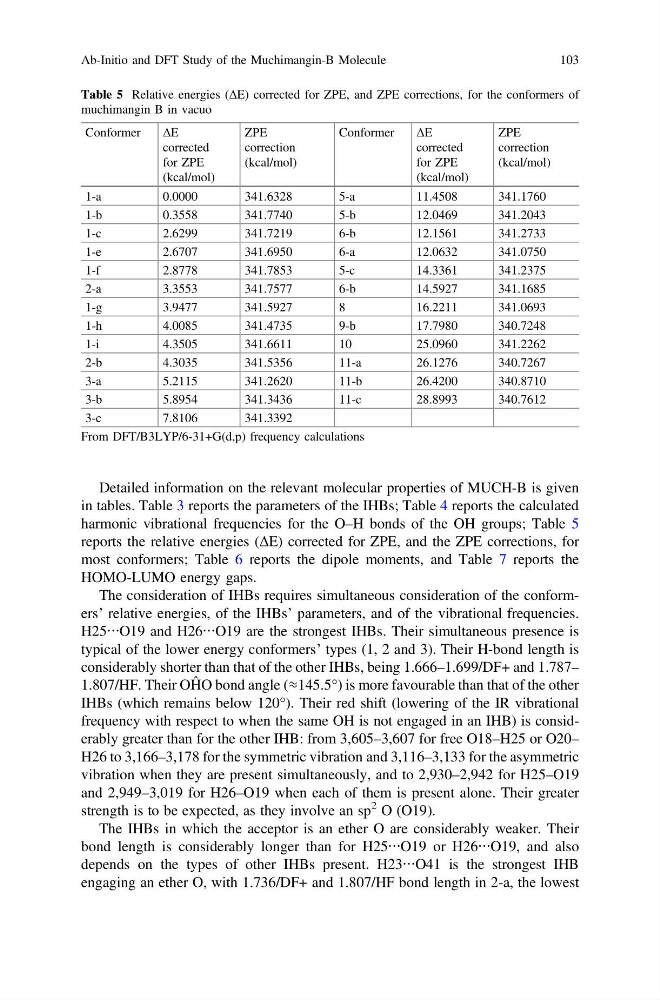
harmonic vibrational frequencies for the O–H bonds of the OH groups; Table 5
reports the relative energies (ΔE) corrected for ZPE, and the ZPE corrections, for
most conformers; Table 6 reports the dipole moments, and Table 7 reports the
HOMO-LUMO energy gaps.
The consideration of IHBs requires simultaneous consideration of the conformers’ relative energies, of the IHBs’ parameters, and of the vibrational frequencies.
H25⋯O19 and H26⋯O19 are the strongest IHBs. Their simultaneous presence is
typical of the lower energy conformers’ types (1, 2 and 3). Their H-bond length is
considerably shorter than that of the other IHBs, being 1.666–1.699/DF+ and 1.787–
1.807/HF. Their OĤO bond angle (≈145.5°) is more favourable than that of the other
IHBs (which remains below 120°). Their red shift (lowering of the IR vibrational
frequency with respect to when the same OH is not engaged in an IHB) is considerably greater than for the other IHB: from 3,605–3,607 for free O18–H25 or O20–
H26 to 3,166–3,178 for the symmetric vibration and 3,116–3,133 for the asymmetric
vibration when they are present simultaneously, and to 2,930–2,942 for H25–O19
and 2,949–3,019 for H26–O19 when each of them is present alone. Their greater
strength is to be expected, as they involve an sp
2 O (O19).
The IHBs in which the acceptor is an ether O are considerably weaker. Their
bond length is considerably longer than for H25⋯O19 or H26⋯O19, and also
depends on the types of other IHBs present. H23⋯O41 is the strongest IHB
engaging an ether O, with 1.736/DF+ and 1.807/HF bond length in 2-a, the lowest
Table 5 Relative energies (ΔE) corrected for ZPE, and ZPE corrections, for the conformers of
muchimangin B in vacuo
Conformer
ΔE
corrected
for ZPE
(kcal/mol)
ZPE
correction
(kcal/mol)
Conformer
ΔE
corrected
for ZPE
(kcal/mol)
ZPE
correction
(kcal/mol)
1-a
0.0000
341.6328
5-a
11.4508
341.1760
1-b
0.3558
341.7740
5-b
12.0469
341.2043
1-c
2.6299
341.7219
6-b
12.1561
341.2733
1-e
2.6707
341.6950
6-a
12.0632
341.0750
1-f
2.8778
341.7853
5-c
14.3361
341.2375
2-a
3.3553
341.7577
6-b
14.5927
341.1685
1-g
3.9477
341.5927
8
16.2211
341.0693
1-h
4.0085
341.4735
9-b
17.7980
340.7248
1-i
4.3505
341.6611
10
25.0960
341.2262
2-b
4.3035
341.5356
11-a
26.1276
340.7267
3-a
5.2115
341.2620
11-b
26.4200
340.8710
3-b
5.8954
341.3436
11-c
28.8993
340.7612
3-c
7.8106
341.3392
From DFT/B3LYP/6-31+G(d,p) frequency calculations
Ab-Initio and DFT Study of the Muchimangin-B Molecule
103
in tables. Table 3 reports the parameters of the IHBs; Table 4 reports the calculated
harmonic vibrational frequencies for the O–H bonds of the OH groups; Table 5
reports the relative energies (ΔE) corrected for ZPE, and the ZPE corrections, for
most conformers; Table 6 reports the dipole moments, and Table 7 reports the
HOMO-LUMO energy gaps.
The consideration of IHBs requires simultaneous consideration of the conformers’ relative energies, of the IHBs’ parameters, and of the vibrational frequencies.
H25⋯O19 and H26⋯O19 are the strongest IHBs. Their simultaneous presence is
typical of the lower energy conformers’ types (1, 2 and 3). Their H-bond length is
considerably shorter than that of the other IHBs, being 1.666–1.699/DF+ and 1.787–
1.807/HF. Their OĤO bond angle (≈145.5°) is more favourable than that of the other
IHBs (which remains below 120°). Their red shift (lowering of the IR vibrational
frequency with respect to when the same OH is not engaged in an IHB) is considerably greater than for the other IHB: from 3,605–3,607 for free O18–H25 or O20–
H26 to 3,166–3,178 for the symmetric vibration and 3,116–3,133 for the asymmetric
vibration when they are present simultaneously, and to 2,930–2,942 for H25–O19
and 2,949–3,019 for H26–O19 when each of them is present alone. Their greater
strength is to be expected, as they involve an sp
2 O (O19).
The IHBs in which the acceptor is an ether O are considerably weaker. Their
bond length is considerably longer than for H25⋯O19 or H26⋯O19, and also
depends on the types of other IHBs present. H23⋯O41 is the strongest IHB
engaging an ether O, with 1.736/DF+ and 1.807/HF bond length in 2-a, the lowest
Table 5 Relative energies (ΔE) corrected for ZPE, and ZPE corrections, for the conformers of
muchimangin B in vacuo
Conformer
ΔE
corrected
for ZPE
(kcal/mol)
ZPE
correction
(kcal/mol)
Conformer
ΔE
corrected
for ZPE
(kcal/mol)
ZPE
correction
(kcal/mol)
1-a
0.0000
341.6328
5-a
11.4508
341.1760
1-b
0.3558
341.7740
5-b
12.0469
341.2043
1-c
2.6299
341.7219
6-b
12.1561
341.2733
1-e
2.6707
341.6950
6-a
12.0632
341.0750
1-f
2.8778
341.7853
5-c
14.3361
341.2375
2-a
3.3553
341.7577
6-b
14.5927
341.1685
1-g
3.9477
341.5927
8
16.2211
341.0693
1-h
4.0085
341.4735
9-b
17.7980
340.7248
1-i
4.3505
341.6611
10
25.0960
341.2262
2-b
4.3035
341.5356
11-a
26.1276
340.7267
3-a
5.2115
341.2620
11-b
26.4200
340.8710
3-b
5.8954
341.3436
11-c
28.8993
340.7612
3-c
7.8106
341.3392
From DFT/B3LYP/6-31+G(d,p) frequency calculations
Ab-Initio and DFT Study of the Muchimangin-B Molecule
103