

with high relative energy are not sufficiently populated to have a role in the biological activity. The only reason for considering them in the computational study of
a molecule is their utilisation as references to estimate the influence of the various
factors determining conformational preferences and the conformers’ energetics. For
instance, a conformer in which a certain IHB is removed can help assess the
stabilising influence of that IHB, by comparison with the conformer in which it is
present.
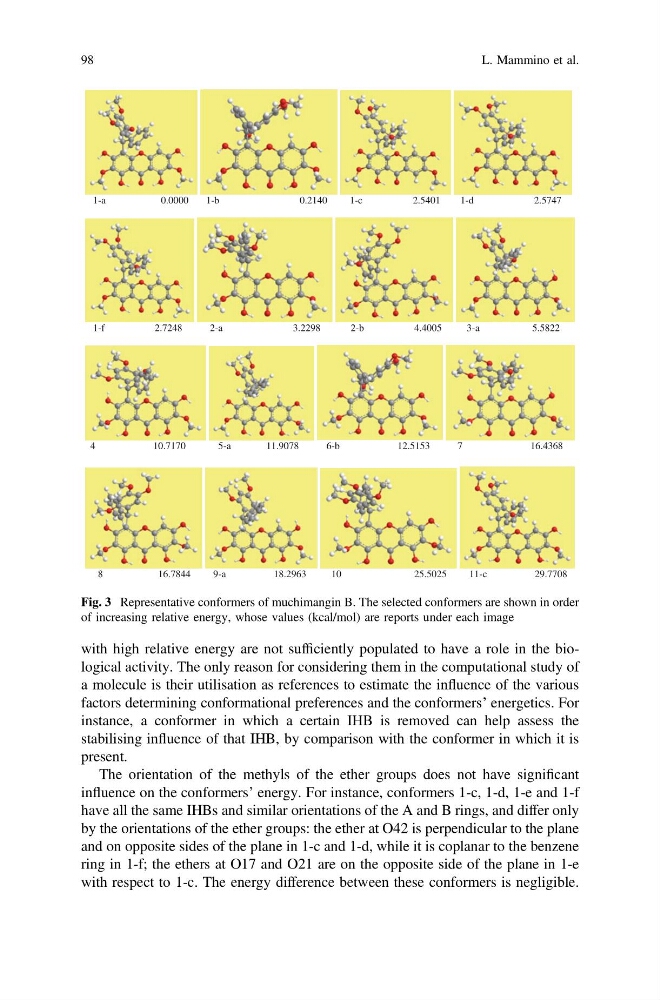
The orientation of the methyls of the ether groups does not have significant
influence on the conformers’ energy. For instance, conformers 1-c, 1-d, 1-e and 1-f
have all the same IHBs and similar orientations of the A and B rings, and differ only
by the orientations of the ether groups: the ether at O42 is perpendicular to the plane
and on opposite sides of the plane in 1-c and 1-d, while it is coplanar to the benzene
ring in 1-f; the ethers at O17 and O21 are on the opposite side of the plane in 1-e
with respect to 1-c. The energy difference between these conformers is negligible.
1-a
0.0000
1-b
0.2140
1-c
2.5401
1-d
2.5747
1-f
2.7248
2-a
3.2298
2-b
4.4005
3-a
5.5822
4
10.7170
5-a
11.9078
6-b
12.5153
7
16.4368
8
16.7844
9-a
18.2963
10
25.5025
11-c
29.7708
Fig. 3 Representative conformers of muchimangin B. The selected conformers are shown in order
of increasing relative energy, whose values (kcal/mol) are reports under each image
98
L. Mammino et al.
a molecule is their utilisation as references to estimate the influence of the various
factors determining conformational preferences and the conformers’ energetics. For
instance, a conformer in which a certain IHB is removed can help assess the
stabilising influence of that IHB, by comparison with the conformer in which it is
present.
The orientation of the methyls of the ether groups does not have significant
influence on the conformers’ energy. For instance, conformers 1-c, 1-d, 1-e and 1-f
have all the same IHBs and similar orientations of the A and B rings, and differ only
by the orientations of the ether groups: the ether at O42 is perpendicular to the plane
and on opposite sides of the plane in 1-c and 1-d, while it is coplanar to the benzene
ring in 1-f; the ethers at O17 and O21 are on the opposite side of the plane in 1-e
with respect to 1-c. The energy difference between these conformers is negligible.
1-a
0.0000
1-b
0.2140
1-c
2.5401
1-d
2.5747
1-f
2.7248
2-a
3.2298
2-b
4.4005
3-a
5.5822
4
10.7170
5-a
11.9078
6-b
12.5153
7
16.4368
8
16.7844
9-a
18.2963
10
25.5025
11-c
29.7708
Fig. 3 Representative conformers of muchimangin B. The selected conformers are shown in order
of increasing relative energy, whose values (kcal/mol) are reports under each image
98
L. Mammino et al.