

59
Essences of Interaction
objectives are laid out; the requirements delineated (as best known at the
time); and the limitations of funding are specified along with the spending
rate, milestones, reviews, and delivery schedule(s). In addition, any other
resources that are available or are specified to support the project are
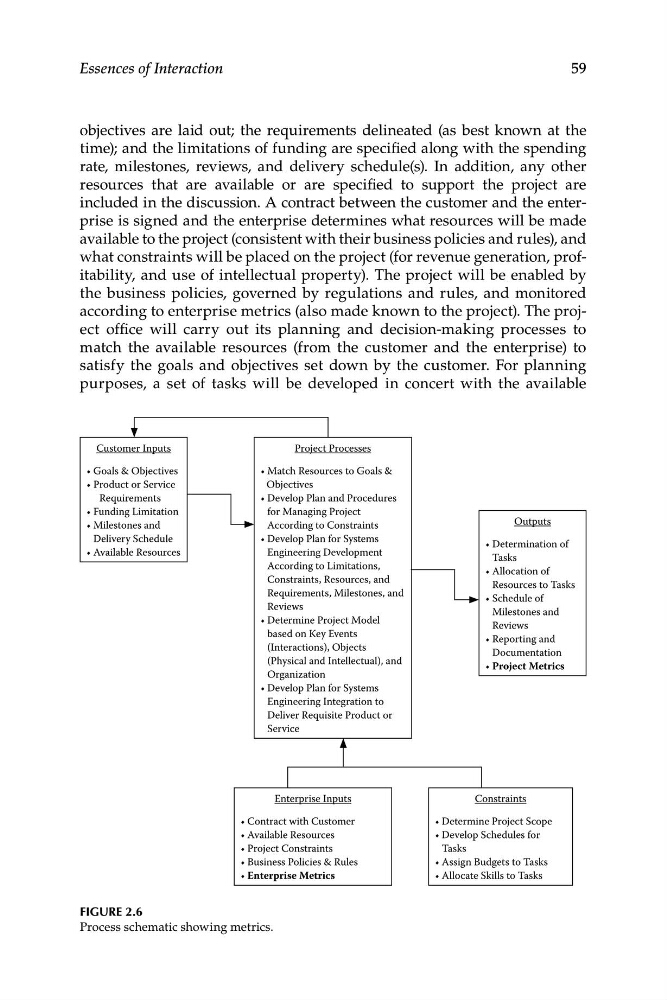
included in the discussion. A contract between the customer and the enterprise is signed and the enterprise determines what resources will be made
available to the project (consistent with their business policies and rules), and
what constraints will be placed on the project (for revenue generation, profitability, and use of intellectual property). The project will be enabled by
the business policies, governed by regulations and rules, and monitored
according to enterprise metrics (also made known to the project). The project office will carry out its planning and decision-making processes to
match the available resources (from the customer and the enterprise) to
satisfy the goals and objectives set down by the customer. For planning
purposes, a set of tasks will be developed in concert with the available
Customer Inputs
• Goals & Objectives
• Product or Service
Requirements
• Funding Limitation
• Milestones and
Delivery Schedule
• Available Resources
Project Processes
• Match Resources to Goals &
Objectives
• Develop Plan and Procedures
for Managing Project
According to Constraints
• Develop Plan for Systems
Engineering Development
According to Limitations,
Constraints, Resources, and
Requirements, Milestones, and
Reviews
• Determine Project Model
based on Key Events
(Interactions), Objects
(Physical and Intellectual), and
Organization
• Develop Plan for Systems
Engineering Integration to
Deliver Requisite Product or
Service
Outputs
• Determination of
Tasks
• Allocation of
Resources to Tasks
• Schedule of
Milestones and
Reviews
• Reporting and
Documentation
• Project Metrics
Enterprise Inputs
• Contract with Customer
• Available Resources
• Project Constraints
• Business Policies & Rules
• Enterprise Metrics
Constraints
• Determine Project Scope
• Develop Schedules for
Tasks
• Assign Budgets to Tasks
• Allocate Skills to Tasks
FIgure 2.6
Process schematic showing metrics.
Essences of Interaction
objectives are laid out; the requirements delineated (as best known at the
time); and the limitations of funding are specified along with the spending
rate, milestones, reviews, and delivery schedule(s). In addition, any other
resources that are available or are specified to support the project are
included in the discussion. A contract between the customer and the enterprise is signed and the enterprise determines what resources will be made
available to the project (consistent with their business policies and rules), and
what constraints will be placed on the project (for revenue generation, profitability, and use of intellectual property). The project will be enabled by
the business policies, governed by regulations and rules, and monitored
according to enterprise metrics (also made known to the project). The project office will carry out its planning and decision-making processes to
match the available resources (from the customer and the enterprise) to
satisfy the goals and objectives set down by the customer. For planning
purposes, a set of tasks will be developed in concert with the available
Customer Inputs
• Goals & Objectives
• Product or Service
Requirements
• Funding Limitation
• Milestones and
Delivery Schedule
• Available Resources
Project Processes
• Match Resources to Goals &
Objectives
• Develop Plan and Procedures
for Managing Project
According to Constraints
• Develop Plan for Systems
Engineering Development
According to Limitations,
Constraints, Resources, and
Requirements, Milestones, and
Reviews
• Determine Project Model
based on Key Events
(Interactions), Objects
(Physical and Intellectual), and
Organization
• Develop Plan for Systems
Engineering Integration to
Deliver Requisite Product or
Service
Outputs
• Determination of
Tasks
• Allocation of
Resources to Tasks
• Schedule of
Milestones and
Reviews
• Reporting and
Documentation
• Project Metrics
Enterprise Inputs
• Contract with Customer
• Available Resources
• Project Constraints
• Business Policies & Rules
• Enterprise Metrics
Constraints
• Determine Project Scope
• Develop Schedules for
Tasks
• Assign Budgets to Tasks
• Allocate Skills to Tasks
FIgure 2.6
Process schematic showing metrics.