

Control
Mechanism
Physical boundary (before
mechanism enabled)
Functional boundary (after
mechanism enabled)
Behavioral boundary (after
mechanism enabled)
Able to perform
(output EMMI)
Able to receive
input (EMMI)
Able to loss EMMI while
achieving performance
33
Essences of Interaction
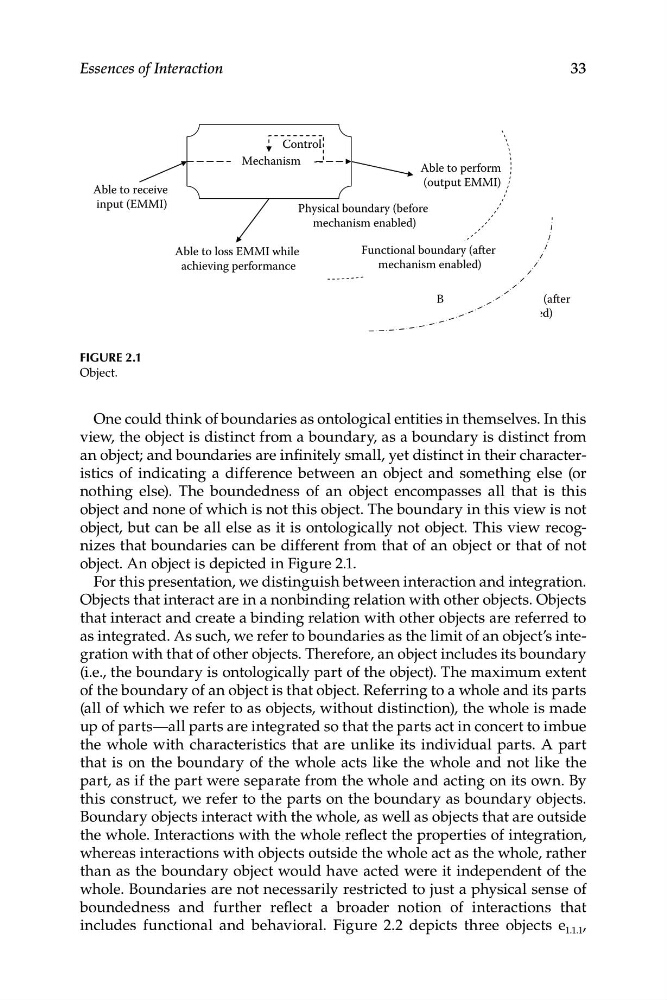
FIgure 2.1
Object.
One could think of boundaries as ontological entities in themselves. In this
view, the object is distinct from a boundary, as a boundary is distinct from
an object; and boundaries are infinitely small, yet distinct in their characteristics of indicating a difference between an object and something else (or
nothing else). The boundedness of an object encompasses all that is this
object and none of which is not this object. The boundary in this view is not
object, but can be all else as it is ontologically not object. This view recognizes that boundaries can be different from that of an object or that of not
object. An object is depicted in Figure 2.1.
For this presentation, we distinguish between interaction and integration.
Objects that interact are in a nonbinding relation with other objects. Objects
that interact and create a binding relation with other objects are referred to
as integrated. As such, we refer to boundaries as the limit of an object’s integration with that of other objects. Therefore, an object includes its boundary
(i.e., the boundary is ontologically part of the object). The maximum extent
of the boundary of an object is that object. Referring to a whole and its parts
(all of which we refer to as objects, without distinction), the whole is made
up of parts—all parts are integrated so that the parts act in concert to imbue
the whole with characteristics that are unlike its individual parts. A part
that is on the boundary of the whole acts like the whole and not like the
part, as if the part were separate from the whole and acting on its own. By
this construct, we refer to the parts on the boundary as boundary objects.
Boundary objects interact with the whole, as well as objects that are outside
the whole. Interactions with the whole reflect the properties of integration,
whereas interactions with objects outside the whole act as the whole, rather
than as the boundary object would have acted were it independent of the
whole. Boundaries are not necessarily restricted to just a physical sense of
boundedness and further reflect a broader notion of interactions that
includes functional and behavioral. Figure 2.2 depicts three objects e 1.1.1 ,
Mechanism
Physical boundary (before
mechanism enabled)
Functional boundary (after
mechanism enabled)
Behavioral boundary (after
mechanism enabled)
Able to perform
(output EMMI)
Able to receive
input (EMMI)
Able to loss EMMI while
achieving performance
33
Essences of Interaction
FIgure 2.1
Object.
One could think of boundaries as ontological entities in themselves. In this
view, the object is distinct from a boundary, as a boundary is distinct from
an object; and boundaries are infinitely small, yet distinct in their characteristics of indicating a difference between an object and something else (or
nothing else). The boundedness of an object encompasses all that is this
object and none of which is not this object. The boundary in this view is not
object, but can be all else as it is ontologically not object. This view recognizes that boundaries can be different from that of an object or that of not
object. An object is depicted in Figure 2.1.
For this presentation, we distinguish between interaction and integration.
Objects that interact are in a nonbinding relation with other objects. Objects
that interact and create a binding relation with other objects are referred to
as integrated. As such, we refer to boundaries as the limit of an object’s integration with that of other objects. Therefore, an object includes its boundary
(i.e., the boundary is ontologically part of the object). The maximum extent
of the boundary of an object is that object. Referring to a whole and its parts
(all of which we refer to as objects, without distinction), the whole is made
up of parts—all parts are integrated so that the parts act in concert to imbue
the whole with characteristics that are unlike its individual parts. A part
that is on the boundary of the whole acts like the whole and not like the
part, as if the part were separate from the whole and acting on its own. By
this construct, we refer to the parts on the boundary as boundary objects.
Boundary objects interact with the whole, as well as objects that are outside
the whole. Interactions with the whole reflect the properties of integration,
whereas interactions with objects outside the whole act as the whole, rather
than as the boundary object would have acted were it independent of the
whole. Boundaries are not necessarily restricted to just a physical sense of
boundedness and further reflect a broader notion of interactions that
includes functional and behavioral. Figure 2.2 depicts three objects e 1.1.1 ,