

346 Appendix 2: Product Upgrades Based on Minimum Expected Quality Loss
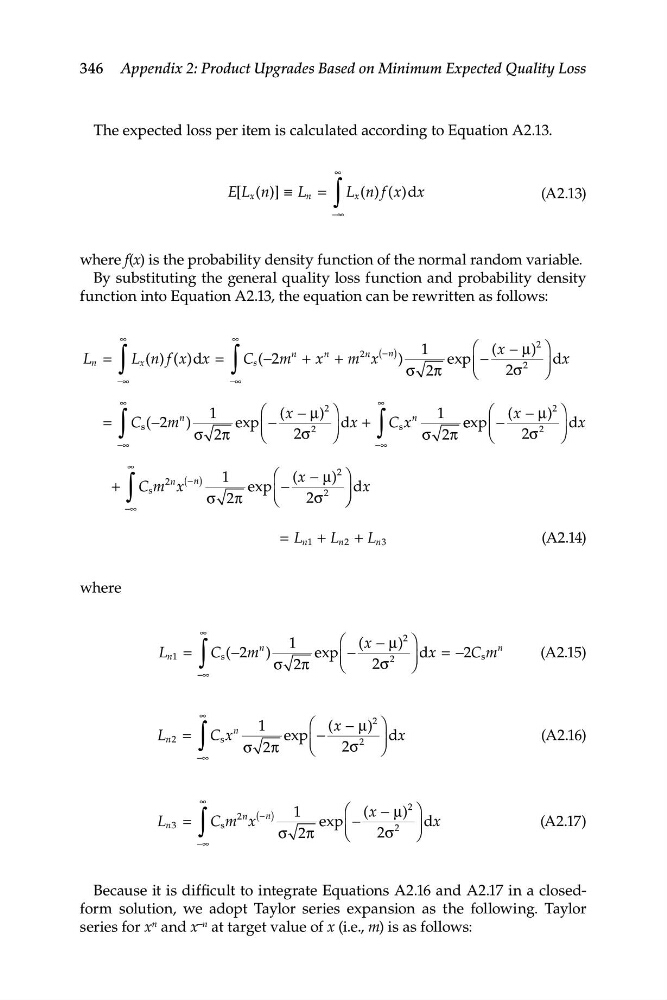
The expected loss per item is calculated according to Equation A2.13.
∞
E[ L x ( n )] ≡ L n = L x (n ) f (x )dx
(A2.13)
−
∫
∞
where f(x) is the probability density function of the normal random variable.
By substituting the general quality loss function and probability density
function into Equation A2.13, the equation can be rewritten as follows:
∞
∞
2
n
n
2n ( − )
(x − µ) ⎞
L
n
1
⎛
n =
∫
L x (n ) f (x ) dx =
∫
C s (−2m + x + m x )
exp −
⎜ ⎜
σ
2
⎟ dx
2π
⎝
2σ ⎠
−∞
−∞
∫
∞
∞
n
1
⎛ (x − µ)
2
⎞
1
⎛ (x − µ)
2
⎞
= C s (−2m )
exp −
⎜
⎟
∫
n
2
dx + C s x
e exp −
⎜
2
⎟ dx
σ 2π
⎝
2σ ⎠
σ 2π
⎝
2σ ⎠
−∞
−∞
∫
∞
1
⎛ (x − µ)
2
2
(
⎞
+ C m
n x
−
s
n)
exp −
⎜
σ 2 π
2
⎟ dx
⎝
2σ ⎠ ⎠
−∞
= L n1 + L + L
(A2.14)
n2
n3
where
∫
∞
n
1
⎛ (x − µ)
2
⎞
L n1 = C s (−2m )
exp −
n
⎜
2
⎟ dx = −2C s m
(A2.15)
σ 2π
⎝
2σ ⎠
−∞
∫
∞
n
1
⎛ (x − µ)
2
⎞
L n 2 = C s x
exp −
⎜
2
⎟ dx
(A2.16)
σ 2π
⎝
2σ ⎠
−∞
∫
∞
2n (−n )
1
⎛ (x − µ)
2
⎞
L n 3 = C s m x
exp −
⎜
⎟ dx
(A2.17)
σ 2π
⎝
2σ
2
⎠
−∞
Because it is difficult to integrate Equations A2.16 and A2.17 in a closedform solution, we adopt Taylor series expansion as the following. Taylor
series for x n and x −n at target value of x (i.e., m) is as follows:
The expected loss per item is calculated according to Equation A2.13.
∞
E[ L x ( n )] ≡ L n = L x (n ) f (x )dx
(A2.13)
−
∫
∞
where f(x) is the probability density function of the normal random variable.
By substituting the general quality loss function and probability density
function into Equation A2.13, the equation can be rewritten as follows:
∞
∞
2
n
n
2n ( − )
(x − µ) ⎞
L
n
1
⎛
n =
∫
L x (n ) f (x ) dx =
∫
C s (−2m + x + m x )
exp −
⎜ ⎜
σ
2
⎟ dx
2π
⎝
2σ ⎠
−∞
−∞
∫
∞
∞
n
1
⎛ (x − µ)
2
⎞
1
⎛ (x − µ)
2
⎞
= C s (−2m )
exp −
⎜
⎟
∫
n
2
dx + C s x
e exp −
⎜
2
⎟ dx
σ 2π
⎝
2σ ⎠
σ 2π
⎝
2σ ⎠
−∞
−∞
∫
∞
1
⎛ (x − µ)
2
2
(
⎞
+ C m
n x
−
s
n)
exp −
⎜
σ 2 π
2
⎟ dx
⎝
2σ ⎠ ⎠
−∞
= L n1 + L + L
(A2.14)
n2
n3
where
∫
∞
n
1
⎛ (x − µ)
2
⎞
L n1 = C s (−2m )
exp −
n
⎜
2
⎟ dx = −2C s m
(A2.15)
σ 2π
⎝
2σ ⎠
−∞
∫
∞
n
1
⎛ (x − µ)
2
⎞
L n 2 = C s x
exp −
⎜
2
⎟ dx
(A2.16)
σ 2π
⎝
2σ ⎠
−∞
∫
∞
2n (−n )
1
⎛ (x − µ)
2
⎞
L n 3 = C s m x
exp −
⎜
⎟ dx
(A2.17)
σ 2π
⎝
2σ
2
⎠
−∞
Because it is difficult to integrate Equations A2.16 and A2.17 in a closedform solution, we adopt Taylor series expansion as the following. Taylor
series for x n and x −n at target value of x (i.e., m) is as follows: