

336 Appendix 2: Product Upgrades Based on Minimum Expected Quality Loss
Performance
–3
0
1
2
3
4
5
6
–2
–1
0
Target value, m
1
2
3
4
–δ
+δ
Losses
High
specification
limit
Lower
specification
limit
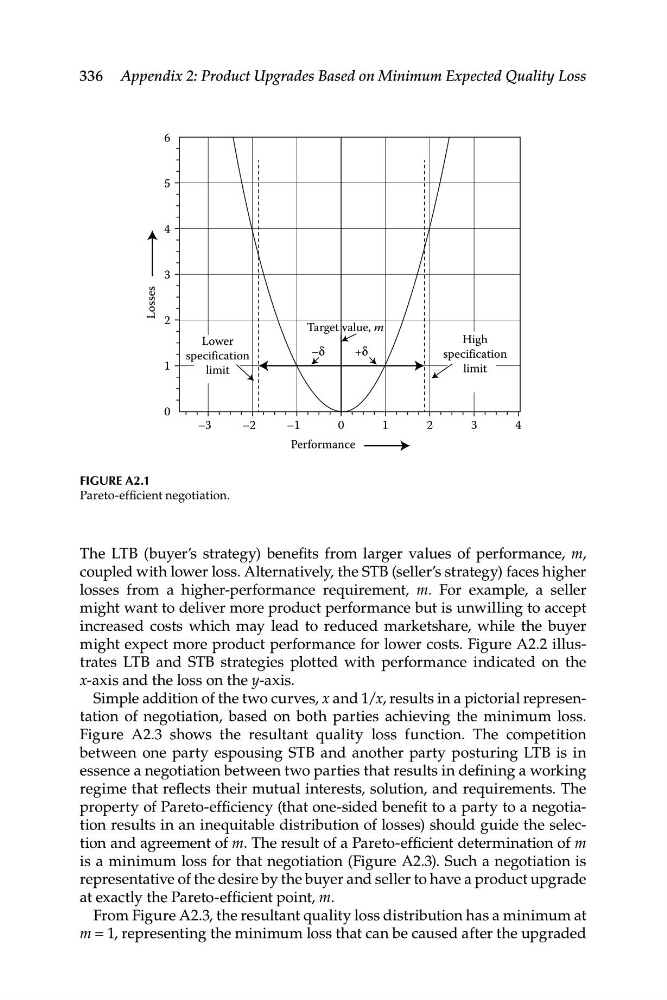
FIgure A2.1
Pareto-efficient negotiation.
The LTB (buyer’s strategy) benefits from larger values of performance, m,
coupled with lower loss. Alternatively, the STB (seller’s strategy) faces higher
losses from a higher-performance requirement, m. For example, a seller
might want to deliver more product performance but is unwilling to accept
increased costs which may lead to reduced marketshare, while the buyer
might expect more product performance for lower costs. Figure A2.2 illustrates LTB and STB strategies plotted with performance indicated on the
x-axis and the loss on the y-axis.
Simple addition of the two curves, x and 1/x, results in a pictorial representation of negotiation, based on both parties achieving the minimum loss.
Figure A2.3 shows the resultant quality loss function. The competition
between one party espousing STB and another party posturing LTB is in
essence a negotiation between two parties that results in defining a working
regime that reflects their mutual interests, solution, and requirements. The
property of Pareto-efficiency (that one-sided benefit to a party to a negotiation results in an inequitable distribution of losses) should guide the selection and agreement of m. The result of a Pareto-efficient determination of m
is a minimum loss for that negotiation (Figure A2.3). Such a negotiation is
representative of the desire by the buyer and seller to have a product upgrade
at exactly the Pareto-efficient point, m.
From Figure A2.3, the resultant quality loss distribution has a minimum at
m = 1, representing the minimum loss that can be caused after the upgraded
Performance
–3
0
1
2
3
4
5
6
–2
–1
0
Target value, m
1
2
3
4
–δ
+δ
Losses
High
specification
limit
Lower
specification
limit
FIgure A2.1
Pareto-efficient negotiation.
The LTB (buyer’s strategy) benefits from larger values of performance, m,
coupled with lower loss. Alternatively, the STB (seller’s strategy) faces higher
losses from a higher-performance requirement, m. For example, a seller
might want to deliver more product performance but is unwilling to accept
increased costs which may lead to reduced marketshare, while the buyer
might expect more product performance for lower costs. Figure A2.2 illustrates LTB and STB strategies plotted with performance indicated on the
x-axis and the loss on the y-axis.
Simple addition of the two curves, x and 1/x, results in a pictorial representation of negotiation, based on both parties achieving the minimum loss.
Figure A2.3 shows the resultant quality loss function. The competition
between one party espousing STB and another party posturing LTB is in
essence a negotiation between two parties that results in defining a working
regime that reflects their mutual interests, solution, and requirements. The
property of Pareto-efficiency (that one-sided benefit to a party to a negotiation results in an inequitable distribution of losses) should guide the selection and agreement of m. The result of a Pareto-efficient determination of m
is a minimum loss for that negotiation (Figure A2.3). Such a negotiation is
representative of the desire by the buyer and seller to have a product upgrade
at exactly the Pareto-efficient point, m.
From Figure A2.3, the resultant quality loss distribution has a minimum at
m = 1, representing the minimum loss that can be caused after the upgraded