

14
Engineering Systems Integration
Object A
(a)
(b)
Object B
Object A
Object B
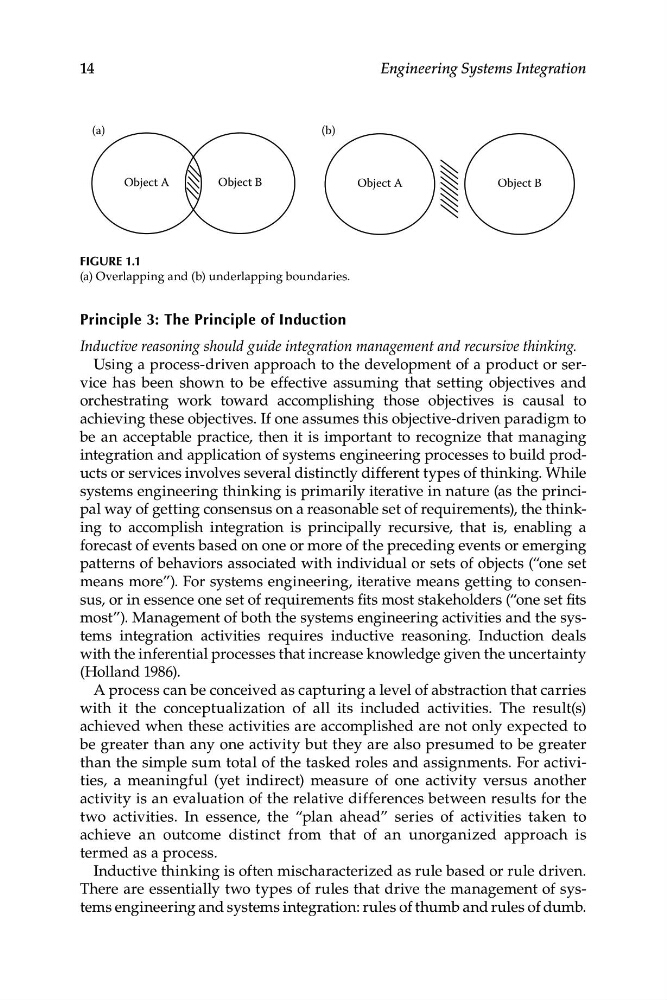
FIgure 1.1
(a) Overlapping and (b) underlapping boundaries.
Principle 3: The Principle of Induction
Inductive reasoning should guide integration management and recursive thinking.
Using a process-driven approach to the development of a product or service has been shown to be effective assuming that setting objectives and
orchestrating work toward accomplishing those objectives is causal to
achieving these objectives. If one assumes this objective-driven paradigm to
be an acceptable practice, then it is important to recognize that managing
integration and application of systems engineering processes to build products or services involves several distinctly different types of thinking. While
systems engineering thinking is primarily iterative in nature (as the principal way of getting consensus on a reasonable set of requirements), the thinking to accomplish integration is principally recursive, that is, enabling a
forecast of events based on one or more of the preceding events or emerging
patterns of behaviors associated with individual or sets of objects (“one set
means more”). For systems engineering, iterative means getting to consensus, or in essence one set of requirements fits most stakeholders (“one set fits
most”). Management of both the systems engineering activities and the systems integration activities requires inductive reasoning. Induction deals
with the inferential processes that increase knowledge given the uncertainty
(Holland 1986).
A process can be conceived as capturing a level of abstraction that carries
with it the conceptualization of all its included activities. The result(s)
achieved when these activities are accomplished are not only expected to
be greater than any one activity but they are also presumed to be greater
than the simple sum total of the tasked roles and assignments. For activities, a meaningful (yet indirect) measure of one activity versus another
activity is an evaluation of the relative differences between results for the
two activities. In essence, the “plan ahead” series of activities taken to
achieve an outcome distinct from that of an unorganized approach is
termed as a process.
Inductive thinking is often mischaracterized as rule based or rule driven.
There are essentially two types of rules that drive the management of systems engineering and systems integration: rules of thumb and rules of dumb.
Engineering Systems Integration
Object A
(a)
(b)
Object B
Object A
Object B
FIgure 1.1
(a) Overlapping and (b) underlapping boundaries.
Principle 3: The Principle of Induction
Inductive reasoning should guide integration management and recursive thinking.
Using a process-driven approach to the development of a product or service has been shown to be effective assuming that setting objectives and
orchestrating work toward accomplishing those objectives is causal to
achieving these objectives. If one assumes this objective-driven paradigm to
be an acceptable practice, then it is important to recognize that managing
integration and application of systems engineering processes to build products or services involves several distinctly different types of thinking. While
systems engineering thinking is primarily iterative in nature (as the principal way of getting consensus on a reasonable set of requirements), the thinking to accomplish integration is principally recursive, that is, enabling a
forecast of events based on one or more of the preceding events or emerging
patterns of behaviors associated with individual or sets of objects (“one set
means more”). For systems engineering, iterative means getting to consensus, or in essence one set of requirements fits most stakeholders (“one set fits
most”). Management of both the systems engineering activities and the systems integration activities requires inductive reasoning. Induction deals
with the inferential processes that increase knowledge given the uncertainty
(Holland 1986).
A process can be conceived as capturing a level of abstraction that carries
with it the conceptualization of all its included activities. The result(s)
achieved when these activities are accomplished are not only expected to
be greater than any one activity but they are also presumed to be greater
than the simple sum total of the tasked roles and assignments. For activities, a meaningful (yet indirect) measure of one activity versus another
activity is an evaluation of the relative differences between results for the
two activities. In essence, the “plan ahead” series of activities taken to
achieve an outcome distinct from that of an unorganized approach is
termed as a process.
Inductive thinking is often mischaracterized as rule based or rule driven.
There are essentially two types of rules that drive the management of systems engineering and systems integration: rules of thumb and rules of dumb.