

316
Engineering Systems Integration
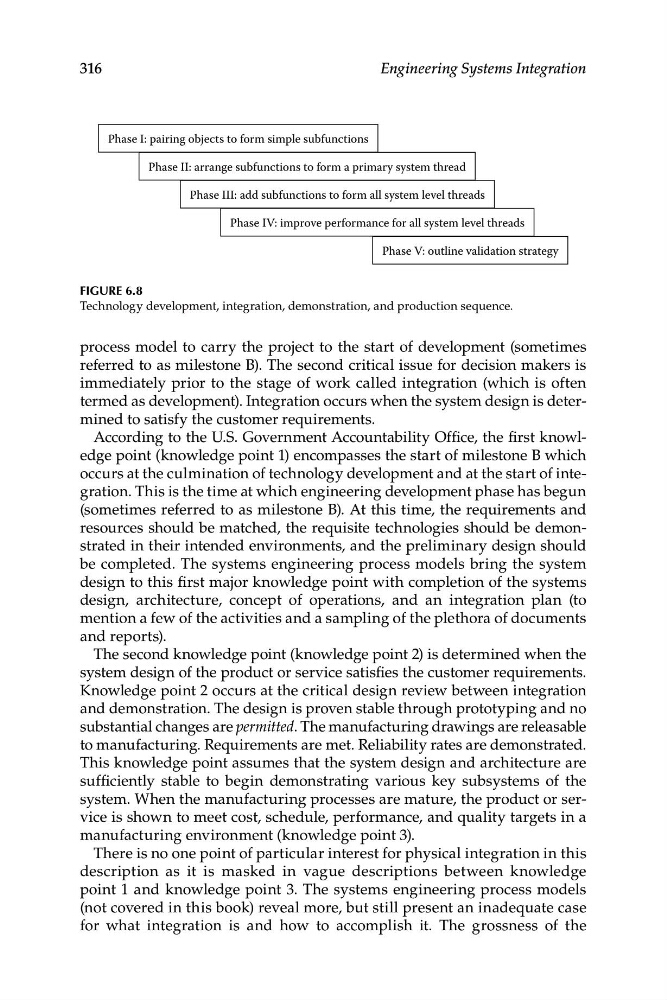
Phase I: pairing objects to form simple subfunctions
Phase II: arrange subfunctions to form a primary system thread
Phase III: add subfunctions to form all system level threads
Phase IV: improve performance for all system level threads
Phase V: outline validation strategy
FIgure 6.8
Technology development, integration, demonstration, and production sequence.
process model to carry the project to the start of development (sometimes
referred to as milestone B). The second critical issue for decision makers is
immediately prior to the stage of work called integration (which is often
termed as development). Integration occurs when the system design is determined to satisfy the customer requirements.
According to the U.S. Government Accountability Office, the first knowledge point (knowledge point 1) encompasses the start of milestone B which
occurs at the culmination of technology development and at the start of integration. This is the time at which engineering development phase has begun
(sometimes referred to as milestone B). At this time, the requirements and
resources should be matched, the requisite technologies should be demonstrated in their intended environments, and the preliminary design should
be completed. The systems engineering process models bring the system
design to this first major knowledge point with completion of the systems
design, architecture, concept of operations, and an integration plan (to
mention a few of the activities and a sampling of the plethora of documents
and reports).
The second knowledge point (knowledge point 2) is determined when the
system design of the product or service satisfies the customer requirements.
Knowledge point 2 occurs at the critical design review between integration
and demonstration. The design is proven stable through prototyping and no
substantial changes are permitted. The manufacturing drawings are releasable
to manufacturing. Requirements are met. Reliability rates are demonstrated.
This knowledge point assumes that the system design and architecture are
sufficiently stable to begin demonstrating various key subsystems of the
system. When the manufacturing processes are mature, the product or service is shown to meet cost, schedule, performance, and quality targets in a
manufacturing environment (knowledge point 3).
There is no one point of particular interest for physical integration in this
description as it is masked in vague descriptions between knowledge
point 1 and knowledge point 3. The systems engineering process models
(not covered in this book) reveal more, but still present an inadequate case
for what integration is and how to accomplish it. The grossness of the