

EMMI
Object
Object
Object
Partial thread
Subfunction
Subfunction
308
Engineering Systems Integration
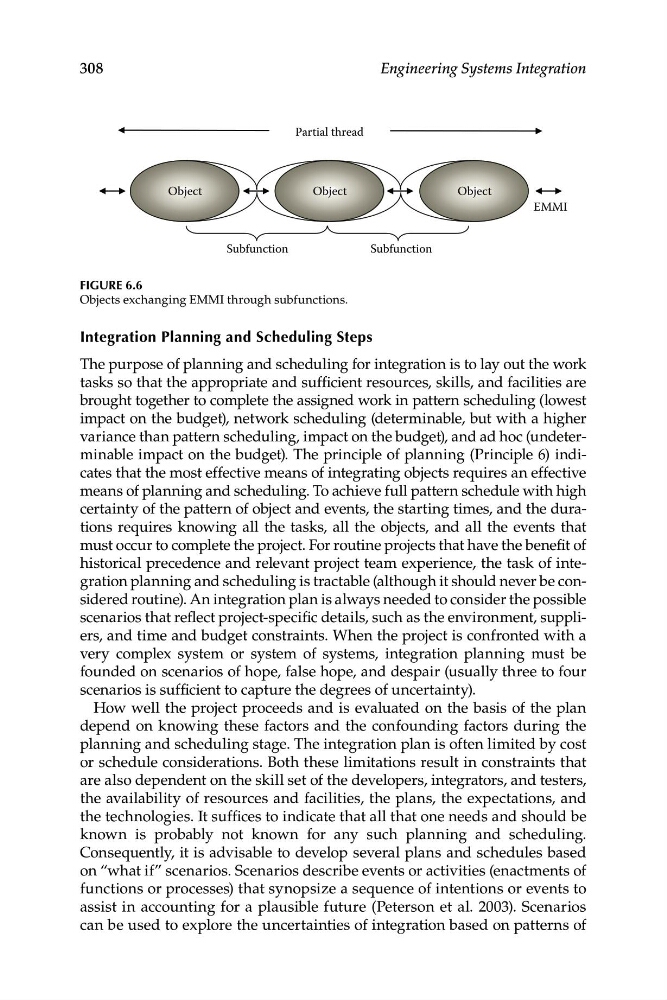
FIgure 6.6
Objects exchanging EMMI through subfunctions.
Integration Planning and Scheduling Steps
The purpose of planning and scheduling for integration is to lay out the work
tasks so that the appropriate and sufficient resources, skills, and facilities are
brought together to complete the assigned work in pattern scheduling (lowest
impact on the budget), network scheduling (determinable, but with a higher
variance than pattern scheduling, impact on the budget), and ad hoc (undeterminable impact on the budget). The principle of planning (Principle 6) indicates that the most effective means of integrating objects requires an effective
means of planning and scheduling. To achieve full pattern schedule with high
certainty of the pattern of object and events, the starting times, and the durations requires knowing all the tasks, all the objects, and all the events that
must occur to complete the project. For routine projects that have the benefit of
historical precedence and relevant project team experience, the task of integration planning and scheduling is tractable (although it should never be considered routine). An integration plan is always needed to consider the possible
scenarios that reflect project-specific details, such as the environment, suppliers, and time and budget constraints. When the project is confronted with a
very complex system or system of systems, integration planning must be
founded on scenarios of hope, false hope, and despair (usually three to four
scenarios is sufficient to capture the degrees of uncertainty).
How well the project proceeds and is evaluated on the basis of the plan
depend on knowing these factors and the confounding factors during the
planning and scheduling stage. The integration plan is often limited by cost
or schedule considerations. Both these limitations result in constraints that
are also dependent on the skill set of the developers, integrators, and testers,
the availability of resources and facilities, the plans, the expectations, and
the technologies. It suffices to indicate that all that one needs and should be
known is probably not known for any such planning and scheduling.
Consequently, it is advisable to develop several plans and schedules based
on “what if” scenarios. Scenarios describe events or activities (enactments of
functions or processes) that synopsize a sequence of intentions or events to
assist in accounting for a plausible future (Peterson et al. 2003). Scenarios
can be used to explore the uncertainties of integration based on patterns of