

7
6.5
6
5.5
5
4.5
4
3.5
3
2.5
2
1.5
1
0.5
0
–0.5
Y
Target, m
Minimum loss
X
Losses (EMMI)
0 0.5 1 1.5 2 2.5 3 3.5 4 4.5 5 5.5 6 6.5 7 7.5
Performance
297
Systems Integration Management
already included in the mechanisms, processes, and physical entities. The
designer’s and the architect’s intentions are to design robustness into the product to mitigate excessive variation in achieving performance(s) so that value can
be imparted to the customer without an associated loss (Yao et al. 1999).
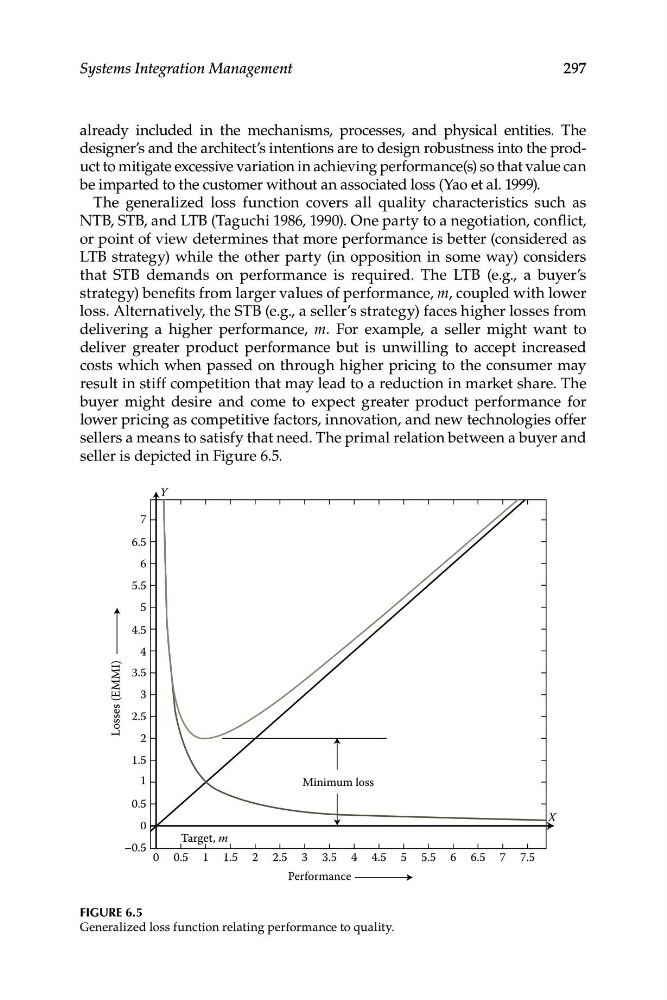
The generalized loss function covers all quality characteristics such as
NTB, STB, and LTB (Taguchi 1986, 1990). One party to a negotiation, conflict,
or point of view determines that more performance is better (considered as
LTB strategy) while the other party (in opposition in some way) considers
that STB demands on performance is required. The LTB (e.g., a buyer’s
strategy) benefits from larger values of performance, m, coupled with lower
loss. Alternatively, the STB (e.g., a seller’s strategy) faces higher losses from
delivering a higher performance, m. For example, a seller might want to
deliver greater product performance but is unwilling to accept increased
costs which when passed on through higher pricing to the consumer may
result in stiff competition that may lead to a reduction in market share. The
buyer might desire and come to expect greater product performance for
lower pricing as competitive factors, innovation, and new technologies offer
sellers a means to satisfy that need. The primal relation between a buyer and
seller is depicted in Figure 6.5.
FIgure 6.5
Generalized loss function relating performance to quality.
6.5
6
5.5
5
4.5
4
3.5
3
2.5
2
1.5
1
0.5
0
–0.5
Y
Target, m
Minimum loss
X
Losses (EMMI)
0 0.5 1 1.5 2 2.5 3 3.5 4 4.5 5 5.5 6 6.5 7 7.5
Performance
297
Systems Integration Management
already included in the mechanisms, processes, and physical entities. The
designer’s and the architect’s intentions are to design robustness into the product to mitigate excessive variation in achieving performance(s) so that value can
be imparted to the customer without an associated loss (Yao et al. 1999).
The generalized loss function covers all quality characteristics such as
NTB, STB, and LTB (Taguchi 1986, 1990). One party to a negotiation, conflict,
or point of view determines that more performance is better (considered as
LTB strategy) while the other party (in opposition in some way) considers
that STB demands on performance is required. The LTB (e.g., a buyer’s
strategy) benefits from larger values of performance, m, coupled with lower
loss. Alternatively, the STB (e.g., a seller’s strategy) faces higher losses from
delivering a higher performance, m. For example, a seller might want to
deliver greater product performance but is unwilling to accept increased
costs which when passed on through higher pricing to the consumer may
result in stiff competition that may lead to a reduction in market share. The
buyer might desire and come to expect greater product performance for
lower pricing as competitive factors, innovation, and new technologies offer
sellers a means to satisfy that need. The primal relation between a buyer and
seller is depicted in Figure 6.5.
FIgure 6.5
Generalized loss function relating performance to quality.