

284
Engineering Systems Integration
“To plan”
“To direct”
“To communicate”
“To organize”
“To control”
“To team-build”
1.0
1.1.1
1.1.2
1.1.3
1.1.4
1.1.5
1.1.6
“To manage”
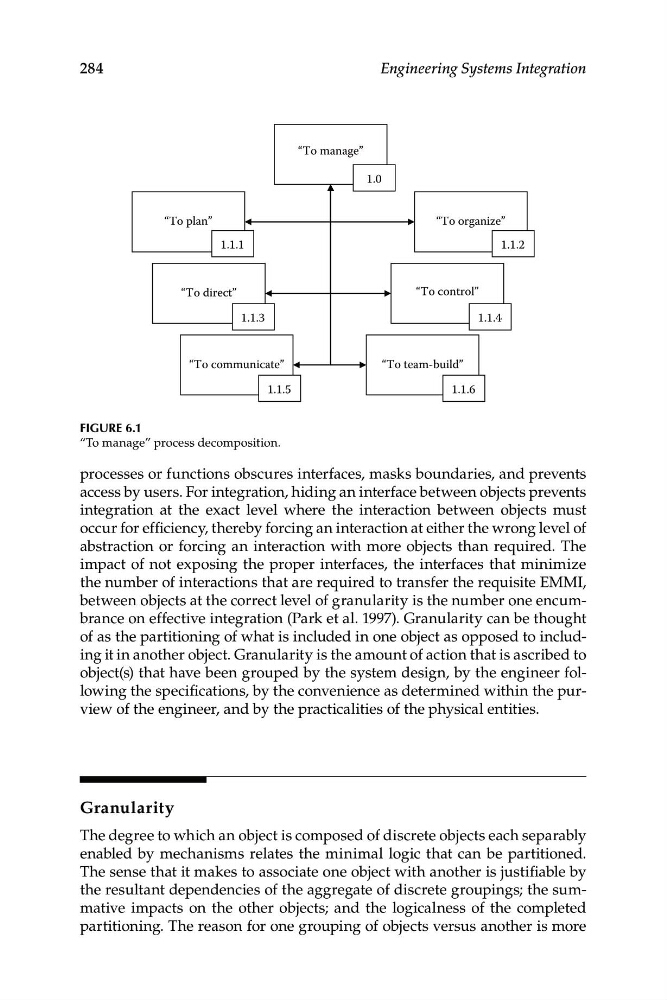
FIgure 6.1
“To manage” process decomposition.
processes or functions obscures interfaces, masks boundaries, and prevents
access by users. For integration, hiding an interface between objects prevents
integration at the exact level where the interaction between objects must
occur for efficiency, thereby forcing an interaction at either the wrong level of
abstraction or forcing an interaction with more objects than required. The
impact of not exposing the proper interfaces, the interfaces that minimize
the number of interactions that are required to transfer the requisite EMMI,
between objects at the correct level of granularity is the number one encumbrance on effective integration (Park et al. 1997). Granularity can be thought
of as the partitioning of what is included in one object as opposed to including it in another object. Granularity is the amount of action that is ascribed to
object(s) that have been grouped by the system design, by the engineer following the specifications, by the convenience as determined within the purview of the engineer, and by the practicalities of the physical entities.
Granularity
The degree to which an object is composed of discrete objects each separably
enabled by mechanisms relates the minimal logic that can be partitioned.
The sense that it makes to associate one object with another is justifiable by
the resultant dependencies of the aggregate of discrete groupings; the summative impacts on the other objects; and the logicalness of the completed
partitioning. The reason for one grouping of objects versus another is more
Engineering Systems Integration
“To plan”
“To direct”
“To communicate”
“To organize”
“To control”
“To team-build”
1.0
1.1.1
1.1.2
1.1.3
1.1.4
1.1.5
1.1.6
“To manage”
FIgure 6.1
“To manage” process decomposition.
processes or functions obscures interfaces, masks boundaries, and prevents
access by users. For integration, hiding an interface between objects prevents
integration at the exact level where the interaction between objects must
occur for efficiency, thereby forcing an interaction at either the wrong level of
abstraction or forcing an interaction with more objects than required. The
impact of not exposing the proper interfaces, the interfaces that minimize
the number of interactions that are required to transfer the requisite EMMI,
between objects at the correct level of granularity is the number one encumbrance on effective integration (Park et al. 1997). Granularity can be thought
of as the partitioning of what is included in one object as opposed to including it in another object. Granularity is the amount of action that is ascribed to
object(s) that have been grouped by the system design, by the engineer following the specifications, by the convenience as determined within the purview of the engineer, and by the practicalities of the physical entities.
Granularity
The degree to which an object is composed of discrete objects each separably
enabled by mechanisms relates the minimal logic that can be partitioned.
The sense that it makes to associate one object with another is justifiable by
the resultant dependencies of the aggregate of discrete groupings; the summative impacts on the other objects; and the logicalness of the completed
partitioning. The reason for one grouping of objects versus another is more