

190
Engineering Systems Integration
a particular context, such as environment), and attributes (those items that
are neither intrinsic properties nor traits, but associated with the object).
From Chapter 1, we summarize the principles of integration, and then discuss the implications of those principles with reference to systems.
Principle 1: The Principle of Alignment: Alignment of strategies for the
business enterprise, the key stakeholders, and the project results in
better outcomes for product or service development.
Principle 2: The Principle of Partitioning: Partitioning of objects can create
tractable problems to solve if and only if boundary contiguity is
achieved.
Principle 3: The Principle of Induction: Inductive reasoning should guide
integration management and recursive thinking.
Principle 4: The Principle of Limitation: Integration is only as good as
architecture captures stakeholder requirements.
Principle 5: The Principle of Forethought: Integration is a primary, key
activity, not an afterthought considered as a result of development.
Principle 6: The Principle of Planning: Integration planning is predicated
on pattern scheduling (lowest impact on budget), network scheduling (determinable impact on budget), and ad hoc scheduling (undetermined impact on budget).
Principle 7: The Principle of Loss: When two objects are integrated, both
objects give up some measure of autonomous behavior.
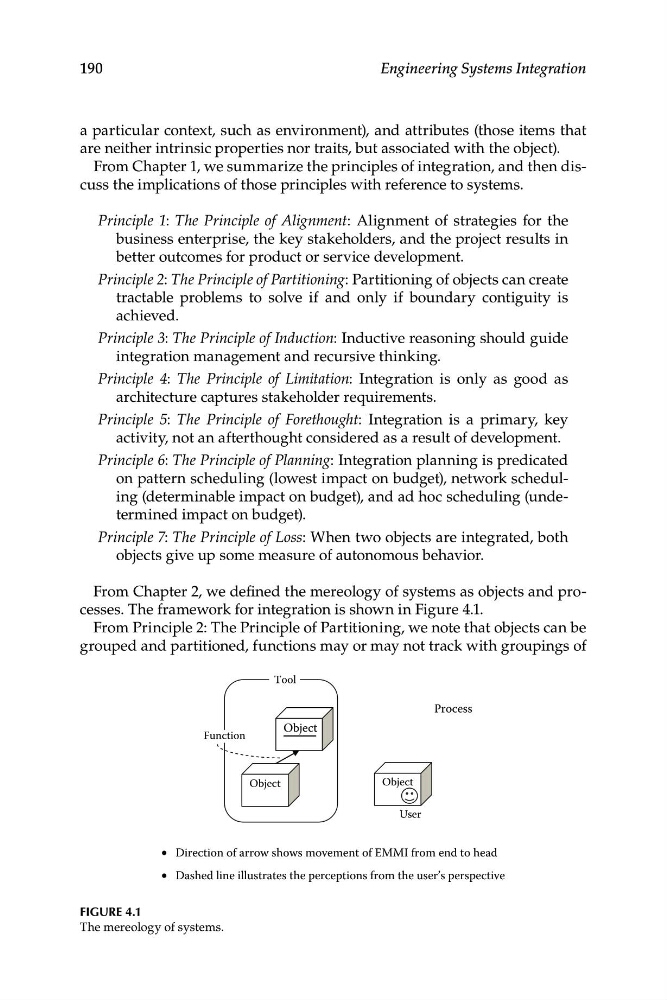
From Chapter 2, we defined the mereology of systems as objects and processes. The framework for integration is shown in Figure 4.1.
From Principle 2: The Principle of Partitioning, we note that objects can be
grouped and partitioned, functions may or may not track with groupings of
Object
Object
Function
Object
User
Process
Tool
• Direction of arrow shows movement of EMMI from end to head
• Dashed line illustrates the perceptions from the user’s perspective
FIgure 4.1
The mereology of systems.
Engineering Systems Integration
a particular context, such as environment), and attributes (those items that
are neither intrinsic properties nor traits, but associated with the object).
From Chapter 1, we summarize the principles of integration, and then discuss the implications of those principles with reference to systems.
Principle 1: The Principle of Alignment: Alignment of strategies for the
business enterprise, the key stakeholders, and the project results in
better outcomes for product or service development.
Principle 2: The Principle of Partitioning: Partitioning of objects can create
tractable problems to solve if and only if boundary contiguity is
achieved.
Principle 3: The Principle of Induction: Inductive reasoning should guide
integration management and recursive thinking.
Principle 4: The Principle of Limitation: Integration is only as good as
architecture captures stakeholder requirements.
Principle 5: The Principle of Forethought: Integration is a primary, key
activity, not an afterthought considered as a result of development.
Principle 6: The Principle of Planning: Integration planning is predicated
on pattern scheduling (lowest impact on budget), network scheduling (determinable impact on budget), and ad hoc scheduling (undetermined impact on budget).
Principle 7: The Principle of Loss: When two objects are integrated, both
objects give up some measure of autonomous behavior.
From Chapter 2, we defined the mereology of systems as objects and processes. The framework for integration is shown in Figure 4.1.
From Principle 2: The Principle of Partitioning, we note that objects can be
grouped and partitioned, functions may or may not track with groupings of
Object
Object
Function
Object
User
Process
Tool
• Direction of arrow shows movement of EMMI from end to head
• Dashed line illustrates the perceptions from the user’s perspective
FIgure 4.1
The mereology of systems.