

179
Foundations in Systems Integration
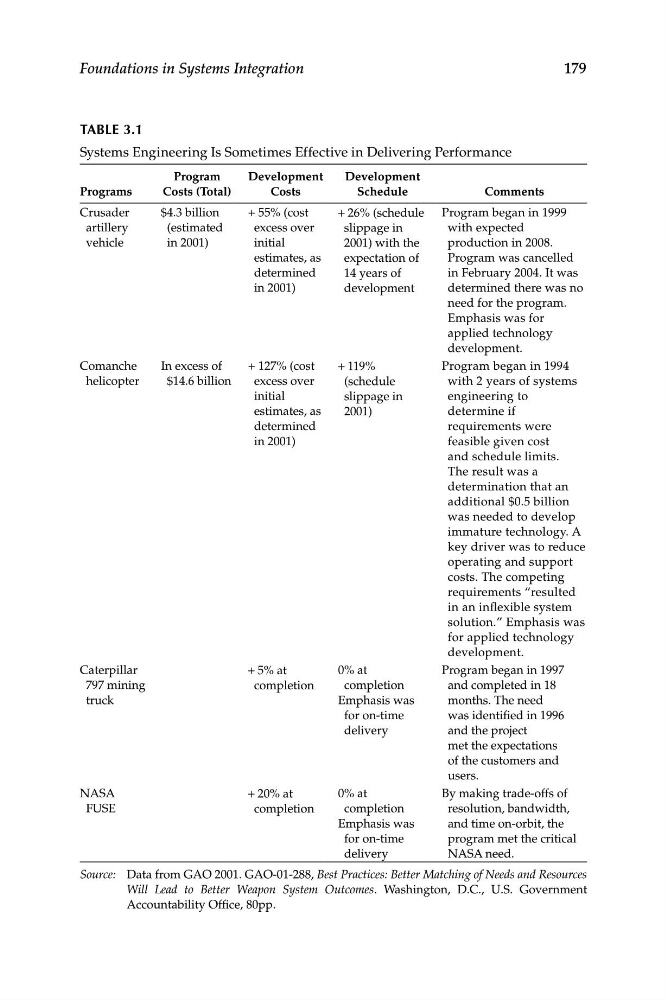
TABLe 3.1
Systems Engineering Is Sometimes Effective in Delivering Performance
Programs
Program
Costs (Total)
Development
Costs
Development
Schedule
Comments
Crusader
artillery
vehicle
$4.3 billion
(estimated
in 2001)
+ 55% (cost
excess over
initial
estimates, as
determined
in 2001)
+ 26% (schedule
slippage in
2001) with the
expectation of
14 years of
development
Program began in 1999
with expected
production in 2008.
Program was cancelled
in February 2004. It was
determined there was no
need for the program.
Emphasis was for
applied technology
development.
Comanche
helicopter
In excess of
$14.6 billion
+ 127% (cost
excess over
initial
estimates, as
determined
in 2001)
+ 119%
(schedule
slippage in
2001)
Program began in 1994
with 2 years of systems
engineering to
determine if
requirements were
feasible given cost
and schedule limits.
The result was a
determination that an
additional $0.5 billion
was needed to develop
immature technology. A
key driver was to reduce
operating and support
costs. The competing
requirements “resulted
in an inflexible system
solution.” Emphasis was
for applied technology
development.
Caterpillar
797 mining
truck
+ 5% at
completion
0% at
completion
Emphasis was
for on-time
Program began in 1997
and completed in 18
months. The need
was identified in 1996
delivery
and the project
met the expectations
of the customers and
users.
NASA
FUSE
+ 20% at
completion
0% at
completion
Emphasis was
for on-time
delivery
By making trade-offs of
resolution, bandwidth,
and time on-orbit, the
program met the critical
NASA need.
Source: Data from GAO 2001. GAO-01-288, Best Practices: Better Matching of Needs and Resources
Will Lead to Better Weapon System Outcomes. Washington, D.C., U.S. Government
Accountability Office, 80pp.