

Objects
Development
Integration
Objects
Object
interactions
EMMI
Object to object
EMMI
Object on
objects EMMI
End to end
EMMI
Concepteffective
Needs
Problem
Stakeholders
Protoeffective
Objects
Prioritize
Interactions
Iterations
Systemeffective
Tests
Objects
EMMI
Recursions
Processes
Elicit
requirements
Define
functions
Design and
architect
Test object to
object EMMI
Test object on
objects EMMI
Test end to
end EMMI
114
Engineering Systems Integration
does not imply integration. Lifecycle is merely the temporal interpretation of
integration, not the impetus.
Rather than thinking of integration in a lifecycle sense or in a process
sense (as is typical through the use of systems engineering process models),
this presentation focuses on the progression and results of interaction and
integration for a set of processes and objects (the mereology of integration).
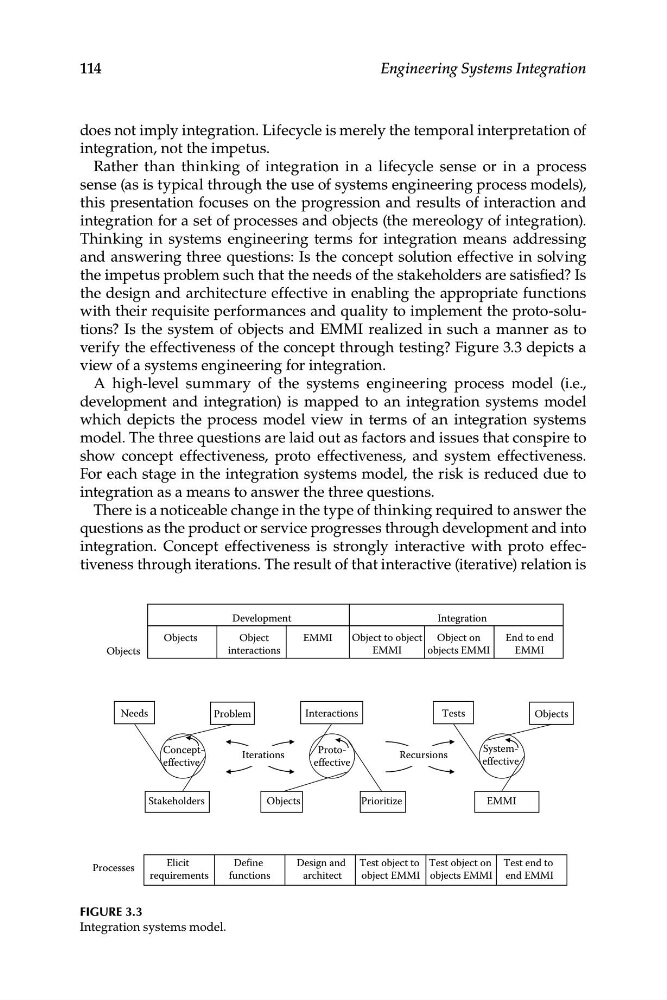
Thinking in systems engineering terms for integration means addressing
and answering three questions: Is the concept solution effective in solving
the impetus problem such that the needs of the stakeholders are satisfied? Is
the design and architecture effective in enabling the appropriate functions
with their requisite performances and quality to implement the proto-solutions? Is the system of objects and EMMI realized in such a manner as to
verify the effectiveness of the concept through testing? Figure 3.3 depicts a
view of a systems engineering for integration.
A high-level summary of the systems engineering process model (i.e.,
development and integration) is mapped to an integration systems model
which depicts the process model view in terms of an integration systems
model. The three questions are laid out as factors and issues that conspire to
show concept effectiveness, proto effectiveness, and system effectiveness.
For each stage in the integration systems model, the risk is reduced due to
integration as a means to answer the three questions.
There is a noticeable change in the type of thinking required to answer the
questions as the product or service progresses through development and into
integration. Concept effectiveness is strongly interactive with proto effectiveness through iterations. The result of that interactive (iterative) relation is
FIgure 3.3
Integration systems model.
Development
Integration
Objects
Object
interactions
EMMI
Object to object
EMMI
Object on
objects EMMI
End to end
EMMI
Concepteffective
Needs
Problem
Stakeholders
Protoeffective
Objects
Prioritize
Interactions
Iterations
Systemeffective
Tests
Objects
EMMI
Recursions
Processes
Elicit
requirements
Define
functions
Design and
architect
Test object to
object EMMI
Test object on
objects EMMI
Test end to
end EMMI
114
Engineering Systems Integration
does not imply integration. Lifecycle is merely the temporal interpretation of
integration, not the impetus.
Rather than thinking of integration in a lifecycle sense or in a process
sense (as is typical through the use of systems engineering process models),
this presentation focuses on the progression and results of interaction and
integration for a set of processes and objects (the mereology of integration).
Thinking in systems engineering terms for integration means addressing
and answering three questions: Is the concept solution effective in solving
the impetus problem such that the needs of the stakeholders are satisfied? Is
the design and architecture effective in enabling the appropriate functions
with their requisite performances and quality to implement the proto-solutions? Is the system of objects and EMMI realized in such a manner as to
verify the effectiveness of the concept through testing? Figure 3.3 depicts a
view of a systems engineering for integration.
A high-level summary of the systems engineering process model (i.e.,
development and integration) is mapped to an integration systems model
which depicts the process model view in terms of an integration systems
model. The three questions are laid out as factors and issues that conspire to
show concept effectiveness, proto effectiveness, and system effectiveness.
For each stage in the integration systems model, the risk is reduced due to
integration as a means to answer the three questions.
There is a noticeable change in the type of thinking required to answer the
questions as the product or service progresses through development and into
integration. Concept effectiveness is strongly interactive with proto effectiveness through iterations. The result of that interactive (iterative) relation is
FIgure 3.3
Integration systems model.