

Object e 1.1.1 interacts with object e 1.1.2
Object e 1.1.2
Object e 1.1.2 interacts with object e 1.1.1
Object e 1.1.2 interacts with object e 1.1.3
Object e 1.1.3 interacts with object e 1.1.2
Object e 1.1.3
Object e 1.1.1
Object e 1.1.1 interacts with object e 1.1.3
Object e 1.1.3 interacts with object e 1.1.1
Object e 1.1.2 interacts with object e 1.1.1
Object e 2
109
Foundations in Systems Integration
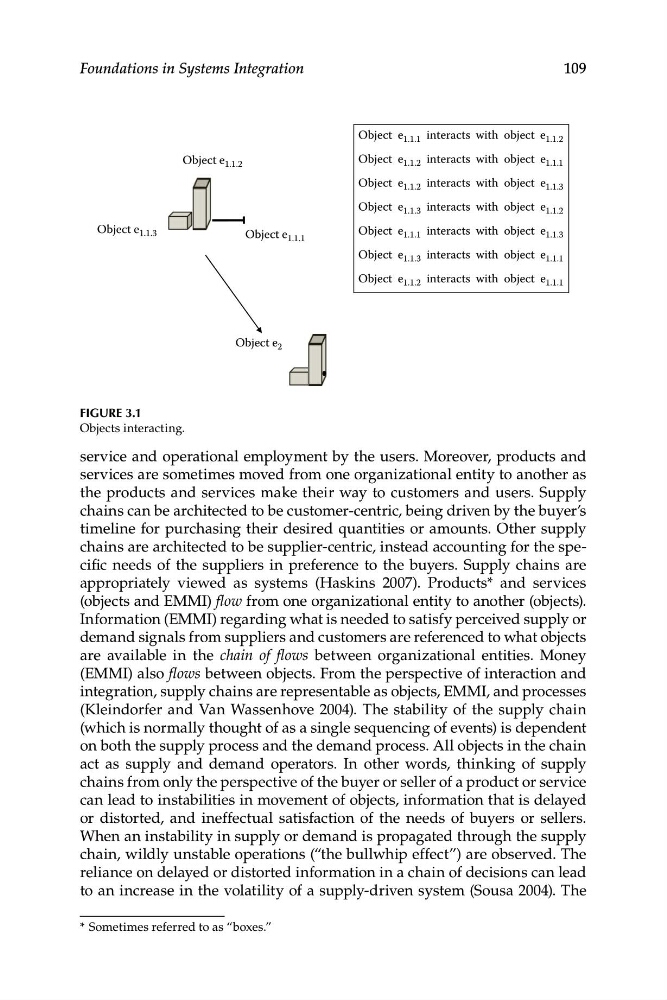
FIgure 3.1
Objects interacting.
service and operational employment by the users. Moreover, products and
services are sometimes moved from one organizational entity to another as
the products and services make their way to customers and users. Supply
chains can be architected to be customer-centric, being driven by the buyer’s
timeline for purchasing their desired quantities or amounts. Other supply
chains are architected to be supplier-centric, instead accounting for the specific needs of the suppliers in preference to the buyers. Supply chains are
appropriately viewed as systems (Haskins 2007). Products* and services
(objects and EMMI) flow from one organizational entity to another (objects).
Information (EMMI) regarding what is needed to satisfy perceived supply or
demand signals from suppliers and customers are referenced to what objects
are available in the chain of flows between organizational entities. Money
(EMMI) also flows between objects. From the perspective of interaction and
integration, supply chains are representable as objects, EMMI, and processes
(Kleindorfer and Van Wassenhove 2004). The stability of the supply chain
(which is normally thought of as a single sequencing of events) is dependent
on both the supply process and the demand process. All objects in the chain
act as supply and demand operators. In other words, thinking of supply
chains from only the perspective of the buyer or seller of a product or service
can lead to instabilities in movement of objects, information that is delayed
or distorted, and ineffectual satisfaction of the needs of buyers or sellers.
When an instability in supply or demand is propagated through the supply
chain, wildly unstable operations (“the bullwhip effect”) are observed. The
reliance on delayed or distorted information in a chain of decisions can lead
to an increase in the volatility of a supply-driven system (Sousa 2004). The
* Sometimes referred to as “boxes.”
Object e 1.1.2
Object e 1.1.2 interacts with object e 1.1.1
Object e 1.1.2 interacts with object e 1.1.3
Object e 1.1.3 interacts with object e 1.1.2
Object e 1.1.3
Object e 1.1.1
Object e 1.1.1 interacts with object e 1.1.3
Object e 1.1.3 interacts with object e 1.1.1
Object e 1.1.2 interacts with object e 1.1.1
Object e 2
109
Foundations in Systems Integration
FIgure 3.1
Objects interacting.
service and operational employment by the users. Moreover, products and
services are sometimes moved from one organizational entity to another as
the products and services make their way to customers and users. Supply
chains can be architected to be customer-centric, being driven by the buyer’s
timeline for purchasing their desired quantities or amounts. Other supply
chains are architected to be supplier-centric, instead accounting for the specific needs of the suppliers in preference to the buyers. Supply chains are
appropriately viewed as systems (Haskins 2007). Products* and services
(objects and EMMI) flow from one organizational entity to another (objects).
Information (EMMI) regarding what is needed to satisfy perceived supply or
demand signals from suppliers and customers are referenced to what objects
are available in the chain of flows between organizational entities. Money
(EMMI) also flows between objects. From the perspective of interaction and
integration, supply chains are representable as objects, EMMI, and processes
(Kleindorfer and Van Wassenhove 2004). The stability of the supply chain
(which is normally thought of as a single sequencing of events) is dependent
on both the supply process and the demand process. All objects in the chain
act as supply and demand operators. In other words, thinking of supply
chains from only the perspective of the buyer or seller of a product or service
can lead to instabilities in movement of objects, information that is delayed
or distorted, and ineffectual satisfaction of the needs of buyers or sellers.
When an instability in supply or demand is propagated through the supply
chain, wildly unstable operations (“the bullwhip effect”) are observed. The
reliance on delayed or distorted information in a chain of decisions can lead
to an increase in the volatility of a supply-driven system (Sousa 2004). The
* Sometimes referred to as “boxes.”