

Limitations of
Constraints
Modal
imposed on
causalities
budgets and
schedules
Customer
Project
Proximate
Conditional
causalities
budgets and
schedules
Developer
causalities
Subjective frame
Objective
frame
Cognition Procedures Models
Behaviors
functions
objects
Social and management domain
Product
or
service
domain
Nexus of
objective causalities
82
Engineering Systems Integration
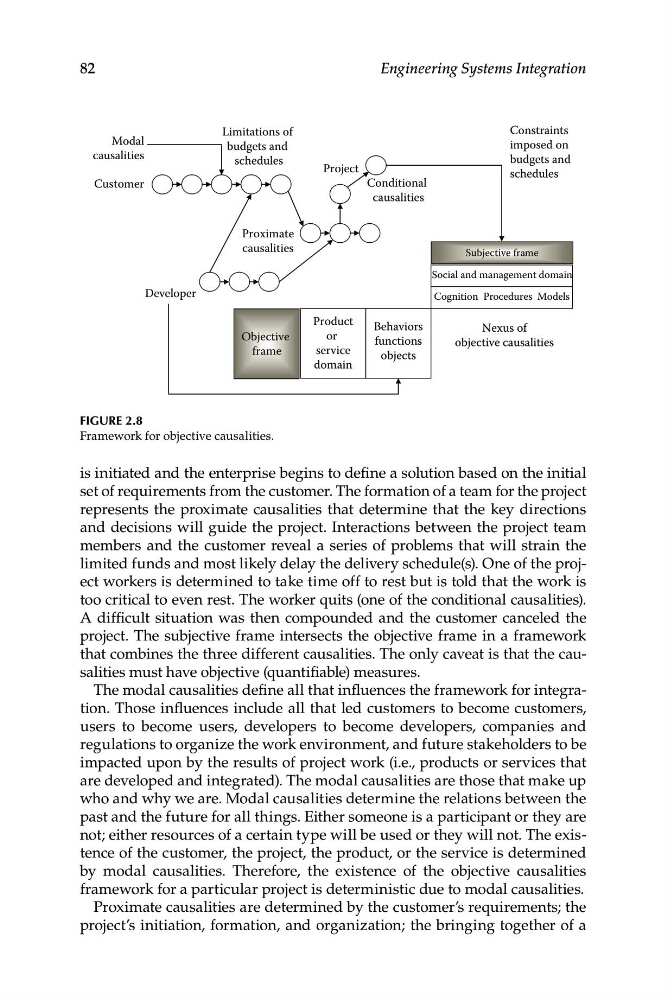
FIgure 2.8
Framework for objective causalities.
is initiated and the enterprise begins to define a solution based on the initial
set of requirements from the customer. The formation of a team for the project
represents the proximate causalities that determine that the key directions
and decisions will guide the project. Interactions between the project team
members and the customer reveal a series of problems that will strain the
limited funds and most likely delay the delivery schedule(s). One of the project workers is determined to take time off to rest but is told that the work is
too critical to even rest. The worker quits (one of the conditional causalities).
A difficult situation was then compounded and the customer canceled the
project. The subjective frame intersects the objective frame in a framework
that combines the three different causalities. The only caveat is that the causalities must have objective (quantifiable) measures.
The modal causalities define all that influences the framework for integration. Those influences include all that led customers to become customers,
users to become users, developers to become developers, companies and
regulations to organize the work environment, and future stakeholders to be
impacted upon by the results of project work (i.e., products or services that
are developed and integrated). The modal causalities are those that make up
who and why we are. Modal causalities determine the relations between the
past and the future for all things. Either someone is a participant or they are
not; either resources of a certain type will be used or they will not. The existence of the customer, the project, the product, or the service is determined
by modal causalities. Therefore, the existence of the objective causalities
framework for a particular project is deterministic due to modal causalities.
Proximate causalities are determined by the customer’s requirements; the
project’s initiation, formation, and organization; the bringing together of a
Constraints
Modal
imposed on
causalities
budgets and
schedules
Customer
Project
Proximate
Conditional
causalities
budgets and
schedules
Developer
causalities
Subjective frame
Objective
frame
Cognition Procedures Models
Behaviors
functions
objects
Social and management domain
Product
or
service
domain
Nexus of
objective causalities
82
Engineering Systems Integration
FIgure 2.8
Framework for objective causalities.
is initiated and the enterprise begins to define a solution based on the initial
set of requirements from the customer. The formation of a team for the project
represents the proximate causalities that determine that the key directions
and decisions will guide the project. Interactions between the project team
members and the customer reveal a series of problems that will strain the
limited funds and most likely delay the delivery schedule(s). One of the project workers is determined to take time off to rest but is told that the work is
too critical to even rest. The worker quits (one of the conditional causalities).
A difficult situation was then compounded and the customer canceled the
project. The subjective frame intersects the objective frame in a framework
that combines the three different causalities. The only caveat is that the causalities must have objective (quantifiable) measures.
The modal causalities define all that influences the framework for integration. Those influences include all that led customers to become customers,
users to become users, developers to become developers, companies and
regulations to organize the work environment, and future stakeholders to be
impacted upon by the results of project work (i.e., products or services that
are developed and integrated). The modal causalities are those that make up
who and why we are. Modal causalities determine the relations between the
past and the future for all things. Either someone is a participant or they are
not; either resources of a certain type will be used or they will not. The existence of the customer, the project, the product, or the service is determined
by modal causalities. Therefore, the existence of the objective causalities
framework for a particular project is deterministic due to modal causalities.
Proximate causalities are determined by the customer’s requirements; the
project’s initiation, formation, and organization; the bringing together of a