

the actual rift valley system. Lake Victoria, which lies
between two rift valley systems, was formed by tectonic
movements about 100,000 years ago.
In humid climates all lakes will have outlets in the
form of rivers or via the groundwater, but in arid
climates lakes develop into evaporite basins without
outlets. Normal, non-saline lakes differ from ocean
basins in several ways:
1. Low salinity leads to slower flocculation of clay
particles than in marine basins, producing more
distinct lamination.
2. Low wave and tidal energy and weaker currents
mean less erosion and resedimentation. Seasonal
variation in the influx of sediments may produce
annual cycles in lacustrine sediments.
3. Limited water circulation makes it easier for the
water to develop layering based on temperature
(thermocline) and therefore also density
(pycnocline) between dense layers at the bottom
and less dense water near the surface. This may
restrict oxidation of organic material and promote
the development of organic-rich sediments (source
rocks) in the deeper parts of the lakes. In warm
climates the temperatures of the lake waters are
always above 4
C which makes the water stratification rather stable. In colder climates the water
column will be inverted when the temperatures falls
to 4
C which is the highest density. This results in
an oxygen supply to the lake bottom.
4. River water will generally have approximately the
same density as lake water, and will therefore mix
well and deposit sediments rapidly. Cold (glacial)
river water or river water with a lot of suspended
material will be heavier than lake water, however,
and will form turbidity currents along the bottom.
5. Lake sediments have a distinctly different fauna
from marine basins. The geochemistry of lake
sediments and the composition of carbonates and
b
Windward side
erosion
Cross-bedding (foreset)
(Deflation)
Erosion
Leeward side
deposition
a
c
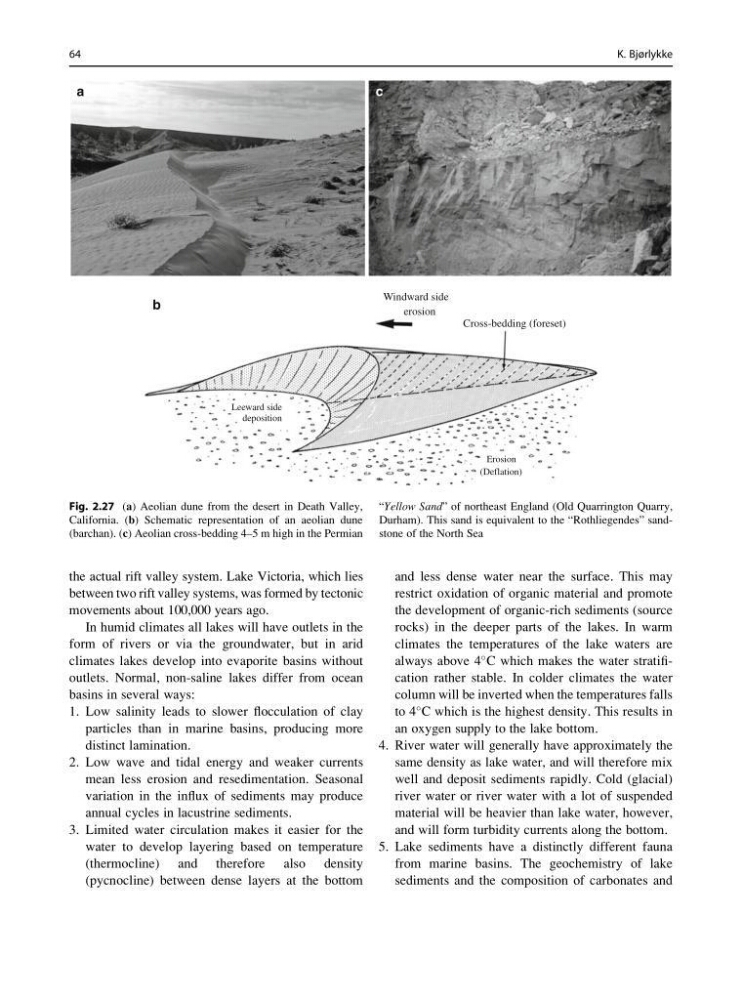
Fig. 2.27 (a) Aeolian dune from the desert in Death Valley,
California. (b) Schematic representation of an aeolian dune
(barchan). (c) Aeolian cross-bedding 4–5 m high in the Permian
“Yellow Sand” of northeast England (Old Quarrington Quarry,
Durham). This sand is equivalent to the “Rothliegendes” sandstone of the North Sea
64
K. Bjørlykke
between two rift valley systems, was formed by tectonic
movements about 100,000 years ago.
In humid climates all lakes will have outlets in the
form of rivers or via the groundwater, but in arid
climates lakes develop into evaporite basins without
outlets. Normal, non-saline lakes differ from ocean
basins in several ways:
1. Low salinity leads to slower flocculation of clay
particles than in marine basins, producing more
distinct lamination.
2. Low wave and tidal energy and weaker currents
mean less erosion and resedimentation. Seasonal
variation in the influx of sediments may produce
annual cycles in lacustrine sediments.
3. Limited water circulation makes it easier for the
water to develop layering based on temperature
(thermocline) and therefore also density
(pycnocline) between dense layers at the bottom
and less dense water near the surface. This may
restrict oxidation of organic material and promote
the development of organic-rich sediments (source
rocks) in the deeper parts of the lakes. In warm
climates the temperatures of the lake waters are
always above 4
C which makes the water stratification rather stable. In colder climates the water
column will be inverted when the temperatures falls
to 4
C which is the highest density. This results in
an oxygen supply to the lake bottom.
4. River water will generally have approximately the
same density as lake water, and will therefore mix
well and deposit sediments rapidly. Cold (glacial)
river water or river water with a lot of suspended
material will be heavier than lake water, however,
and will form turbidity currents along the bottom.
5. Lake sediments have a distinctly different fauna
from marine basins. The geochemistry of lake
sediments and the composition of carbonates and
b
Windward side
erosion
Cross-bedding (foreset)
(Deflation)
Erosion
Leeward side
deposition
a
c
Fig. 2.27 (a) Aeolian dune from the desert in Death Valley,
California. (b) Schematic representation of an aeolian dune
(barchan). (c) Aeolian cross-bedding 4–5 m high in the Permian
“Yellow Sand” of northeast England (Old Quarrington Quarry,
Durham). This sand is equivalent to the “Rothliegendes” sandstone of the North Sea
64
K. Bjørlykke