

takes place (Fig. 2.14). They therefore migrate as a
result of the combined effects of erosion and deposition. Current ripples form in fine-grained sand when
the velocity exceeds the lower limit for sediment
movement. Sections through ripples show inclined
foreset laminae, a structure called “small-scale crosslamination”. Ripples may also form in coarser sand
but there is an upper limit of 0.6–0.7 mm for the grain
diameter. Ripples are less than 3–5 cm high, and may
have a wavelength of up to 40 cm. The ripple index is
an expression of the ratio of the wavelength divided by
the wave height, and varies between 10 and 40. Waves
may generate oscillatory flow that produces symmetrical ripples, which have foreset laminae pointing in
both directions.
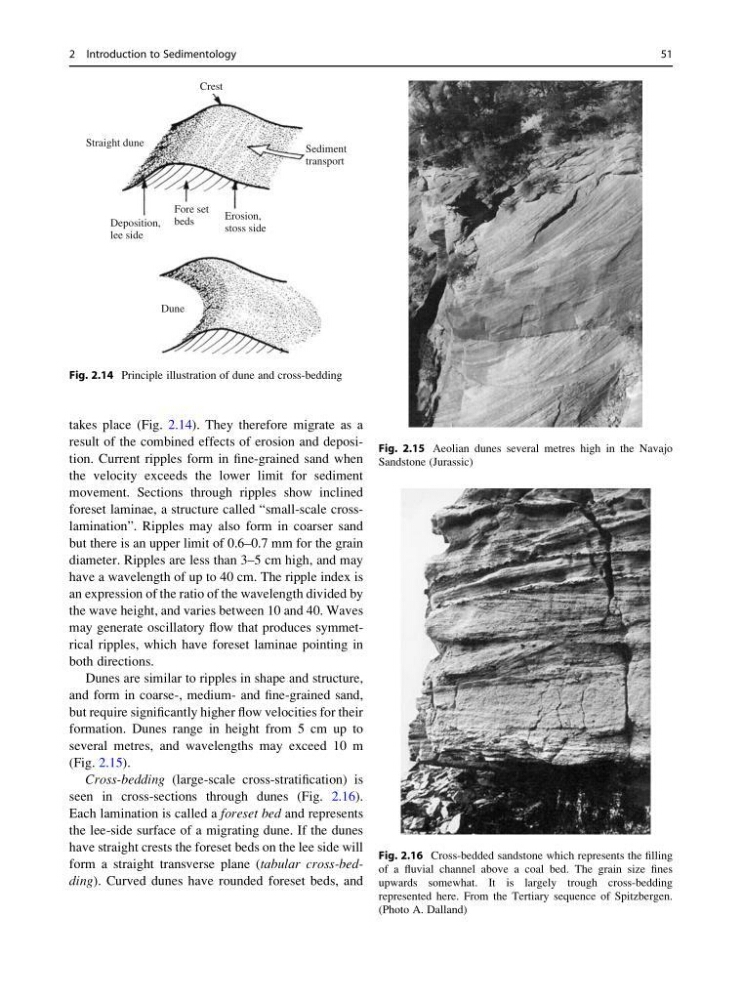
Dunes are similar to ripples in shape and structure,
and form in coarse-, medium- and fine-grained sand,
but require significantly higher flow velocities for their
formation. Dunes range in height from 5 cm up to
several metres, and wavelengths may exceed 10 m
(Fig. 2.15).
Cross-bedding (large-scale cross-stratification) is
seen in cross-sections through dunes (Fig. 2.16).
Each lamination is called a foreset bed and represents
the lee-side surface of a migrating dune. If the dunes
have straight crests the foreset beds on the lee side will
form a straight transverse plane (tabular cross-bedding). Curved dunes have rounded foreset beds, and
Crest
Sediment
transport
Straight dune
Deposition,
lee side
Fore set
beds
Erosion,
stoss side
Dune
Fig. 2.14 Principle illustration of dune and cross-bedding
Fig. 2.15 Aeolian dunes several metres high in the Navajo
Sandstone (Jurassic)
Fig. 2.16 Cross-bedded sandstone which represents the filling
of a fluvial channel above a coal bed. The grain size fines
upwards somewhat. It is largely trough cross-bedding
represented here. From the Tertiary sequence of Spitzbergen.
(Photo A. Dalland)
2 Introduction to Sedimentology
51
result of the combined effects of erosion and deposition. Current ripples form in fine-grained sand when
the velocity exceeds the lower limit for sediment
movement. Sections through ripples show inclined
foreset laminae, a structure called “small-scale crosslamination”. Ripples may also form in coarser sand
but there is an upper limit of 0.6–0.7 mm for the grain
diameter. Ripples are less than 3–5 cm high, and may
have a wavelength of up to 40 cm. The ripple index is
an expression of the ratio of the wavelength divided by
the wave height, and varies between 10 and 40. Waves
may generate oscillatory flow that produces symmetrical ripples, which have foreset laminae pointing in
both directions.
Dunes are similar to ripples in shape and structure,
and form in coarse-, medium- and fine-grained sand,
but require significantly higher flow velocities for their
formation. Dunes range in height from 5 cm up to
several metres, and wavelengths may exceed 10 m
(Fig. 2.15).
Cross-bedding (large-scale cross-stratification) is
seen in cross-sections through dunes (Fig. 2.16).
Each lamination is called a foreset bed and represents
the lee-side surface of a migrating dune. If the dunes
have straight crests the foreset beds on the lee side will
form a straight transverse plane (tabular cross-bedding). Curved dunes have rounded foreset beds, and
Crest
Sediment
transport
Straight dune
Deposition,
lee side
Fore set
beds
Erosion,
stoss side
Dune
Fig. 2.14 Principle illustration of dune and cross-bedding
Fig. 2.15 Aeolian dunes several metres high in the Navajo
Sandstone (Jurassic)
Fig. 2.16 Cross-bedded sandstone which represents the filling
of a fluvial channel above a coal bed. The grain size fines
upwards somewhat. It is largely trough cross-bedding
represented here. From the Tertiary sequence of Spitzbergen.
(Photo A. Dalland)
2 Introduction to Sedimentology
51